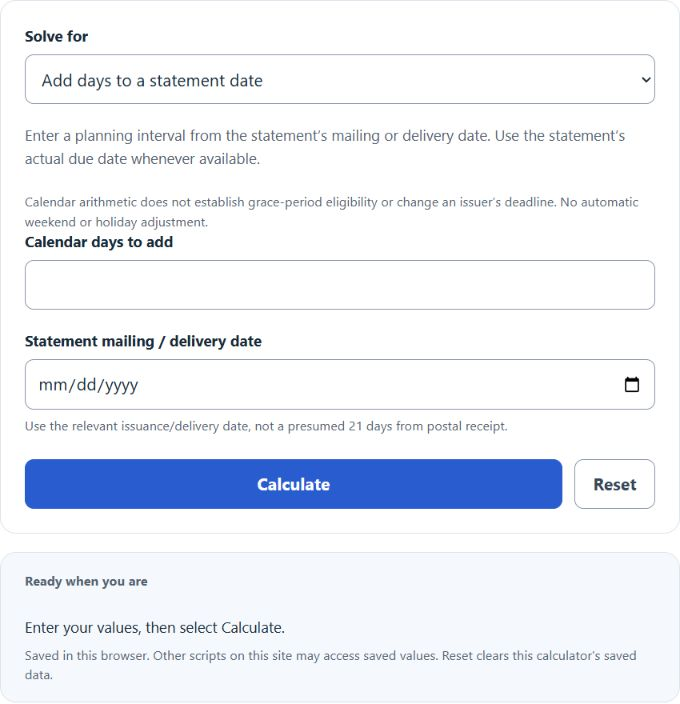
Use this Credit Card Grace Period Calculator to estimate a payment due date and count elapsed calendar days from an eligible purchase to its due date.
Credit Card Grace Period Formula
For planning, add a user-entered interval to the relevant statement mailing or delivery date. Use the actual due date printed on the statement whenever available; postal receipt does not start an automatic 21-day clock.
Due Date = Statement Date + d
For a purchase already assigned to a known billing cycle, the elapsed interval excludes the starting date and equals due date minus purchase date; interest-free treatment separately depends on the card agreement:
Interest-Free Days = Due Date - Purchase Date
Variables:
- d is the entered calendar-day planning interval
- Statement Date is the relevant statement mailing or delivery date used for planning
- Purchase Date is the transaction date
- Due Date is the date by which the issuer must receive payment
U.S. card issuers generally must have reasonable procedures designed to ensure statements are mailed or delivered at least 21 days before the disclosed payment due date. That timing rule does not guarantee that every transaction receives an interest-free grace period. Grace periods are usually conditional on paying an eligible purchase balance in full and on time, and card agreements can exclude cash advances and balance transfers.
Use the actual due date printed on the statement whenever it is available. The date calculator is most useful for planning or checking a statement timeline, not replacing the issuer's posted deadline.
Statement-to-Due-Date Reference
The examples below begin with a statement date of July 1 and add the entered number of calendar days.
| Days after statement | Estimated due date | Timing note |
|---|---|---|
| 21 days | July 22 | Common federal minimum timing reference |
| 24 days | July 25 | Often seen when statements issue shortly after cycle close |
| 25 days | July 26 | Longer contractual period |
| 28 days | July 29 | Four full weeks |
Example Problems
Example 1: Find a due date.
Using July 3 as the relevant statement mailing/delivery date and a user-entered 21-day planning interval, Adding 21 calendar days gives an estimated due date of July 24.
Example 2: Count potential interest-free days.
A purchase is made on June 10, the billing cycle closes June 30, and the payment due date is July 25. The purchase-to-due period is 45 days, including 20 days before the cycle closes and 25 days after it closes.
Frequently Asked Questions
Do all credit cards have a grace period?
No. A purchase grace period is common but not required, and it can depend on paying the prior balance in full. The card agreement explains which balances qualify and what must be paid to keep the benefit.
Does the 21-day rule mean my due date is always 21 days after cycle close?
No. The rule concerns statement mailing or delivery before the disclosed due date, not simply cycle closing or the date postal mail arrives. The actual statement deadline and payment cutoff control.
Do cash advances receive a grace period?
Usually not. Cash-advance interest commonly starts on the transaction or posting date. Balance transfers may also begin accruing interest immediately unless a promotional offer provides a different rate.