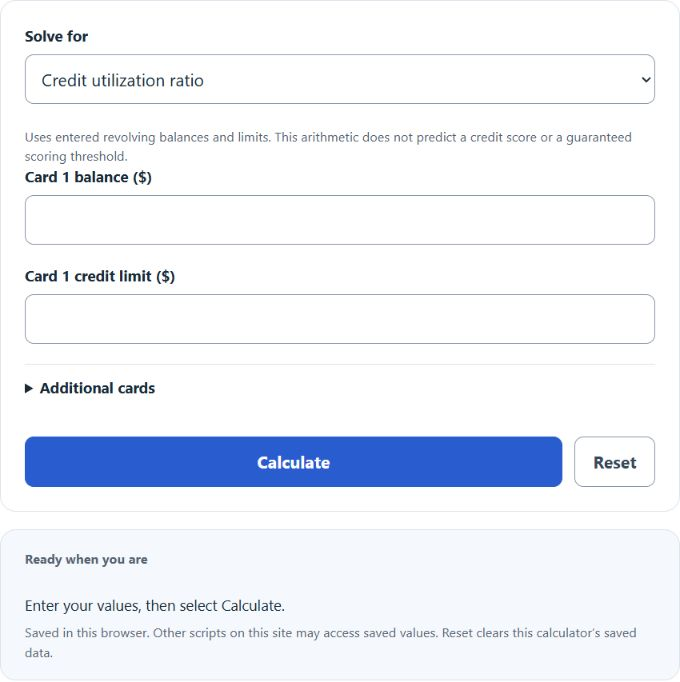
Calculate your credit utilization ratio from your card balances and credit limits to see how much of your available credit you are using and the portion of the entered credit limits in use. This tool does not predict a score.
Credit Utilization Formula
Per-card utilization:
CU = (B / L) * 100
Overall utilization across all revolving accounts:
CU = (TB / TL) * 100
Where:
- CU is the credit utilization ratio, expressed as a percent.
- B is the balance on a single card.
- L is the credit limit on that card.
- TB is the total balance across all of your cards.
- TL is the total credit limit across all of your cards.
Per-card utilization tells you how much of one card limit you are using. Overall utilization tells you how much of your combined limit you are using across every revolving account. Both figures are reported to the credit bureaus, and utilization is one factor within the Amounts Owed category, which accounts for roughly 30 percent of a typical FICO score.
Utilization Ranges and Score Impact
The ranges below are descriptive examples, not guaranteed score bands. Lower utilization generally helps; the effect depends on the scoring model and credit profile. There is no universal 30% scoring cliff.
| Utilization | Interpretation |
|---|---|
| 0% to less than 10% | Low utilization; no score guarantee |
| 10% to less than 30% | Moderate illustrative range |
| 30% to less than 50% | Higher illustrative range; not a scoring threshold |
| 50% to 100% | High share of the entered credit limits in use |
The table below shows the largest total balance you can carry while staying at two common targets, based on your total credit limit.
| Total Credit Limit | Balance at 10% | Balance at 30% |
|---|---|---|
| $5,000 | $500 | $1,500 |
| $10,000 | $1,000 | $3,000 |
| $20,000 | $2,000 | $6,000 |
Example Problems
Example 1. You have two cards. Card 1 has a $300 balance on a $2,000 limit, and Card 2 has a $1,200 balance on a $4,000 limit. Card 1 utilization is 300 / 2000 * 100, which is 15%. Card 2 utilization is 1200 / 4000 * 100, which is 30%. Your overall utilization is the total balance of $1,500 divided by the total limit of $6,000, times 100, which is 25%.
Example 2. You want to know the most you can owe while staying at 30% on a total limit of $10,000. The maximum balance is 10000 * (30 / 100), which is $3,000.
Frequently Asked Questions
What is a good credit utilization ratio? Lower utilization generally helps, but 30% is not a universal scoring threshold. FICO notes that keeping utilization below 10% can help, while exact score effects vary by profile.
Should I aim for 0% utilization? Reported zero balances may score differently from small reported balances. You do not need to carry interest-bearing debt to report utilization; reported balances and payment timing differ. This calculator does not recommend a borrowing balance.
How does overall utilization differ from per-card utilization? Overall utilization uses the sum of all balances divided by the sum of all limits, while per-card utilization looks at one card on its own. Both are considered, so a single maxed-out card can still hurt you even when your overall ratio is low.