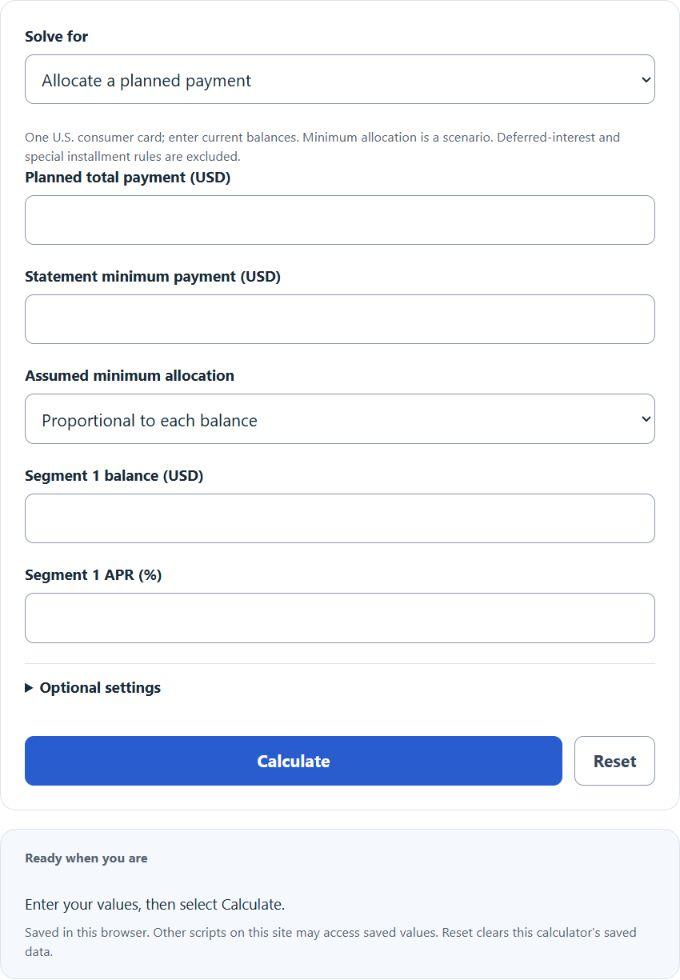
Use this Credit Card Payment Allocation Calculator to estimate how the minimum and excess payment split across balances with different APRs on one card.
Credit Card Payment Allocation Formula
A credit card can hold several balance segments, such as purchases, cash advances, promotional balances, and deferred-interest purchases. The required minimum payment may be allocated under the issuer’s method. The portion paid above that minimum is generally directed to the highest APR first.
Excess Payment = Total Payment - Required Minimum
 Allocation_i = min(Excess Remaining, Balance_i Remaining)
Variables:
- Total Payment is the amount sent to the issuer
- Required Minimum is the statement’s minimum payment
- Excess Payment is the amount governed by the high-APR allocation rule
- Balancei is each APR segment on the account
- Allocationi is the payment assigned to that segment
The calculator first estimates how the required minimum is distributed using the selected method: proportionally by balance, lowest APR first, or highest APR first. It then sorts the remaining balances from highest APR to lowest and applies the excess payment until it is used up. The minimum allocation is an estimate because issuers can use their own method within applicable rules.
This model covers one U.S. consumer card and adds no interest or new charges. It excludes deferred-interest and special installment allocation rules. Special rules may apply to deferred-interest promotions, particularly near the end of the promotional period. Use the card agreement and statement to confirm how a real payment will be credited.
Payment Allocation Example
The table shows a $500 payment with a $120 required minimum. The minimum is allocated proportionally, and the $380 excess goes to the highest APR balance first.
| Balance segment | Starting balance | APR | Estimated payment | Ending balance |
|---|---|---|---|---|
| Cash advance | $1,500 | 29.99% | $413.96 | $1,086.04 |
| Purchases | $3,000 | 19.99% | $67.93 | $2,932.07 |
| Promotion | $800 | 0% | $18.11 | $781.89 |
Example Problems
Example 1: Allocate a planned payment.
Three segments total $5,300. A $120 minimum is allocated proportionally: about $33.96, $67.93, and $18.11. The remaining $380 goes first to the 29.99% segment, so that segment receives about $413.96 in total. This model distributes leftover cents by largest fractional remainder, with segment order breaking ties; actual issuer rules can differ.
Example 2: Find the payment needed to clear the highest-rate segment.
If the highest-APR segment starts at $1,500 and receives about $33.96 from the estimated minimum allocation, $1,466.04 remains. A total payment of about $1,586.04—the $120 minimum plus that remaining amount—would clear that segment under the entered allocation assumptions.
Frequently Asked Questions
Does every dollar go to the highest APR first?
No. The issuer generally controls allocation of the required minimum. The federal high-APR rule usually applies to the amount above the required minimum, which is why the calculator separates the two portions.
What if two balances have the same APR?
The order between equal-rate segments may not matter for interest cost, but the issuer can choose an internal allocation order. The calculator keeps segment order when APRs tie. The clear-segment mode clears only the first nonzero segment with the highest APR.
How are deferred-interest balances handled?
Deferred-interest promotions can receive special treatment, especially during the final billing cycles before expiration. This estimator does not override those special rules, so review the promotion terms before relying on a payment allocation.