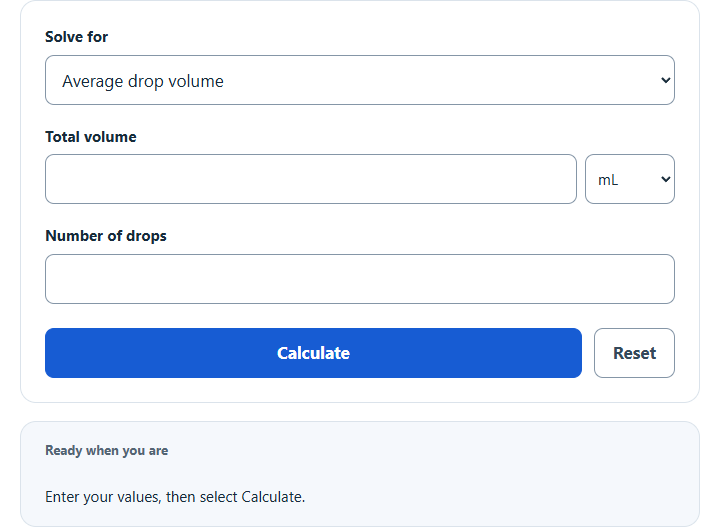
Calculate average drop volume from a total volume and drop count, or convert drops to mL using the standard 0.05 mL drop (20 drops per mL) or your own.
Related Calculators
- Relative Density Calculator
- Liquid Percentage Calculator
- Volume Fraction Calculator
- Moles To Liters Calculator
- All Chemistry Calculators
Calculator Functions
| Function | What it does | What it requires |
|---|---|---|
| Average drop volume | Finds the average volume of one drop from a measured volume and a drop count | Requires the total volume and the number of drops |
| Total volume | Finds the volume that a number of drops adds up to | Requires the number of drops and a drop size, either the standard 0.05 mL drop or a custom drop volume |
| Number of drops | Estimates how many drops make up a volume | Requires the total volume and a drop size, either the standard 0.05 mL drop or a custom drop volume |
Total volume is entered in mL, L, cc, tsp or fl oz and converted to mL. The number of drops is a whole number, and a custom drop volume is entered in mL per drop.
Average Drop Volume Formulas
| ADV | Average drop volume (mL/drop) |
| TV | Total volume (mL) |
| ND | Number of drops |
Volumes in other units are converted to mL first: 1 cc is 1 mL, 1 US teaspoon is 4.92892 mL and 1 US fluid ounce is 29.5735 mL [2].
Average drop volume
This is the main formula. A total of 5 mL collected over 100 drops gives 5 ÷ 100 = 0.05 mL/drop. The result also shows drops per mL, which is 1 ÷ ADV, or 20 in this case.
Total volume
The standard drop size is 0.05 mL, which is 20 drops per mL. It matches the pharmacopeial medicine dropper, which delivers 20 drops of water weighing 1 g at 15 °C, with a tolerance of ±10% [1]. Forty standard drops come to 0.05 × 40 = 2 mL, and the result is also shown in liters and teaspoons. With a custom drop volume of 0.04 mL, 50 drops also come to 2 mL.
Number of drops
A volume of 5 mL in standard drops is 5 ÷ 0.05 = 100 drops. One fluid ounce at 0.04 mL per drop is 29.5735 ÷ 0.04 = 739.34 drops. A result with a fraction is a drop equivalent, not a count of whole drops.
How to Calculate Average Drop Volume
Count the drops while dispensing them into a small graduated cylinder or onto a balance, and stop at a round number such as 50 or 100. Read the collected volume in mL, or divide the mass in grams by the liquid’s density in g/mL. Divide that volume by the number of drops. More drops give a steadier average, because the reading error is spread over a larger volume.
Limits of This Estimate
- Drop size changes with the liquid, the dropper tip, the angle it is held at and the temperature. The 0.05 mL drop describes water from a standard dropper [1], so a measured average for the liquid and dropper in use is more reliable.
- An average says nothing about how much single drops differ from each other.
- A drop count is not a way to measure a medicine dose. Use the mL markings on a calibrated dropper or an oral syringe.
Sources
- United States Pharmacopeia (USP 35), General Chapter 1176, Prescription Balances and Volumetric Apparatus: the medicine dropper that delivers 20 drops of water per gram
- NIST, Guide for the Use of the International System of Units (SP 811), Appendix B.8: teaspoon and fluid ounce in mL