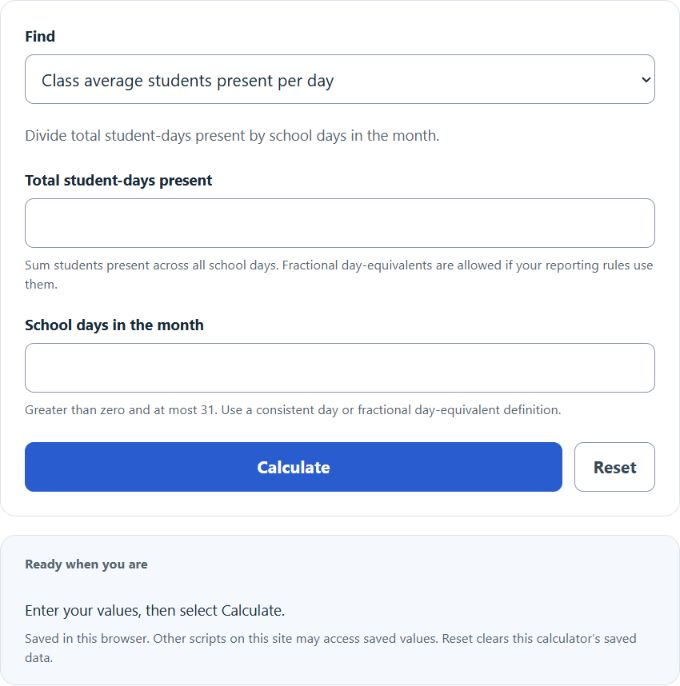
Enter the attendance rate (%) and the number of days of school in the month into the Average Monthly Attendance Calculator. The calculator will evaluate the Average Monthly Attendance.

Average Monthly Attendance of Students Calculator

Enter any 2 values to calculate the missing variable


Related Calculators

Average Monthly Attendance Formula

The formula for calculating average monthly attendance of students is:

AMA = (AR / 100) * DM

Where AMA is the average monthly attendance (days per month), AR is the attendance rate expressed as a percentage, and DM is the total number of instructional days in the month. This formula converts the percentage rate into a decimal and multiplies it by total available school days to produce the expected number of days a student (or group of students) actually attends.

The formula can be rearranged to solve for any of the three variables. To find the attendance rate when you know actual attendance days and total school days: AR = (AMA / DM) * 100. To find the number of school days in the month: DM = AMA / (AR / 100).

Why Average Monthly Attendance Matters

Average monthly attendance is not just an administrative metric. In much of the United States, school funding is tied directly to how many students show up each day. The most common mechanism is Average Daily Attendance (ADA), used by states like California, Texas, and Idaho to determine how much money a district receives from the state. California alone allocates its entire Local Control Funding Formula (LCFF) based on ADA, and a shift to enrollment-based funding would cost the state an estimated $3.4 billion per year. When a student misses school, the district loses a proportional share of per-pupil funding for that day.

Monthly attendance tracking gives administrators a more granular view than annual ADA. Attendance patterns fluctuate significantly by month. September and January often show the highest attendance rates due to the start of new semesters, while December and May tend to dip as students miss days around holidays or near the end of the year. A school with 22 instructional days in October and a 93% attendance rate has an AMA of 20.46 days, while the same school in December with only 15 instructional days and a 88% rate produces an AMA of just 13.2 days. Tracking these month-to-month shifts helps districts identify intervention windows before chronic absenteeism sets in.

U.S. Attendance Data and Trends

Before the COVID-19 pandemic, the national average daily attendance rate for PK-12 students was approximately 94%. That figure dropped to roughly 90% during the 2022-2023 school year. By the 2024-2025 school year, the national rate has recovered to approximately 93.45%, approaching but not yet matching pre-pandemic norms.

Chronic absenteeism, defined as missing 10% or more of school days in a year (roughly 18 days in a 180-day calendar), surged from 15% of students pre-pandemic to 28.5% during the 2021-2022 school year. As of 2024-2025, roughly 22% of students (about 10.8 million) remain chronically absent. Urban districts are five to six times more likely to report extreme chronic absenteeism than suburban or rural districts.

To put these numbers in monthly terms: a student in a school with 20 instructional days per month and a 94% attendance rate attends 18.8 days per month. At 90%, that drops to 18 days. That difference of 0.8 days per month accumulates to roughly 7.2 days over a 9-month school year, which is nearly half the chronic absenteeism threshold.

Instructional Days by Month

The number of instructional days per month varies based on the school calendar, state requirements, and holidays. Most U.S. states require 180 instructional days per year (27 of 38 states with day-based requirements mandate this number). Arizona formally defines a school month as 20 days or four weeks of five days each.

A typical U.S. school calendar distributes instructional days roughly as follows: September has 20 to 22 days, October has 21 to 23 days, November has 16 to 18 days (due to Thanksgiving break), December has 14 to 16 days (due to winter break), January has 19 to 21 days, February has 18 to 20 days, March has 18 to 22 days (depending on spring break timing), April has 17 to 21 days, May has 19 to 22 days, and June typically has 5 to 15 days depending on the district’s end date. These variations directly affect the AMA calculation, since the same attendance rate produces very different attendance-day counts in a 22-day October versus a 15-day December.

How States Calculate Attendance Differently

Not all states measure attendance the same way, and this affects how monthly attendance figures translate to funding and accountability metrics. Most states use day-based calculations: a student is either present or absent on a given day. Connecticut considers a student “in attendance” if they are present at their assigned school or a school-sponsored activity for at least half of the regular school day.

Ohio takes a different approach entirely, using hours rather than days. Ohio’s formula multiplies aggregate hours of attendance by 100, then divides by the sum of aggregate hours of membership plus unexcused absence hours. Ohio also converts each student into a Full-Time Equivalent (FTE) based on enrolled hours, so a part-year student counts as a fraction of a full student.

Idaho calculates ADA twice: once from the first day of school through the first Friday in November, and once using the best 28 weeks of the school year. The higher of the two values is used for funding. Texas uses ADA projections to determine the cost of public education across biennium budget cycles. TEA projected a statewide ADA of 5,009,942 for 2025-2026 and 4,990,784 for 2026-2027, reflecting a slight ongoing decline of about 0.3% per year.

Attendance and Academic Outcomes

Research consistently links higher attendance to better academic performance, though the relationship is not perfectly linear. A meta-analysis of 85 studies found that regular attendance correlated with a 28% increase in academic achievement and a 33% increase in student engagement. Students who attend class regularly hold an average GPA of 3.2 compared to 2.8 for students with lower attendance, and are 37% more likely to graduate from high school.

The impact begins early. Absenteeism in kindergarten is associated with lower achievement in reading, math, and general knowledge in first grade, as well as higher absenteeism in subsequent years. Missing 10% of the school year (about 18 days in a 180-day calendar, or roughly 2 days per month) is the threshold at which research shows measurable negative effects on performance.

Timing also matters. Unexcused absences at the beginning and end of the school year are more harmful to achievement than those in the middle. This suggests that monthly attendance tracking is particularly important in September, October, May, and June, when interventions can have the greatest effect.

ADA vs. Enrollment-Based Funding

A major policy shift is underway across U.S. states. Historically, many states funded schools based on Average Daily Attendance. Today, only six states still use ADA as their primary funding mechanism, with California being the largest. The rest have moved to enrollment-based models, which count every enrolled student regardless of daily attendance.

The debate centers on a tradeoff. ADA-based funding creates a financial incentive for schools to maximize attendance, which research supports as beneficial to students. However, it also penalizes districts with high poverty rates, where chronic absenteeism is driven by factors outside the school’s control, such as housing instability, lack of transportation, and health issues. In California, the Legislative Analyst’s Office found that about 90% of districts would receive more funding under an enrollment-based formula, with the largest increases going to high school districts and those serving more low-income, English learner, and foster youth students.

Missouri is taking a hybrid approach. By fiscal year 2030, Missouri’s formula will weight 50% on attendance and 50% on enrollment. Mississippi moved entirely to Average Net Enrollment (ANE) in 2024 with the passage of House Bill 4130, replacing its decades-old ADA system.

Practical Applications of This Calculator

School administrators use monthly attendance calculations for several purposes: projecting state funding based on expected ADA, identifying months with attendance dips that may require targeted outreach programs, comparing attendance across grade levels or buildings within a district, and reporting to school boards and state agencies.

Teachers and counselors can use monthly attendance data to flag students approaching the chronic absenteeism threshold. If a student has attended only 16 out of 20 days (80% rate) in a given month, that pace over a full year would result in 36 missed days, well above the 18-day chronic absence threshold. Early identification allows for family outreach, mentoring programs, or referral to support services before the pattern becomes entrenched.

Parents can use this calculator to understand their child’s attendance in context. An attendance rate of 90% sounds high, but over a 180-day school year it means 18 missed days, placing the student right at the chronic absenteeism line. Converting this to a monthly figure makes the impact more tangible: at 90% with 20 school days per month, a student misses 2 full days each month.