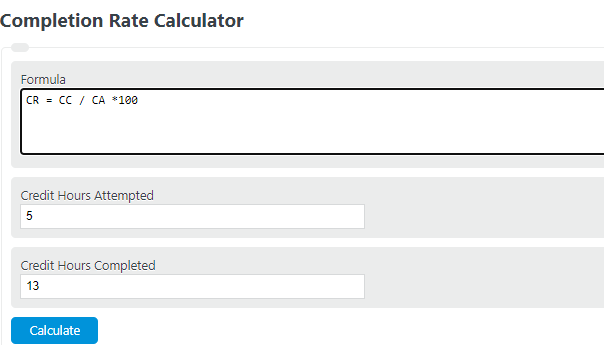
Calculate completion rate, incomplete count, and the additional tasks, credits, forms, or courses needed to reach a target percentage.
- All Statistics Calculators
- Cost Per Credit Hour Calculator
- Overall Grade Calculator
- Completion Percentage Calculator
Completion Rate Formula
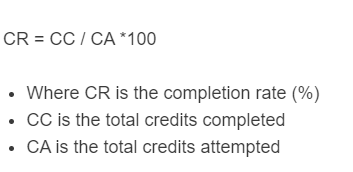
The following formula is used to calculate a completion rate.
- Where CR is the completion rate (%)
- CC is the total credits completed
- CA is the total credits attempted
To calculate a completion rate, divide the cumulative number of credits completed by the cumulative number of credits attempted, then multiply by 100.
What Counts as Attempted Credits
A credit hour is counted as “attempted” once a student remains enrolled past the institution’s official census date (the last day to drop without academic record). The following all count as attempted credits for SAP purposes:
- Courses completed with any passing grade (A, B, C, D)
- Courses failed (F grade)
- Courses withdrawn from after the census date (W grade)
- Courses with an unresolved incomplete grade (I)
- Every separate attempt at a repeated course
- Transfer credits accepted by the institution
Courses dropped before the census date are generally excluded from attempted credit counts entirely. The exact cutoff date varies by institution and should be confirmed with the financial aid office.
What Counts as Completed Credits
A credit hour is counted as “completed” only when a passing grade is earned. The general standard across institutions is:
- Count as completed: A, B, C, D, P (Pass), and accepted transfer credits
- Do not count as completed: F (Fail), W (Withdrawal), WF (Withdraw/Fail), I (Incomplete), AU (Audit), NC (No Credit)
A grade of D typically satisfies the “completed” threshold for SAP purposes even if it does not satisfy the prerequisite for the next course in a sequence. Students in programs with minimum grade requirements (such as nursing or engineering) may find they pass the SAP completion check but still need to retake a course, counting that course as attempted twice but completed only once in their rate.
The 67% Federal Financial Aid Threshold
The U.S. Department of Education requires students to complete at least 67% of all attempted credit hours to maintain eligibility for federal financial aid, including Pell Grants, Direct Loans, and work-study programs. This standard is formally called the “pace of completion” component of Satisfactory Academic Progress (SAP). A student who falls below 67% is placed on financial aid warning or suspension depending on whether it is a first-time or repeated occurrence.
Some institutions apply tiered thresholds based on total credits attempted. A common tiered structure requires 58% completion for students with 1 to 21 attempted hours, 62% for those with 22 to 32 attempted hours, and 67% for those with 33 or more attempted hours. The federal standard sets the minimum floor; individual schools may set stricter requirements.
SAP is evaluated cumulatively, not semester by semester. A strong semester does not erase a poor one from the calculation. A student who fails three courses in their first semester and never fails again carries that deficit in their completion rate for their entire enrollment.
How Withdrawals and Repeated Courses Affect Your Rate
Withdrawals are among the most consequential factors in completion rate calculations. A course from which a student withdraws after the census date counts as attempted but not completed, reducing the completion rate without contributing to GPA. Because the denominator grows without the numerator growing, the impact is disproportionate at lower credit totals. A student who has attempted 30 credits and completed 25 (83.3%) and then withdraws from a 3-credit course drops to 25 of 33, or 75.8%, a meaningful decline from a single decision.
Repeated courses are counted as attempted each time they are taken. Federal regulations allow financial aid to cover a repeated course, but only once after a passing grade has already been earned. For SAP completion rate purposes, the repeat counts as an additional attempted credit hour, and only if the student passes the retake does the numerator increase. Failing a repeated course adds to attempted credits without any gain in completed credits, compounding the problem.
National Completion Rate Benchmarks
According to the National Student Clearinghouse Research Center, students who began college in fall 2017 had a six-year credential completion rate of 62.2%. The breakdown by institution type shows a wide spread: public four-year institutions reached 67.4%, private non-profit four-year institutions reached 77.5%, and community colleges saw 43.4% of their 2017 cohort complete a credential within six years.
The federal SAP threshold of 67% was calibrated with the expectation that students would complete their program within 150% of its published length, for example within six years for a four-year degree. The fact that the national six-year completion rate (62.2%) sits below the per-semester SAP floor (67%) reflects a distinction in what is being measured: SAP tracks semester-level pace while national completion rates count only students who ultimately earn a credential, excluding those still enrolled or who stopped out temporarily.
Community college retention improved from 51% for the fall 2013 cohort to 55% for the fall 2022 cohort per Clearinghouse data. First-generation students, part-time students, and those who stop out and re-enroll account for much of the variance in institutional completion rates relative to the national average.
Recovering from a Low Completion Rate
A student whose completion rate falls below the institutional SAP threshold can take several paths to restore eligibility. The most direct is completing all enrolled courses in the next term without any withdrawals or failures, bringing the cumulative rate back above the minimum. Because SAP is cumulative, recovery requires not just stopping the damage but actively improving the ratio over multiple terms.
Consider the recovery math: a student with 30 attempted and 18 completed credits has a 60% completion rate, 7 points below the 67% floor. To recover through coursework alone, they must complete additional credits with no further drops or failures. If they enroll in 15 credit hours and pass all of them, their new rate is 33 of 45, or 73.3%, clearing the threshold. Each failed or withdrawn course during recovery extends the timeline further, since it adds to attempted credits without adding to completed credits.
Students who cannot recover through coursework alone may file a SAP appeal, documenting a mitigating circumstance such as illness, a family emergency, or a documented personal crisis. Approved appeals typically result in a financial aid probation period during which the student must meet a custom academic plan developed with an advisor. The appeal process and outcomes vary by institution, so checking directly with the financial aid office is the most reliable first step.
FAQ
A completion rate is the percentage of credit hours successfully completed out of all credit hours attempted. For federal financial aid purposes, students must maintain at least a 67% completion rate to satisfy the pace-of-completion component of Satisfactory Academic Progress (SAP).
Yes. A withdrawal (W) recorded after the institution’s census date counts as an attempted credit hour but not a completed one, lowering your completion rate. Withdrawals that occur before the census date are usually excluded from SAP calculations entirely.
At most institutions, accepted transfer credits count as both attempted and completed in the cumulative SAP calculation. This can be a meaningful advantage for transfer students, as credits from prior coursework with strong performance can raise an otherwise borderline completion rate.
No. SAP has two separate components: the completion rate (pace) and a minimum GPA requirement. Students can fail the pace component while maintaining an adequate GPA, or fail the GPA component while maintaining adequate pace. Both must be met to remain eligible for federal financial aid.
Federal regulations require students to complete their program within 150% of its published length (for example, within 6 years for a 4-year degree, or within 90 credit hours for a 60-credit associate degree). A student maintaining exactly 67% completion will mathematically complete a 120-credit degree within approximately 179 attempted credits, just under the 180-credit maximum. Students who only barely meet the 67% threshold each term may find themselves approaching the maximum timeframe limit before accumulating enough credits to graduate.