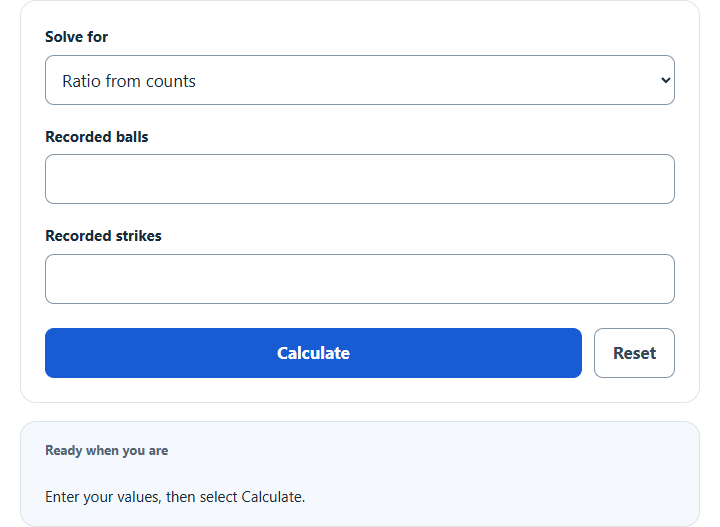
Calculate a pitcher’s ball-to-strike ratio and strike percentage from ball and strike counts, or estimate counts for a target ratio and pitch total.
Related Calculators
- Strikeout Percentage Calculator
- K/9 Strikeouts Per Nine Calculator
- ERA Calculator
- FIP Calculator
- Home Runs Per 9 Calculator
- Home Run Distance Calculator
- All Sports and Fitness Calculators
Calculator Functions
| Function | What it does | What it requires |
|---|---|---|
| Ratio from counts | Finds the ball-to-strike ratio and the strike percentage of a set of pitches | Requires the number of recorded balls and recorded strikes |
| Counts from target ratio | Finds the whole numbers of balls and strikes that come closest to a target ratio | Requires the target balls per strike as a decimal and the total number of classified pitches |
Both functions also show the ball percentage, the simplified ball-to-strike ratio such as 2:3, the strike-to-ball ratio and the pitch totals.
Ball Strike Ratio Formulas
| BSR | Ball-to-strike ratio, in balls per strike |
| B | Number of balls |
| S | Number of strikes |
Ratio from counts
Balls are divided by strikes. A pitcher with 20 balls and 30 strikes has a ratio of 20 ÷ 30 = 0.67 balls per strike, which simplifies to 2:3. The strike-to-ball ratio is the same division turned over, 30 ÷ 20 = 1.5 strikes per ball. With no strikes the ratio is undefined, and the percentages are still shown.
Strike Percentage
Strike percentage is the share of all classified pitches that were strikes. With 30 strikes in 50 pitches it is 30 ÷ 50 × 100 = 60%, and the ball percentage is the remaining 40%. Ratio from counts shows both.
Counts from target ratio
T is the total number of pitches and r is the target balls per strike. The balls are the rest, B = T − S. The ideal figures are rarely whole numbers, so the balls are rounded to the nearest whole pitch, with a half rounded up, and the strikes take what is left. For 100 pitches at a target of 0.5, the ideal is 66.67 strikes and 33.33 balls, which becomes 33 balls and 67 strikes. The achieved ratio is then 33 ÷ 67 = 0.49, and the result shows how far that is from the target.
Limits of This Estimate
- What counts as a strike depends on the scoring source. Recorded strikes can include called strikes, swinging strikes, fouls and balls put in play, so the counts should come from one source that treats them consistently.
- Strike percentage is not the share of pitches thrown in the strike zone, and a low ball-to-strike ratio does not by itself show good control.