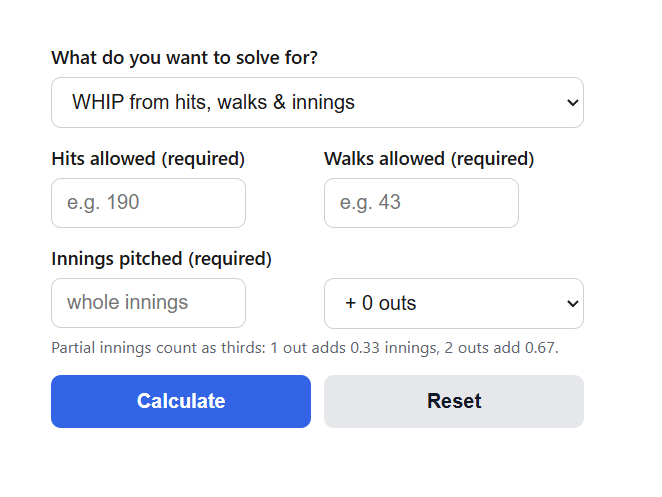
Calculate WHIP (walks plus hits per inning pitched) from a pitcher’s hits, walks, and innings, including partial innings, and see how the result rates.
WHIP Formula
WHIP = (H + BB) / IP
- WHIP is walks plus hits per inning pitched
- H is the number of hits the pitcher has allowed
- BB is the number of walks (bases on balls) the pitcher has allowed
- IP is innings pitched, with partial innings counted as thirds (.1 equals one out or 1/3 of an inning, .2 equals two outs or 2/3)
The default mode of the calculator applies this formula directly. Enter hits allowed, walks allowed, and innings pitched, and it returns the WHIP rounded to two decimal places along with the exact three-decimal value, a rating on the MLB scale, and the equivalent number of baserunners allowed per nine innings. Note that WHIP only counts hits and walks. Hit-by-pitches, errors, and fielder’s choices put runners on base but do not change WHIP.
Max Baserunners = Target WHIP * IP
The second mode reverses the formula. Pick a target WHIP and a number of innings, and the calculator returns the maximum combined hits and walks you can allow while staying at or below that target. The result rounds down, because allowing the next whole baserunner pushes WHIP above the target. This is useful for setting concrete outing goals: instead of an abstract target like 1.20, a starter going 6 innings knows the real limit is 7 baserunners.
WHIP Rating Scale and Baserunner Budgets
The first table shows how WHIP values are typically interpreted at the MLB level, where the league average sits around 1.30.
| WHIP | Rating |
|---|---|
| Below 1.00 | Elite (ace territory) |
| 1.00 to 1.10 | Excellent |
| 1.10 to 1.25 | Great |
| 1.25 to 1.40 | Average |
| 1.40 to 1.60 | Below average |
| Above 1.60 | Poor |
The second table turns common WHIP targets into baserunner budgets: the most combined hits and walks a pitcher can allow over a given number of innings while staying at or below each target. Values are rounded down to whole baserunners.
| Innings Pitched | Target 1.00 | Target 1.15 | Target 1.30 |
|---|---|---|---|
| 5 | 5 | 5 | 6 |
| 6 | 6 | 6 | 7 |
| 7 | 7 | 8 | 9 |
| 9 | 9 | 10 | 11 |
| 100 | 100 | 115 | 130 |
| 200 | 200 | 230 | 260 |
Example Problems
Example 1: WHIP over a full season. A starting pitcher allows 190 hits and 43 walks over 202.1 innings pitched. The .1 means one extra out, so IP = 202 + 1/3 = 202.333. Total baserunners = 190 + 43 = 233. WHIP = 233 / 202.333 = 1.152, which displays as 1.15 and rates as Great on the MLB scale. That works out to about 10.36 baserunners per nine innings.
Example 2: Baserunner budget for an outing. A starter wants to hold a 1.10 WHIP over a planned 7-inning outing. Max baserunners = 1.10 x 7 = 7.7, which rounds down to 7. Allowing exactly 7 hits plus walks produces a WHIP of 1.000, while allowing an 8th raises it to 1.143, above the target.
Frequently Asked Questions
Do hit-by-pitches or errors count toward WHIP?
No. WHIP counts only hits and walks. A hit batter reaches base just like a walk, but HBP is tracked separately and is excluded from the formula, which is a known blind spot of the stat. Runners who reach on errors or fielder’s choices are also excluded. Intentional walks, however, are counted as walks and do increase WHIP.
What is a good WHIP at different levels of play?
At the MLB level, anything under 1.00 is elite, and the league average is around 1.30. Standards loosen as you move down levels because defenses convert fewer balls in play into outs and pitchers issue more walks. In college baseball a WHIP in the low 1.30s is strong, and in high school a WHIP under 1.50 is generally solid, with dominant pitchers sitting closer to 1.00. In fantasy baseball leagues, a roster WHIP near 1.15 or lower typically wins the category.
How do I enter partial innings like 202.1?
Baseball box scores record partial innings in outs, not tenths. The .1 in 202.1 means one out, or one third of an inning, and .2 means two outs. In the calculator, enter the whole innings in the first box and pick the extra outs from the dropdown; it converts them to thirds automatically. Entering 202.1 as a decimal would understate the innings and inflate the WHIP slightly.