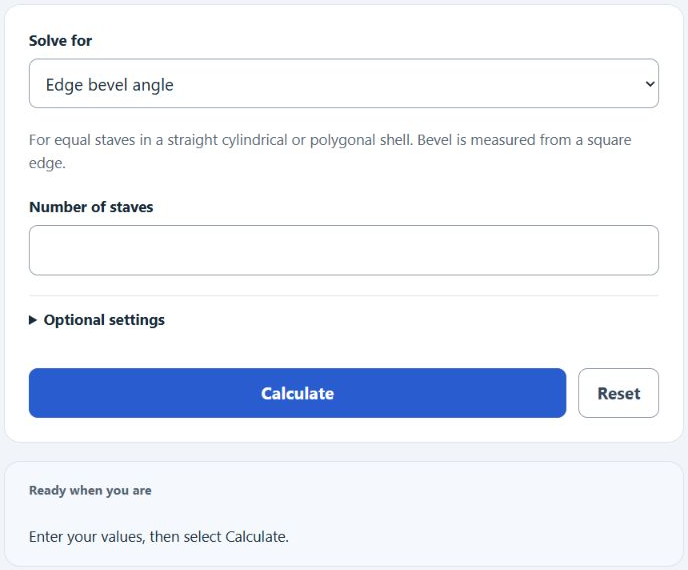
Select Edge bevel angle, Stave count, or Check an angle. Enter the requested values for a straight equal-stave shell; diameter and height are optional references.
Related Calculators
- Stave Shell Calculator
- Wall Angle Calculator
- Bench Slope Calculator
- Length of Slope Calculator
- All Construction Calculators
Barrel Stave Angle Formula
The barrel stave angle calculator uses a cylindrical approximation. It treats the barrel or shell as a regular polygon made from equal-width staves around a circle.
- N = number of staves
- theta_deg = edge bevel angle per side, in degrees
- theta_rad = edge bevel angle per side, in radians
- D = diameter
- C = circumference
- W = approximate arc width per stave along the circumference
- pi = 3.14159265...
If you enter the number of staves, the calculator finds the edge bevel angle per side. For example, a 20-stave cylinder uses a bevel of 180 / 20 = 9 degrees per side.
If you enter the edge bevel angle, the calculator works backward to find the number of staves. For example, a 7.5-degree bevel gives 180 / 7.5 = 24 staves.
Select Check an angle to compare a whole stave count with an entered bevel. Fractional inverse counts are mathematical results, not buildable whole-stave layouts. Diameter and height are optional reference inputs. Diameter is used to estimate circumference and approximate stave width. Height is only carried through as the stave length reference.
Common Stave Counts and Bevel Angles
These values are for straight cylindrical barrels, drums, planters, rings, and similar stave-built shells.
| Number of staves | Edge bevel per side | Turn angle between staves |
|---|---|---|
| 8 | 22.5° | 45° |
| 12 | 15° | 30° |
| 16 | 11.25° | 22.5° |
| 20 | 9° | 18° |
| 24 | 7.5° | 15° |
| 32 | 5.625° | 11.25° |
Approximate Stave Width by Diameter
The width values below are arc widths based on circumference. Your actual cut width can differ if you measure across the flat face of the stave instead of along the outside curve.
| Diameter | 16 staves | 20 staves | 24 staves |
|---|---|---|---|
| 12 in | 2.356 in | 1.885 in | 1.571 in |
| 18 in | 3.534 in | 2.827 in | 2.356 in |
| 24 in | 4.712 in | 3.770 in | 3.142 in |
Example Problems
Example 1: Find the bevel angle for 20 staves
You want to build a straight cylinder with 20 equal staves.
The edge bevel angle is 9° per side.
Example 2: Find the number of staves from a 7.5° bevel
You have a setup that cuts a 7.5-degree bevel per edge, and you want to know the matching stave count.
The matching design uses 24 staves.
FAQs
Is the edge bevel angle the same as the included angle?
No. The edge bevel is measured from a square edge. The turn between neighboring staves is twice that bevel: for 20 staves, the bevel is 9° and the turn is 18°. The polygon interior angle is 162°, so “included angle” should not be used without defining the convention.
Does diameter change the bevel angle?
No. For a straight cylindrical stave layout, the bevel angle depends only on the number of staves. Diameter changes the circumference and the approximate width of each stave, but it does not change the bevel angle.
Can this be used for a traditional bulged barrel?
Only as a rough starting point. A bulged barrel has a changing radius along its height, so the bevel is not a single constant angle from top to bottom. This calculator is intended for straight cylindrical or polygonal stave layouts.