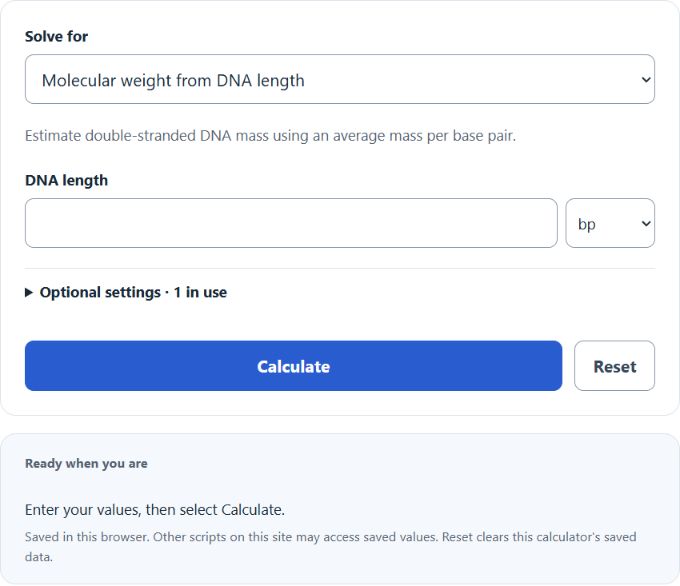
Convert bp to kDa: estimate double-stranded DNA molecular weight from base pairs, kb or Mb at 0.66 kDa per base pair, or find DNA length from kDa.
Related Calculators
- Base Pair To Dalton Calculator
- ng/uL Dilution Calculator
- PCR Cycle Calculator
- Recombination Frequency Calculator
- All Biology Calculators
Calculator Functions
| Function | What it does | What it requires |
|---|---|---|
| Molecular weight from DNA length | Finds the molecular weight of double-stranded DNA from its length | Requires the DNA length in bp, kbp or Mbp |
| DNA length from molecular weight | Finds the length of double-stranded DNA from its molecular weight | Requires the molecular weight in kDa, MDa, Da or g/mol |
| Mass-per-base-pair conversion factor | Finds the average mass per base pair of a DNA molecule | Requires the DNA length and the molecular weight |
The first two functions use 0.660 kDa per base pair unless another mass per base pair is entered, and 0.650 is offered as a preset. Every result lists the length in bp, kbp and Mbp and the mass in kDa, Da and g/mol.
Base Pair to kDa Formulas
| MW | Molecular weight of the double-stranded DNA (kDa) |
| bp | Length in base pairs |
| F | Average mass per base pair (kDa/bp), 0.660 unless changed |
Both factors are averages for double-stranded DNA. One supplier reference gives 650 daltons per base pair, and the same page lists 1 pmol of 1,000 bp DNA as 0.66 µg, which is 660 daltons per base pair [1]. One kDa is 1,000 Da, and a mass in Da is the same number in g/mol, so 660 kDa is 660,000 g/mol. One kbp is 1,000 bp.
Molecular weight from DNA length
The formula above applies directly. A 1,000 bp fragment is 1,000 × 0.660 = 660 kDa, or 650 kDa with the 0.650 factor. A 7.5 kbp plasmid is 7,500 × 0.660 = 4,950 kDa.
DNA length from molecular weight
A 990 kDa double-stranded fragment is 990 ÷ 0.660 = 1,500 bp.
Mass-per-base-pair conversion factor
A 5,000 bp molecule with a measured mass of 3,300 kDa averages 3,300 ÷ 5,000 = 0.660 kDa per base pair.
Limits of This Estimate
- The factor is an average. The real mass of a molecule depends on its base composition, its end groups and any modifications or counterions.
- The factors apply to double-stranded DNA only. Single-stranded DNA, RNA and proteins need their own factors.
- A 0.650 and a 0.660 factor differ by about 1.5%, so results carry at least that much uncertainty.
Sources
- New England Biolabs, Nucleic Acid Data: 650 daltons per base pair and 1 pmol of 1,000 bp DNA = 0.66 µg