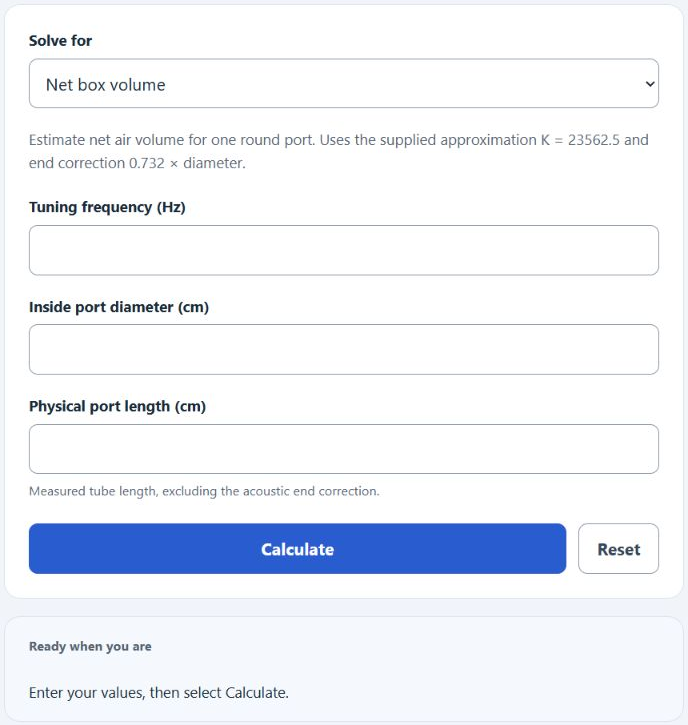
Calculate bass reflex port tuning by finding box volume, tuning frequency, port diameter, or port length from the other three values.
Related Calculators
- Bass Reflex Calculator
- Speaker Impedance Calculator
- Subwoofer Crossover Calculator
- Room Resonant Frequency Calculator
- Speaker Output Calculator
- Speaker Voltage Calculator
- All Physics Calculators
Bass Reflex Port Tuning Formula
The bass reflex port tuning calculation is based on a common round-port approximation of the Helmholtz resonator equation. It uses box volume, tuning frequency, port diameter, and physical port length.
- L = physical port length, in centimeters
- Vb = net internal air volume after driver, port and bracing displacement, in liters
- Fb = box tuning frequency, in hertz
- D = round port diameter, in centimeters
- K = 23562.5, a constant for this unit set using an approximate speed of sound
- 0.732*D = approximate end correction for the port
- a = quadratic coefficient used when solving for port diameter
If you select port length, the calculator finds the physical length needed for the chosen box volume, tuning frequency, and diameter.
If you select box volume, it finds the internal enclosure volume that matches the entered tuning, diameter, and port length.
If you select tuning frequency, it calculates the approximate bass reflex tuning frequency from the entered volume, diameter, and port length.
If you select port diameter, it rearranges the port length formula into a quadratic equation and uses the positive root for the round port diameter.
Illustrative Bass Reflex Tuning Ranges
These illustrative ranges are not validated recommendations for a particular driver. Select tuning from the driver manufacturer’s data and enclosure modeling; this calculator only estimates port geometry.
| Application | Illustrative Fb Range | Notes |
|---|---|---|
| Home subwoofer | 18 to 35 Hz | Lower tuning usually needs a longer port or larger box. |
| Hi-fi bookshelf or tower speaker | 35 to 60 Hz | Often tuned near the low-frequency extension target of the driver. |
| Car audio daily subwoofer | 28 to 38 Hz | Lower values favor deeper bass, higher values can increase output near tuning. |
| PA or sound reinforcement cabinet | 40 to 70 Hz | Usually tuned for output and power handling rather than very deep extension. |
| Woofer Size | Illustrative Port Diameter (not a sizing rule) | Practical Note |
|---|---|---|
| 6.5 in | 5 to 7 cm | Small ports are easier to fit but can become noisy at high output. |
| 8 in | 7 to 10 cm | A flared port is useful if the port velocity is high. |
| 10 in | 8 to 12 cm | Larger diameters reduce chuffing but require longer ports. |
| 12 in | 10 to 15 cm | Very low tuning may require folding the port inside the box. |
| 15 in | 15 to 20 cm | Large enclosures often need large ports or multiple ports. |
Example Problems
Example 1: Find port length
You have a 50 liter box, want a 35 Hz tuning frequency, and plan to use a 10 cm round port.
- Vb = 50 L
- Fb = 35 Hz
- D = 10 cm
The required physical port length is about 31.15 cm.
Example 2: Find tuning frequency
You have a 40 liter box with an 8 cm diameter port that is 20 cm long.
- Vb = 40 L
- D = 8 cm
- L = 20 cm
The approximate bass reflex tuning frequency is 38.18 Hz.
FAQ
Is port length the same as effective port length?
No. The calculator reports physical port length, which is the length you would measure on the actual tube or duct. The formula first uses effective port length, then applies an end correction of 0.732 times the diameter. This correction accounts for the air just outside the port that also moves as part of the resonant air mass.
What happens if I use a larger port diameter?
A larger port diameter usually reduces air velocity and can reduce port noise. The tradeoff is that the port must be longer to keep the same tuning frequency. If the required length is too long to fit in the enclosure, you may need to bend or fold the port, use a slot port, use multiple ports, or change the box volume or tuning target.
Can I use this for multiple round ports?
No. Equal total area alone does not preserve each port’s end correction. For separated identical ports, the corresponding approximation is:
where n is the number of identical ports and D_single is each port’s diameter. This calculator supports n = 1 only; interacting ports and different mounting conditions require a suitable model.