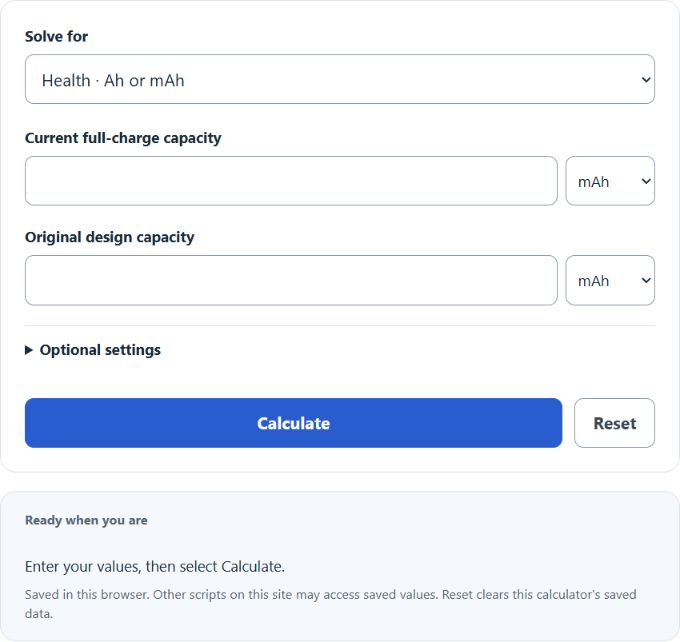
Calculate capacity-based battery health from current full-charge and original design capacity, or explicitly select a reverse calculation. Use matched Ah/mAh or Wh/kWh measurements.
Related Calculators
- Time Per Task Calculator
- Gaming Hours Per Day Calculator
- Date Calculator
- Cost Per Second Calculator
- All Everyday Life and Education Calculators
Watch the full explanation and transcript.
Battery Health Formula
The following formula is used to calculate battery health percentage, also known as State of Health (SOH).
- H = battery health percentage (SOH)
- C_c = current maximum capacity (mAh or Ah)
- C_o = original rated capacity when new (mAh or Ah)
This is a capacity-based SOH estimate. Current means full-charge capacity, not charge remaining today. Other assessments examine resistance, power capability and impedance; this ratio alone does not diagnose safety or remaining life.
What is Battery Health?
Capacity-based SOH compares retained full-charge capacity with the original or design rating entered. A design rating may differ from the cell’s measured capacity when new. Measurement conditions, calibration and rating tolerance can affect the ratio, including values above 100%. State of charge describes today’s charge level; capacity-based SOH describes retained capacity on a consistent measurement basis.
Device-Specific Battery Service Guidance
| Device type | Reference | Notes |
|---|---|---|
| iPhone / iPad | Model-specific | Check current Apple service guidance and symptoms. |
| Android smartphones | Manufacturer-specific | Use the device maker’s capacity and service criteria. |
| Laptop batteries | Manufacturer-specific | Capacity ratio alone does not predict runtime under a changed load. |
| Electric vehicles | Warranty-specific | Consult the exact model, battery and warranty terms. |
| Grid / solar storage | Contract-specific | Use the system specification and capacity-test conditions. |
Why One Threshold Does Not Fit Every Battery
An 80% capacity reference is used in some product specifications and studies, but it is not a universal replacement boundary or degradation knee. Cells at the same capacity-based SOH can have different internal conditions and subsequent lifetimes. The optional threshold in this calculator is a user-chosen comparison, not a replacement recommendation.
Battery Chemistry and Cycle-Life Variation
Cycle life depends on cell design, chemistry, temperature, charge/discharge rates, depth and the chosen end-of-test criterion. Chemistry alone does not determine a fixed cycle count:
| Chemistry | Cycle life | Applications | Interpretation |
|---|---|---|---|
| LFP (LiFePO4) | Test-dependent | Vehicles and storage | Use cell-specific tested ratings. |
| NMC (Li-NiMnCoO2) | Test-dependent | Electronics and vehicles | Operating conditions affect aging. |
| NCA (Li-NiCoAlO2) | Test-dependent | Vehicles and tools | No fixed longevity follows from chemistry alone. |
| NiMH | Test-dependent | Hybrid vehicles and rechargeable cells | Compare matched test protocols. |
Published measurements apply to the tested cells and protocols. They do not establish one degradation rate or remaining lifetime for every battery. Sandia researchers report that cycling conditions can change measured cycle life by thousands of cycles.
Factors Affecting Battery Health Loss
| Factor | Relevant condition | Interpretation |
|---|---|---|
| Temperature | Storage and operation | Follow the battery’s specified temperature range. |
| Depth of discharge | Cycle protocol | Compare life ratings at matched discharge depth. |
| Charge rate | Cell and thermal limits | Use the manufacturer’s allowed charging rate. |
| Storage state of charge | Storage duration and design | Follow product-specific storage guidance. |
| Low-temperature charging | Cell chemistry and design | Follow the specified charging temperature limits. |
Use the manufacturer’s operating and charging limits for the specific battery. No universal percentage-loss-per-cycle or temperature-loss rate is inferred by this calculator. See Apple’s model-specific capacity guidance, experimental research on capacity and degradation knees, and Sandia researchers’ discussion of cycling conditions.