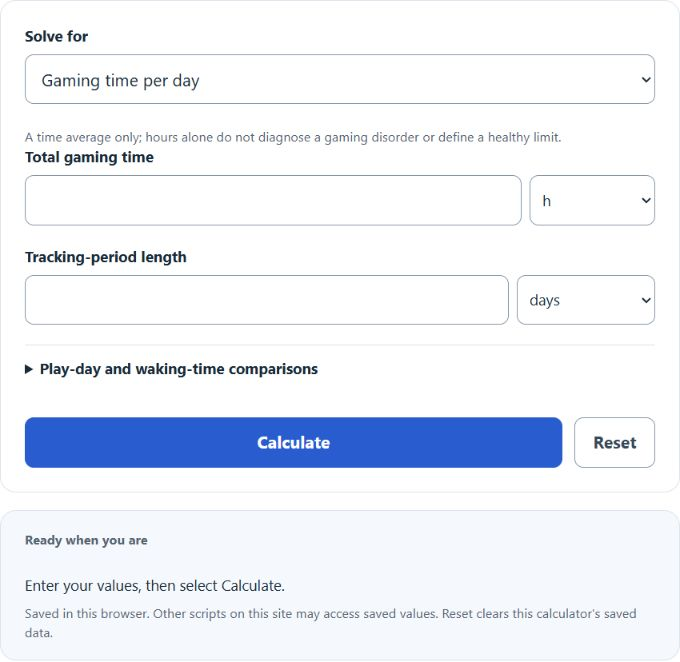
Calculate average gaming hours per day, total playtime, or tracking-period length from daily, weekly, monthly, or yearly gaming time.
Related Calculators
- Time Per Task Calculator
- Day Of Life Calculator
- 12 Hours From Now Calculator
- Playback Speed Calculator
- All Everyday Life and Education Calculators
Gaming Hours Per Day Formula
The following formula is used to calculate the gaming hours per day for a given total number of gaming hours and number of days.
Variables:
- (H_d) is the gaming hours per day
- (H_t) is the total gaming hours
- (D) is the number of days
To calculate the gaming hours per day, divide the total gaming hours by the number of days.
What is Gaming Hours Per Day?
Gaming hours per day is a measure of the average daily time a person spends playing video games over a defined period. It serves as a baseline metric for evaluating gaming habits relative to health guidelines, professional training benchmarks, and population-level averages. The global gaming population reached 3.51 billion active players in 2025, and the average gamer worldwide logs approximately 8.45 hours per week, or roughly 1.2 hours per day. In the United States specifically, the average climbs to 12.8 hours per week (about 1.83 hours per day), reflecting the higher console and PC penetration in that market.
Average Gaming Hours Per Day by Age Group
Gaming time varies substantially across age brackets, driven by differences in free time, platform preferences, and social gaming norms.
Children (ages 4 to 12) average 45 to 60 minutes per individual session but engage in roughly 5.1 sessions per day, largely on mobile platforms. On Roblox alone, children in this demographic spend approximately 140 minutes daily. The American Academy of Pediatrics recommends age-appropriate family media plans that protect sleep, activity and other needs; a single daily gaming allowance does not apply to all children. See the 2026 AAP policy.
Teenagers (ages 13 to 17) spend an average of 15.2 hours per week gaming as of 2025, a 6.4% increase over 2024. This translates to roughly 2.17 hours per day. Weekend sessions frequently exceed 3 hours, while weekday averages hover around 1.5 hours. Approximately 85% of American teens ages 13 to 17 play video games, with 40% playing daily.
Young adults (ages 18 to 29) averaged 10.8 hours of weekly gaming in 2025, a 2.7% year-over-year increase. Statista survey data from March 2025 found that 22% of U.S. adults aged 20 to 29 spent 6 to 10 hours per week gaming, while 8% exceeded 20 hours per week. North American young adults aged 18 to 24 who combine all platforms log roughly 137 minutes per day in virtual environments.
Adults (ages 30 to 49) who play on console and PC average 9.7 to 10 hours per week, though individual sessions range from 1 to 4 hours depending on genre and schedule. The broader 30 to 50 bracket (including non-console players) records 5 to 7 hours of weekly gaming with an average of 2.4 sessions per day.
Adults over 50 have the shortest gameplay at roughly 2.58 hours per week. Notably, 29% of Americans over 50 now play video games, up from just 17% in 2004. Among Baby Boomers, women actually participate at a higher rate (52%) than men (46%).
Gaming Hours by Country
National averages differ based on infrastructure, cultural attitudes toward gaming, and mobile penetration rates. The average American spends 12.8 hours per week (1.83 hours per day). Chinese gamers spend approximately 11 hours per week, though China enforces strict playtime limits for minors. Indian gamers average about 6 hours per week, reflecting a market still largely driven by mobile-first casual play. In 2024, Egyptian players logged the highest daily console gaming time globally at 1 hour and 55 minutes per day. South Korea and Japan, with their deep esports infrastructure, consistently rank among the highest per-capita gaming-time countries, particularly among the 18 to 34 demographic.
Gaming Hours by Platform
The platform a person uses dramatically changes their average session length. Mobile gaming sessions average just 5 to 6 minutes each, reflecting short-burst play on phones during commutes or downtime. Console sessions average 2 to 4 hours per sitting, while PC gaming sessions cluster around a similar range. Console and PC gamers combined average approximately 10 hours of weekly play. Gen Z leads cross-platform adoption, with 69% gaming on mobile, 42% on PC, and 38% on console. The gap between mobile micro-sessions and console/PC marathon sessions means that total daily gaming hours can look very different depending on which platform is being measured.
Health Thresholds: When Gaming Hours Become a Concern
There is no universal daily gaming allowance that this average can identify. Current AAP guidance emphasizes the child, content, family context and whether media displaces sleep, physical activity or other needs. Hours alone do not establish that gaming is healthy or harmful.
The WHO definition of gaming disorder includes impaired control, increasing priority over other activities and continued gaming despite harm, with significant impairment in important areas of life. The pattern is normally evident for at least 12 months. No daily-hours number alone confirms or excludes the disorder.
A five-hour average is not a diagnostic or universal harm threshold. PAHO/WHO guidance states that no specific number of hours determines whether gaming is a problem. Consider its effect on sleep, responsibilities, activity and relationships rather than treating this calculator as a clinical screen.
Cognitive Effects at Different Hour Thresholds
The corrected ABCD study compared children aged 9–10 who reported no gaming with those reporting at least three hours daily. It found very small differences on selected cognitive tasks, alongside higher scores for some behavioral symptoms in the gaming group. These observational associations do not show that gaming caused a benefit or establish an optimal amount of play.
That comparison does not establish a graded benefit curve, an ideal three-hour dose or a five-hour point where benefits reverse. This calculator measures time only; it cannot predict cognitive performance or balance potential benefits against individual harms.
Professional Esports Training Hours
Professional esports athletes represent the upper extreme of daily gaming hours. Most pro players train 6 to 12 hours per day, 6 days per week. A longitudinal study of Counter-Strike: Global Offensive professionals found an average of 30.9 hours per week of total game-specific practice, including 19.6 hours of competitive practice (scrimmages and ranked play) and the remainder in VOD review, aim training, and strategy sessions.
In South Korean StarCraft training houses during the 2008 to 2011 era, 12-hour daily sessions with only one or two rest days per month were standard. Modern esports organizations have moved toward more structured regimens that include physical fitness training, sports psychology, and mandatory rest periods to reduce burnout and repetitive strain injuries. Even at the professional level, raw hours have diminishing returns beyond approximately 6 to 8 hours of focused practice per day, a finding consistent with deliberate practice research across other performance domains.
Physical Health Considerations by Daily Hours
Extended gaming sessions carry specific physical health risks that scale with daily hours. Eye strain from sustained screen focus is one of the most common complaints. The 20-20-20 rule (every 20 minutes, look at something 20 feet away for 20 seconds) is the standard mitigation recommendation for any session exceeding 1 hour. Carpal tunnel syndrome and repetitive strain injuries affecting the wrists, thumbs, and elbows become significantly more likely beyond 3 to 4 hours of continuous play without breaks. Prolonged sitting increases risk for blood clots, obesity, and cardiovascular problems. Gamers who play more than 4 hours per day without physical activity breaks show measurably higher rates of musculoskeletal complaints.
For sessions exceeding 2 hours, ergonomic setup becomes critical: a neutral wrist position, monitor at eye level, feet flat on the floor, and a chair that supports the lumbar spine. Hand and wrist stretches performed every 45 to 60 minutes reduce tendon inflammation. Standing desks or periodic standing intervals help counteract the cardiovascular risks of prolonged sitting.
Gender Differences in Gaming Time
Weekly gaming time averages 6.76 hours for men and 5.45 hours for women globally. The gap narrows considerably when mobile gaming is included, as women make up a larger share of mobile gamers. Among Millennials, the highest percentage report gaming 13+ hours per week. Gen Z and Gen X most commonly report 3 to 7 hours per week, while Boomers cluster at 1 to 3 hours. The average gamer age has risen to 36 years old, reflecting the maturation of gaming alongside its original audience rather than any shift in youth adoption.