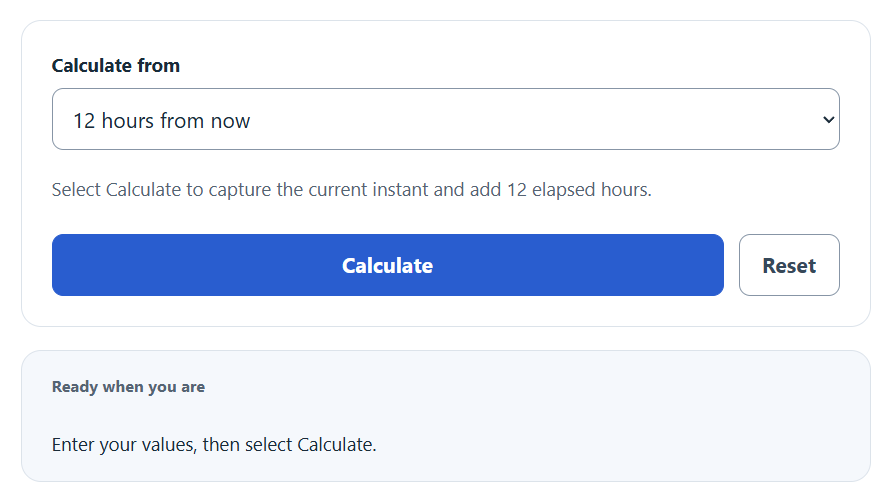
Calculate when 12 hours from now is, 12 hours after a start time, or any custom time shift in local time or UTC, with days, hours, and minutes.
Related Calculators
- 60 Seconds From Now Calculator
- Appointment Date Calculator
- Days In Advance Calculator
- 34-Hour Reset Clock Calculator
- All Everyday Life and Education Calculators
12 Hours From Now Formula
The calculator adds (or subtracts) a fixed number of milliseconds to a base timestamp, then displays the result in your chosen time zone.
- Result = the target date and time
- Base = the starting timestamp in milliseconds (the current moment, or the start time you enter)
- D = days to shift
- H = hours to shift
- M = minutes to shift
For the default "12 hours from now" mode, D = 0, H = 12, M = 0, and Base is the current time. For "Ago" direction, the shift is subtracted instead of added:
The three modes apply this formula differently:
- 12 hours from now uses the current system time as Base and adds 12 hours.
- From a start time uses the date and time you enter as Base and adds 12 hours.
- Any time shift lets you set D, H, M and pick forward or backward from the current time.
Reference Tables
Use the first table to convert 12 hours into other units. The second table shows ordinary clock examples; daylight-saving changes can shift the displayed clock hour.
| Unit | 12 hours equals |
|---|---|
| Days | 0.5 |
| Minutes | 720 |
| Seconds | 43,200 |
| Milliseconds | 43,200,000 |
| Weeks | 0.0714 |
| Start time | 12 hours later | Day change |
|---|---|---|
| 12:00 AM (midnight) | 12:00 PM (noon) | Same day |
| 6:00 AM | 6:00 PM | Same day |
| 9:00 AM | 9:00 PM | Same day |
| 12:00 PM (noon) | 12:00 AM (midnight) | Next day |
| 3:00 PM | 3:00 AM | Next day |
| 8:30 PM | 8:30 AM | Next day |
| 11:45 PM | 11:45 AM | Next day |
Frequently Asked Questions
Does 12 hours from now always cross to the next day?
Usually no. Without a daylight-saving change, a start before noon stays on the same date and a start at or after noon reaches the next date. A clock change can shift that boundary.
Why does the AM or PM flip?
A standard clock face has 12 hours on it. On an ordinary day, adding 12 elapsed hours moves the clock to the opposite half of the day. A daylight-saving change can shift the wall-clock hour.
How does the calculator handle daylight saving time?
The math runs in absolute milliseconds, so it always adds exactly 12 hours of real time. On the day a DST change happens, the wall-clock difference between start and result may look like 11 or 13 hours, even though 12 actual hours have passed.
What is the difference between local time and UTC in the result?
Local time uses the time zone reported by your device. UTC is the global reference time with no daylight saving offset. Pick UTC if you are coordinating with people in other regions or scheduling something against a server clock.