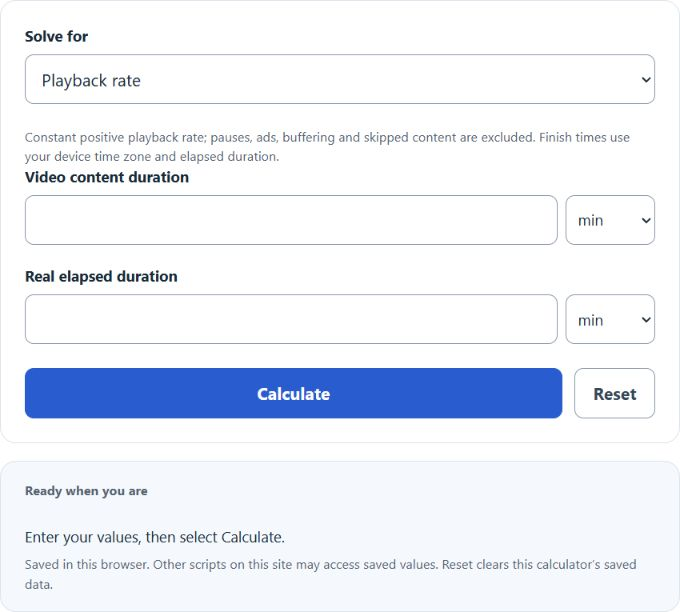
Calculate playback speed, adjusted viewing time, time saved, or finish time from video duration, real time, speed, and segment lengths.
- Every Day Life And Education Calculators
- Video File Size Calculator
- Upload Time Calculator
- Bit Error Rate (BER) Calculator
- Playlist Length Calculator
Playback Speed Formula
The following formula is used to calculate a playback speed (playback rate).
- Where R is the playback speed/playback rate
- V is the total time in the video that has passed
- T is the total amount of real time that has passed
To calculate playback speed, divide video time by real elapsed time. A result of 2.0 means the video played at double speed; 0.5 means half speed.
What is Playback Speed?
Playback speed (or playback rate) is the ratio of video content time to real elapsed time. A rate of 1.0x plays at normal speed; 1.5x plays 50% faster, compressing a 60-minute video to 40 minutes of watch time. Rates below 1.0x slow content down, commonly used for language learning and slow-motion analysis. Available speed ranges depend on the player, device and content.
Playback Speed by the Numbers
The YouTube figures below describe June 2022 usage reported by YouTube in August 2022; they are historical platform observations, not current population estimates.
| Metric | Data |
|---|---|
| Time YouTube users collectively save daily at speeds above 1x | 900+ years |
| Most-used non-normal YouTube speed | 1.5x |
| 2nd most-used YouTube speed | 2.0x |
| 3rd most-used YouTube speed | 1.25x |
| Most-used speed on mobile (iOS and Android) | 1.5x |
| Most-used speed on TV/living room devices | 1.0x (normal) |
| U.S. monthly podcast consumers aged 12+ who ever increased speed (2019) | 26% |
Sources: YouTube, August 2022 report (June 2022 data); Edison Research, The Podcast Consumer 2019, slide 30. Edison used different survey modes across years, so a direct trend is not inferred here.
Effect on Comprehension
Controlled studies of particular lecture videos have found relatively small learning costs through 2x and poorer outcomes beyond 2x. These findings do not establish a universal safe speed: prior knowledge, material, accessibility and study conditions matter.
| Speed | Learning evidence | Notes |
|---|---|---|
| 0.75x | Slower playback | May suit some practice needs; no universal improvement claimed |
| 1.0x | Normal-speed comparison | Baseline in accelerated-lecture studies |
| 1.25x | Modest acceleration | Check understanding for the actual material |
| 1.5x | Small costs in some lecture experiments | Results depend on material and prior knowledge |
| 2.0x | Small costs through 2x in Murphy et al. | Study-specific result, not a guarantee of equal recall |
| 2.5x | Poorer outcomes beyond 2x in Murphy et al. | Not a universal threshold; the cited 2023 medical study compared 1.5x and 2x only |
In one small MATLAB lesson study, the science/engineering and liberal-arts groups at 1.5x had mean test scores of 80.63 and 63.00 out of 100 (n=16 and n=5). These are test scores, not percentages of lecture content retained, and do not establish a general discipline effect. Sources: Murphy et al., 2023 medical-student study, Mo et al.
Time Savings Reference
Based on 1 hour of original content per session, with annual savings calculated at 1 hour of daily consumption.
| Speed | Watch Time (1 hr content) | Time Saved per Session | Annual Savings (1 hr/day) |
|---|---|---|---|
| 1.25x | 48 min | 12 min | ~73 hrs |
| 1.5x | 40 min | 20 min | ~122 hrs |
| 1.75x | 34 min | 26 min | ~156 hrs |
| 2.0x | 30 min | 30 min | ~183 hrs |
| 2.5x | 24 min | 36 min | ~219 hrs |
Example Starting Speeds by Content Type
| Content Type | Example Starting Speed | Rationale |
|---|---|---|
| Entertainment, first watch | 1.0x | Pacing, tone, and emotional beats are speed-sensitive |
| Familiar topic review | 1.5x to 2.0x | Try this for familiar material; check your understanding |
| Lecture or tutorial | 1.25x to 1.5x | Illustrative starting range, not a proven optimum |
| Podcast (solo host) | 1.5x | Illustrative pace for clear speech; preferences vary |
| Podcast (interview or dense content) | 1.25x | Overlapping speakers become harder to follow at higher speeds |
| Audiobook | 1.25x to 1.5x | Adjust to narration, complexity and your preference |
| Language learning | 0.75x to 1.0x | Try slower playback for practice; learning benefits are not guaranteed |
How to Calculate Playback Speed
Divide the video timestamp by real time elapsed. For example: if 300 seconds of video content played in 150 real seconds, the playback rate is 300 / 150 = 2.0x. To find how long a video will take at a given speed, divide the original duration by the speed: a 90-minute video at 1.5x takes 60 minutes of actual viewing time.