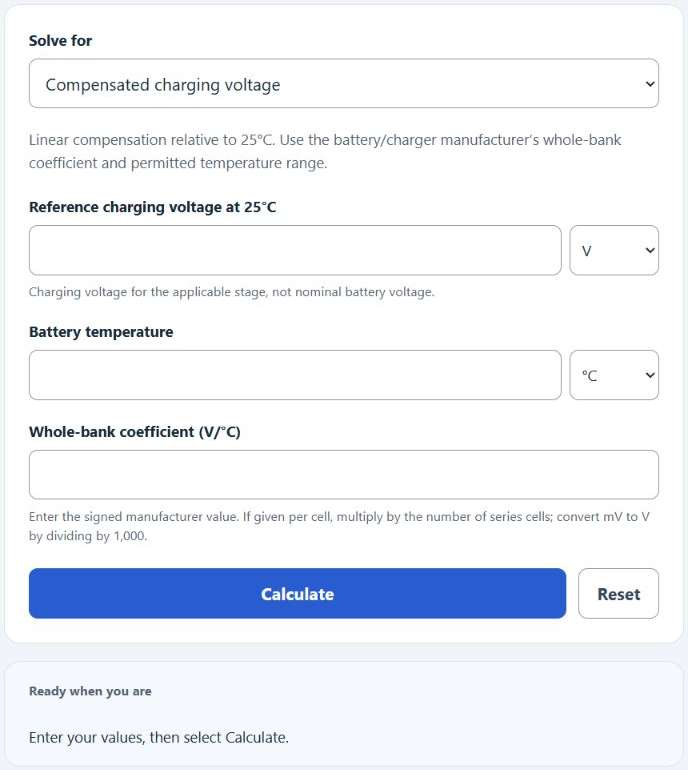
Select compensated charging voltage, model-implied battery temperature, or 25°C reference voltage. Enter the two known quantities and the manufacturer-specified whole-bank coefficient.
- Battery Health Percentage Calculator
- Battery Voltage Calculator
- Battery Capacity Calculator
- Battery Reserve Capacity to Amp Hours Calculator
- Battery Run Time Calculator
- Battery Energy Calculator
- All Automotive Calculators
Battery Temperature Compensation Formula
The calculator uses a fixed reference temperature of 25°C and an entered whole-bank temperature coefficient in V/°C. Coefficients and valid temperature ranges vary by battery and charger. The examples below use -0.024 V/°C only as an illustrative assumption, not a universal charging recommendation.
- Vc = compensated charging voltage, in volts
- Vref = reference charging voltage at 25°C, in volts
- Tc = entered whole-bank temperature coefficient, in V/°C
- T = battery temperature, in °C
- 25 = reference temperature, 25°C
To solve for battery temperature, the formula is rearranged as:
To solve for the reference charging voltage at 25°C, the formula is rearranged as:
Select the value to solve for and enter the two other quantities plus the temperature coefficient. If you enter the reference charging voltage and battery temperature, it calculates the compensated charging voltage. If you enter the compensated voltage and reference voltage, it calculates the battery temperature implied by those values. If you enter the compensated voltage and temperature, it calculates the 25°C reference charging voltage.
Illustrative Temperature Compensation Values
For the illustrative assumptions of -0.024 V/°C and a 14.40 V reference at 25°C, the linear model gives the values below. It does not apply charger voltage clamps or charge-temperature cutoffs. Use only within manufacturer-specified conditions; do not infer safe charging temperatures from this table.
| Battery Temperature | Temperature Difference from 25°C | Compensated Voltage |
|---|---|---|
| 0°C | -25°C | 15.00 V |
| 10°C | -15°C | 14.76 V |
| 25°C | 0°C | 14.40 V |
| 35°C | +10°C | 14.16 V |
| 45°C | +20°C | 13.92 V |
| Battery System | Cells | Illustrative coefficient scaling (not charging settings) |
|---|---|---|
| 2 V lead-acid cell | 1 | -3 to -5 mV/°C |
| 6 V lead-acid battery | 3 | -9 to -15 mV/°C |
| 12 V lead-acid battery | 6 | -18 to -30 mV/°C |
| 24 V lead-acid battery bank | 12 | -36 to -60 mV/°C |
Example Calculations
Example 1: Calculate compensated charging voltage
You have a 12 V battery with a reference charging voltage of 14.40 V at 25°C. The measured battery temperature is 35°C.
The compensated charging voltage is 14.16 V.
Example 2: Calculate battery temperature
You know the compensated charging voltage is 14.64 V and the reference charging voltage at 25°C is 14.40 V.
The battery temperature is 15°C.
FAQ
Why does charging voltage decrease when battery temperature increases?
Lead-acid batteries need less charging voltage when they are warm and more charging voltage when they are cold. If charging voltage is not reduced at higher temperatures, the battery can overcharge, lose water, or age faster. If charging voltage is not increased at lower temperatures, the battery may not fully charge.
What temperature coefficient does this calculator use?
Enter the manufacturer-specified whole-bank coefficient in V/°C. Multiply a per-cell value by the number of series cells and divide mV by 1,000 to obtain volts. The -0.024 V/°C examples and the coefficient-scaling table are arithmetic illustrations, not recommended settings. Charger limits and charge-stage instructions still apply.
Can this be used for lithium batteries?
This formula is mainly for lead-acid charging voltage compensation. Lithium batteries use different charging limits and battery management rules. Do not apply this lead-acid compensation value to a lithium battery unless the battery or charger manufacturer specifically instructs you to do so.