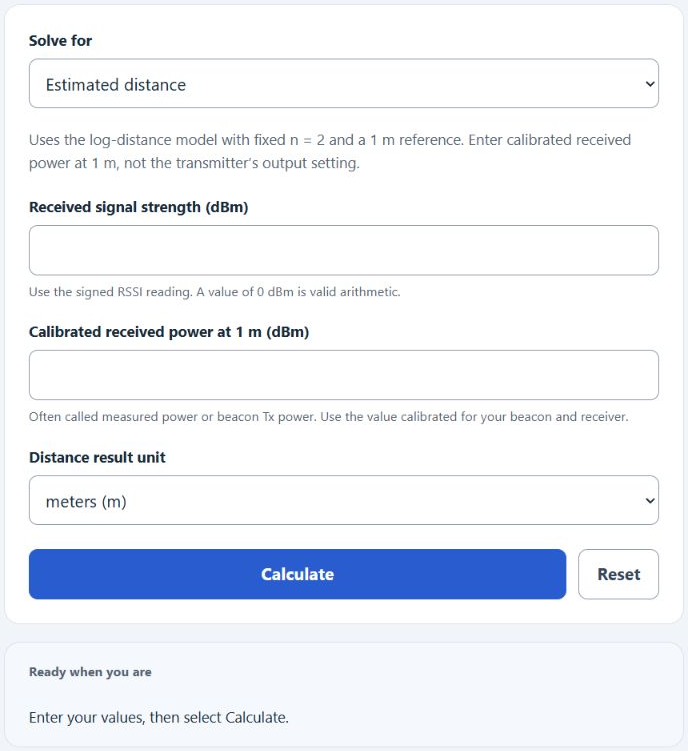
Choose estimated distance, model RSSI or model reference power at 1 m, then enter the known values. Distances support meters, cm, km, feet, yards and miles.
Related Calculators
- Antenna dBi Range Calculator
- dBm to Range Calculator
- Receiver Sensitivity Calculator
- Link Margin Calculator
- Radio Distance Calculator
- Coupling Loss Calculator
- All Physics Calculators
Beacon Distance Formula
The beacon distance calculation uses the log-distance path loss model. This calculator uses a fixed path loss exponent of n = 2, which represents ideal free-space signal behavior.
- D = distance from the beacon, in meters before unit conversion
- RSSI = received signal strength indicator, in dBm
- Tx = calibrated received power at 1 meter, in dBm (not transmitter output power)
- n = path loss exponent, fixed at 2 in this calculator
- log10 = base-10 logarithm
Select the value to solve for, then enter the two displayed inputs. Here Tx means calibrated received power at 1 m. Distance values are converted to meters for the formula, then converted back to your selected unit when distance is the result.
Illustrative Beacon Signal Levels
RSSI values are usually negative. A value closer to 0 means a stronger received signal.
| RSSI range | Relative signal level | Distance-model limitation |
|---|---|---|
| -30 to -50 dBm | Higher received power | No universal accuracy follows from this range |
| -51 to -70 dBm | Lower received power | Requires calibration and environmental checks |
| -71 to -90 dBm | Still lower received power | RSSI alone does not establish distance accuracy |
| Below -90 dBm | Lowest listed received power | Usable range depends on the receiver and environment |
Distance Unit Conversions Used
| Unit | Conversion to meters |
|---|---|
| Centimeters | 1 cm = 0.01 m |
| Meters | 1 m = 1 m |
| Kilometers | 1 km = 1000 m |
| Feet | 1 ft = 0.3048 m |
| Yards | 1 yd = 0.9144 m |
| Miles | 1 mi = 1609.344 m |
Example Calculations
Example 1: Calculate distance
Suppose the RSSI is -70 dBm and the Tx power is -59 dBm.
The estimated beacon distance is 3.5481 meters.
Example 2: Calculate RSSI
Suppose the Tx power is -59 dBm and the distance is 5 meters.
The estimated RSSI is -72.9794 dBm.
FAQs
What is Tx power in a beacon distance calculation?
Tx power, sometimes called measured power, is the expected RSSI at a reference distance of 1 meter from the beacon. For many Bluetooth beacons, this value is a negative dBm number such as -59 dBm. The distance estimate depends heavily on this value, so use the calibrated measured power for your specific beacon when possible.
Why is beacon distance only an estimate?
RSSI changes because of walls, reflections, interference, antenna direction, body blocking, and differences between phones or receivers. The formula assumes a simple signal-loss pattern. Real indoor environments rarely match that perfectly, so the result should be treated as an approximate distance, not an exact measurement.
What does the path loss exponent mean?
The path loss exponent controls how quickly signal strength drops as distance increases. This calculator uses n = 2, which represents free-space conditions. Indoor conditions vary; obstacles and reflections can invalidate the fixed n = 2 assumption.