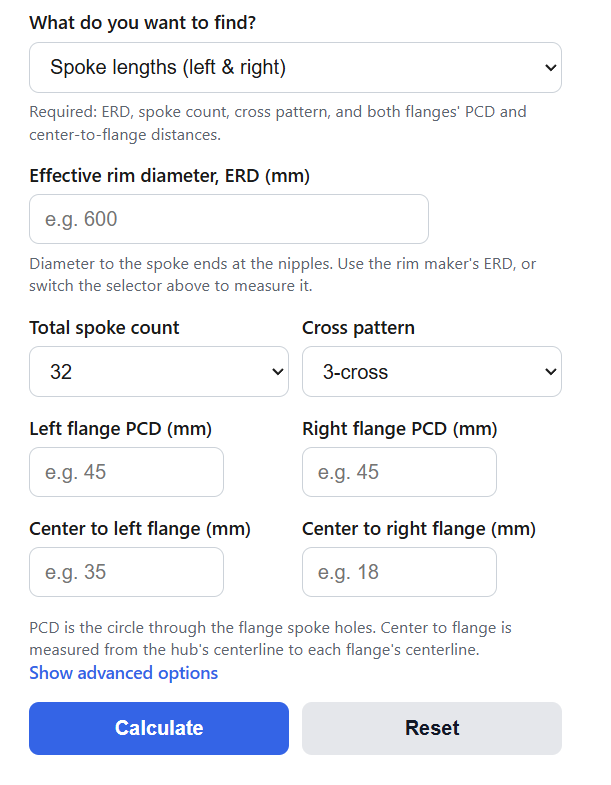
Calculate exact left and right bicycle spoke lengths from rim ERD, hub flange PCD, flange spacing, spoke count, and cross pattern, or measure your rim’s ERD.
Bicycle Spoke Length Formula
The calculator uses the standard wheelbuilding formula. Each spoke runs from a hole in the hub flange to a hole in the rim, and those two points plus the wheel’s geometry form a triangle in space, so the law of cosines gives the spoke’s path:
L = sqrt(d^2 + (P/2)^2 + (ERD/2)^2 - 2*(P/2)*(ERD/2)*cos(a)) - h/2
The angle between a spoke’s hub hole and the rim hole it reaches depends on the lacing pattern:
a = 720 * k / n
Variables:
- L is the spoke length in millimeters, measured from the inside of the elbow to the threaded tip
- ERD is the effective rim diameter in millimeters, measured to the spoke ends at the nipples
- P is the flange pitch circle diameter (PCD), the diameter of the circle through the spoke holes on the hub flange
- d is the center-to-flange distance, from the hub’s centerline to the centerline of the flange
- a is the angle in degrees between the hub hole and the rim hole
- k is the cross pattern (0 for radial up to 4-cross) and n is the total spoke count
- h is the flange spoke hole diameter, usually 2.4 mm; half of it is subtracted because the elbow seats against the edge of the hole
The default mode runs the formula twice, once for each flange, because most hubs place the two flanges at different distances from center and sometimes at different PCDs. Along with both lengths, it reports each side’s bracing angle and the left-side spoke tension as a share of the right side, taken from the lateral component of each spoke’s pull (d divided by L). The single-side mode uses one set of hub measurements, which suits symmetric front wheels or checking one side at a time. The ERD mode works backward from a rim measurement using two spokes with nipples threaded on until the tips sit flush with the slotted ends:
ERD = S1 + S2 + G
S1 and S2 are the lengths of the two measuring spokes hung in opposite rim holes, and G is the gap between their free ends. If the ends overlap instead, the overlap is subtracted.
Cross Pattern Angles and Typical Hub Geometry
The hub-to-rim angle a is what makes lacing pattern matter. It rises with cross count and falls with spoke count, which is why 3-cross needs a different length on a 24-hole wheel than on a 36-hole wheel with the same rim and hub. Radial lacing is always 0 degrees.
| Spoke count | 1-cross | 2-cross | 3-cross | 4-cross |
|---|---|---|---|---|
| 20 | 36° | 72° | 108° | 144° |
| 24 | 30° | 60° | 90° | 120° |
| 28 | 25.7° | 51.4° | 77.1° | 102.9° |
| 32 | 22.5° | 45° | 67.5° | 90° |
| 36 | 20° | 40° | 60° | 80° |
Angles much past 95 degrees mean the spoke leaves the flange nearly tangent and the elbow gets worked hard, so patterns like 4-cross belong on 36 holes and up, while 20 and 24 hole wheels rarely go past 2-cross.
If you cannot find drawings for your hub, the ranges below cover most modern J-bend hubs. They also show the left-to-right tension balance you should expect once the wheel is properly dished, which the calculator reports for your exact numbers. Measure your own hub whenever you can.
| Wheel | Flange PCD (mm) | Center to flange (mm) | Typical left tension share |
|---|---|---|---|
| Front, rim brake | 38 to 45 both sides | 30 to 36 both sides | About 100% |
| Front, disc brake | 45 to 58 left, 38 to 45 right | 22 to 28 left, 30 to 36 right | 110 to 145% |
| Rear, rim brake, 8 to 11 speed | 45 to 58 both sides | 32 to 38 left, 16 to 20 right | 45 to 60% |
| Rear, disc brake, thru axle | 52 to 58 both sides | 26 to 32 left, 18 to 22 right | 60 to 75% |
Example Problems
Example 1. You are building a 32-hole rear wheel, 3-cross on both sides. The rim’s ERD is 600 mm. The hub has a 45 mm PCD on both flanges, the left flange sits 35 mm from center, the right flange sits 18 mm from center, and the spoke holes are 2.4 mm.
First find the angle: a = 720 * 3 / 32 = 67.5 degrees. For the left side, d = 35, P/2 = 22.5, and ERD/2 = 300. The terms are 35^2 = 1225, 22.5^2 = 506.25, 300^2 = 90000, and 2 * 22.5 * 300 * cos(67.5) = 5166.2. So L = sqrt(1225 + 506.25 + 90000 – 5166.2) – 1.2 = sqrt(86565.05) – 1.2 = 294.2 – 1.2 = 293.0 mm. Repeating with d = 18 for the right side gives sqrt(85664.05) – 1.2 = 291.5 mm. You would order 293 mm spokes for the left and 291 mm for the right, and the calculator reports left tension at about 52% of the right side.
Example 2. You want a radial front wheel but do not trust the rim’s published ERD. You hang two 255 mm measuring spokes in opposite holes, tips flush with the nipple slots, and measure a 90.4 mm gap between the free ends. ERD = 255 + 255 + 90.4 = 600.4 mm. For a radial pattern a = 0, so the formula collapses to L = sqrt(d^2 + (ERD/2 – P/2)^2) – h/2. With a different rim at ERD 545 mm, a 40 mm PCD, and a 32 mm center-to-flange, that is L = sqrt(32^2 + (272.5 – 20)^2) – 1.2 = sqrt(1024 + 63756.25) – 1.2 = 254.5 – 1.2 = 253.3 mm, so you would order 253 mm spokes.
Frequently Asked Questions
Should you round spoke lengths up or down?
Round to the nearest whole millimeter, and round down when the result lands almost exactly on a half. With standard 12 mm nipples the spoke tip should end up level with the slotted end of the nipple, and there is about 1 mm of workable range in each direction. Too short leaves fewer threads engaged and weakens the joint; too long makes the nipple bottom out before the spoke reaches tension, which matters even more with hidden or internal nipples. If a shop only stocks even sizes, a spoke within 1 mm of the calculated number is normally fine.
Why are the left and right spoke lengths different?
Because the rim must sit centered between the frame’s dropouts while the hub’s flanges are not centered between them. A rear hub pushes the right flange inward to make room for the cassette, and a front disc hub pushes the left flange inward for the rotor, so each side has its own triangle and its own length. The difference is usually 1 to 3 mm. If both sides round to the same whole millimeter you can order a single length, but never average two lengths that differ by 2 mm or more.
Why does ERD cause most spoke length mistakes?
An error in ERD moves both spoke lengths by roughly half that error, and published ERDs are not standardized: some rim makers measure to the nipple seat rather than to the end of the nipple, which can shift the number by 2 to 4 mm. Measuring your actual rim with the two-spoke method, using the same nipples you will build with, removes that uncertainty. Hub measurement errors matter far less because d and P are small compared to the rim radius.