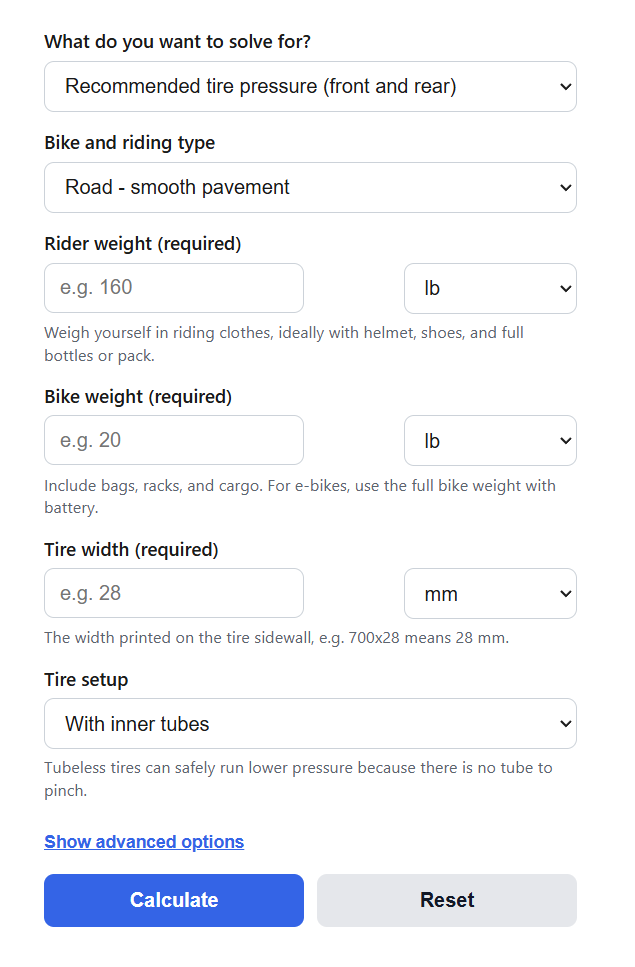
Calculate the ideal front and rear tire pressure for your road, gravel, or mountain bike from rider weight, tire width, and tubeless or tube setup, in psi and bar.
Bike Tire Pressure Formula
For road, gravel, and hybrid tires, the calculator uses a formula fitted to Frank Berto’s 15 percent tire drop data. Tire drop is how much the tire compresses under load, and about 15 percent of the tire’s height is the widely used target for a good balance of speed, comfort, and grip:
P = 600*L / W^2 + 0.75*W - 25
The load on each wheel comes from your total system weight and the front-to-rear weight split:
L_front = SW * F/100
 L_rear = SW * (100 - F)/100
For mountain bike tires, knobs and low pressures put you outside the range where the tire drop data applies, so the calculator switches to a field-tested rule of thumb, scaled by tire width:
P_rear = (R/7 + 2) * (2.35/W_in)
 P_front = (R/7 - 2) * (2.35/W_in)
Variables:
- P is the tire pressure in psi (1 psi = 0.0689 bar)
- L is the load carried by that wheel, in pounds
- W is the tire width in millimeters, and W_in is the tire width in inches
- SW is the system weight: rider plus bike plus any bags or cargo, in pounds
- F is the share of weight on the front wheel, in percent (about 45 percent on road and gravel bikes, 40 percent on mountain bikes)
- R is the rider weight in pounds, used for the mountain bike rule at a reference width of 2.35 inches
In “Recommended tire pressure” mode, the calculator applies the formula for your bike type to each wheel separately, then adjusts the result: rough pavement and hybrid setups get about 5 percent less, gravel gets about 10 percent less, and tubeless setups get 7 percent less because there is no tube to pinch. Results are capped at the 72.5 psi (5 bar) hookless rim limit and at your tire’s max pressure if you enter one.
In “Check a pressure I already run” mode, the calculator inverts the same relationship to find the wheel load your current pressure actually supports at 15 percent drop:
L = W^2 * (P + 25 - 0.75*W) / 600
It compares that with the load estimated from your weight and tells you whether you are over-inflated, under-inflated, or in range.
Recommended Pressure by Rider Weight and Tire Width
The table below shows rear-wheel pressure in psi for a tubed setup, assuming a 20 lb bike and a 55 percent rear weight share. Front pressures run about 10 to 15 percent lower, and tubeless setups about 7 percent lower.
| Rider weight | 25 mm road | 28 mm road | 32 mm road | 40 mm gravel | 45 mm gravel |
|---|---|---|---|---|---|
| 120 lb (54 kg) | 68 | 55 | 44 | 30 | 28 |
| 150 lb (68 kg) | 84 | 68 | 54 | 36 | 33 |
| 180 lb (82 kg) | 99 | 80 | 63 | 42 | 37 |
| 210 lb (95 kg) | 115 | 93 | 73 | 47 | 42 |
Every setup also has hard limits and practical floors that override any recommendation. This is what keeps a pressure both safe on the rim and protected against pinch flats and burping:
| Limit | Value | Why it matters |
|---|---|---|
| Hookless rim maximum (ETRTO) | 72.5 psi (5 bar) | Binding safety limit on all hookless rims; above it the tire can blow off the rim |
| Tire sidewall maximum | Printed on the tire (often 70 to 120 psi road, 35 to 65 psi MTB) | A ceiling, not a target; never exceed the lower of the tire and rim ratings |
| Road tires with tubes, practical floor | About 40 psi | Below this on narrow tires, impacts can pinch the tube against the rim (snakebite flats) |
| MTB with tubes, practical floor | About 18 psi | Same pinch flat mechanism on rocks and roots |
| MTB tubeless, practical floor | About 14 psi | Lower pressures squirm in corners, burp air, and can dent the rim |
Example Problems
Example 1: A 160 lb rider on an 18 lb road bike with 28 mm tires, inner tubes, and smooth pavement. System weight is 178 lb. With a 45/55 split, the front wheel carries 80.1 lb and the rear carries 97.9 lb. For the front: P = 600 * 80.1 / 784 + 0.75 * 28 – 25 = 61.3 + 21 – 25 = 57.3 psi. For the rear: P = 600 * 97.9 / 784 + 21 – 25 = 70.9 psi. Rounded, that is about 57 psi front and 71 psi rear, or 53 and 66 psi with a tubeless setup.
Example 2: A 175 lb rider on a trail mountain bike with 29 x 2.35 tubeless tires. Using the mountain bike rule, P_rear = 175/7 + 2 = 27 psi and P_front = 175/7 – 2 = 23 psi. The width factor is 2.35/2.35 = 1, so no scaling is needed. On 2.6-inch tires the same rider would multiply by 2.35/2.6 and run about 24 psi rear and 21 psi front.
FAQ
Why is the recommendation so far below the max pressure printed on my tire?
The sidewall number is a safety ceiling, not a suggested pressure. Rolling resistance testing on real road surfaces shows that past a certain breakpoint pressure, extra air stops making you faster and starts costing speed, because the bike vibrates and hops instead of absorbing the surface. The 15 percent drop target sits near that breakpoint for most riders, which is why a 160 lb rider on 28 mm tires gets about 71 psi even when the tire is rated to 100 psi or more.
Can I run lower pressure with a tubeless setup?
Yes. Without a tube there is nothing to pinch between the tire and rim on a hard impact, so tubeless tires can run roughly 7 to 15 percent lower pressure for more grip and comfort. The calculator applies a 7 percent reduction automatically. The practical floor is where the tire starts to burp air in hard corners or lets the rim strike through, and if you have hookless rims, never exceed 72.5 psi (5 bar) regardless of setup.
How often should I check my tire pressure?
Before every ride is ideal, because all bicycle tires leak. Butyl tubes lose a few psi per week, lightweight latex tubes can lose 10 to 20 psi overnight, and tubeless tires with sealant typically lose a few psi per day. Temperature also matters: pressure drops about 2 percent for every 10 degrees F of cooling, so a bike inflated in a warm garage reads noticeably lower on a cold morning.