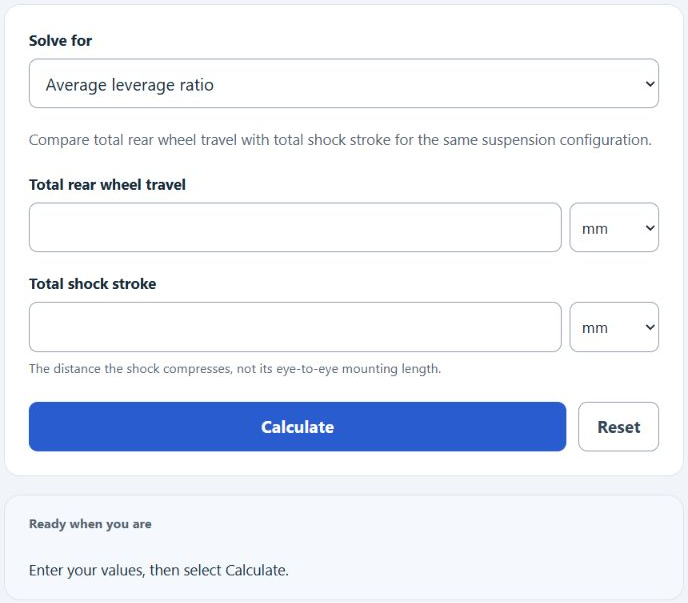
Select average suspension leverage ratio, rear wheel travel, or shock stroke, then enter the two known values. Convert between mm, cm, m, in, or ft.
Bike Leverage Ratio Formula
The average bike leverage ratio is total rear wheel travel divided by total shock stroke for the same suspension configuration. Local leverage can vary through compression; this calculator does not recover that curve. Shock stroke is compression distance, not eye-to-eye length.
- LR = leverage ratio
- RWT = rear wheel travel
- SS = shock stroke
The calculator uses the same basic relationship in three ways:
- Calculate leverage ratio: Enter rear wheel travel and shock stroke. The calculator divides rear wheel travel by shock stroke.
- Calculate rear wheel travel: Enter leverage ratio and shock stroke. The calculator multiplies leverage ratio by shock stroke.
- Calculate shock stroke: Enter rear wheel travel and leverage ratio. The calculator divides rear wheel travel by leverage ratio.
Length inputs are converted to millimeters before calculation, then converted to the selected result unit.
Illustrative Bike Leverage Ratio Ranges
The following broad ranges are illustrative, not verified category limits or fit recommendations. Use your frame’s specified travel and approved shock stroke to calculate its average. An average alone cannot describe starting or ending leverage, progression or shock tune.
| Bike type | Illustrative rear travel | Illustrative average ratio |
|---|---|---|
| XC / short-travel trail | 90 to 120 mm | 2.0:1 to 2.6:1 |
| Trail | 120 to 150 mm | 2.3:1 to 2.9:1 |
| Enduro | 150 to 180 mm | 2.5:1 to 3.2:1 |
| Downhill | 190 to 220 mm | 2.7:1 to 3.5:1 |
Common Shock Stroke Reference
| Shock stroke | Approximate inch equivalent | Example travel at 2.7:1 |
|---|---|---|
| 45 mm | 1.77 in | 121.5 mm |
| 50 mm | 1.97 in | 135 mm |
| 55 mm | 2.17 in | 148.5 mm |
| 60 mm | 2.36 in | 162 mm |
| 65 mm | 2.56 in | 175.5 mm |
Example Calculations
Example 1: Calculate leverage ratio
You have a bike with 150 mm of rear wheel travel and a 55 mm shock stroke.
The average leverage ratio is about 2.73:1.
Example 2: Calculate rear wheel travel
You know the leverage ratio is 2.8:1 and the shock stroke is 50 mm.
The rear wheel travel is 140 mm.
FAQ
What does a 2.8:1 leverage ratio mean?
An average ratio of 2.8:1 means total rear travel is 2.8 times total shock stroke. For example, 50 mm of full stroke corresponds to 140 mm of total travel. It does not mean every 1 mm increment produces 2.8 mm of wheel movement. Confirm any shock change with the frame and shock manufacturers.
Is a higher leverage ratio better?
Not automatically. A higher leverage ratio means the shock has more rear wheel movement to control for each millimeter of stroke. This can require higher air pressure, a stronger spring, or different damping. A lower leverage ratio gives the shock more mechanical advantage, but the best value depends on the frame design and shock tune.
Why is this called an average leverage ratio?
Many suspension designs do not use the same leverage ratio through the whole travel. The ratio may rise, fall, or change shape as the suspension compresses. Dividing total rear wheel travel by total shock stroke gives the average leverage ratio across the full travel.