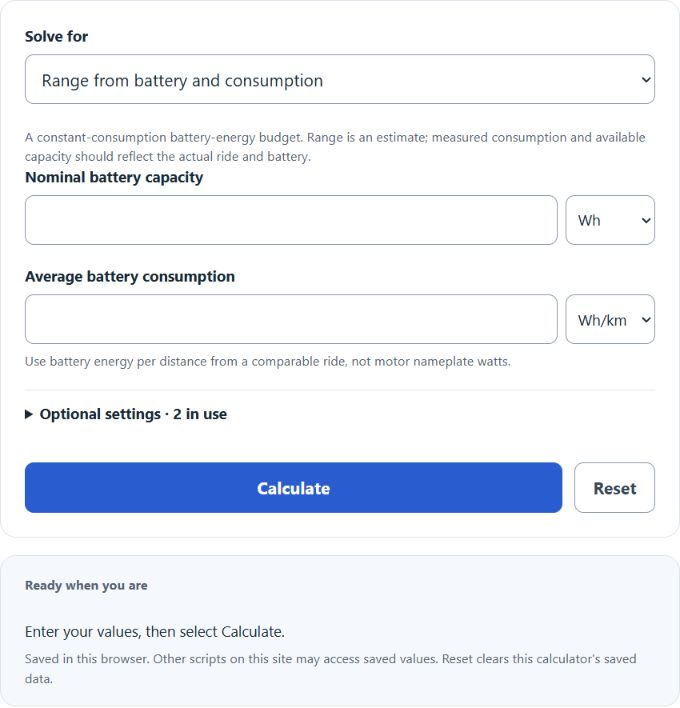
Estimate assisted range from usable battery energy and consumption, or solve the battery or efficiency needed for a target trip.
How the E-Bike Range Calculator Works
An e-bike battery stores watt-hours. Dividing the usable portion by average watt-hours per distance gives a transparent range estimate that can be reversed for battery capacity or allowable consumption.
The calculator subtracts a finish reserve from starting state of charge, applies the remaining percentage to nominal battery capacity, and solves the selected energy-budget target.
Formula and Method
Formula: usable Wh = nominal Wh x (starting charge - reserve) / 100; range = usable Wh / average Wh per distance
Required battery divides trip energy by the usable charge fraction. Allowable consumption divides usable energy by target distance.
Choosing the Right Inputs
Battery capacity is the nominal watt-hour rating. For energy use, prefer a recent ride on similar terrain, assist mode, weather, speed, load, and tire setup. Reserve is a planning buffer, not a claim about the battery-management cutoff.
| Average use | Estimated range | Scenario meaning |
|---|---|---|
| 8 Wh/km | 56.3 km | Low-use scenario |
| 10 Wh/km | 45.0 km | Moderate-use scenario |
| 15 Wh/km | 30.0 km | Higher-use scenario |
| 20 Wh/km | 22.5 km | Very high-use scenario |
Understanding Your Results
Range, required nominal battery, or allowable consumption leads. Supporting outputs show nominal and usable energy, both distance units, both consumption units, and the usable charge window.
Consumption is the key scenario input. More assistance, speed, climbing, cargo, wind, cold, or soft tires generally raises Wh per distance and reduces range.
Worked Example
A 500 Wh battery starting at 100% with a 10% reserve provides 450 usable Wh. At 10 Wh/km, the energy budget supports about 45.0 km or 28.0 miles.
Common Mistakes
Do not divide by nominal capacity without applying charge and reserve, mix Wh/km with Wh/mi, or treat an optimistic display estimate as guaranteed trip range.
Assumptions and Limitations
The calculator is an energy budget, not a motor-controller simulation. It does not predict changing efficiency over speed and torque, voltage sag, battery aging, thermal limits, terrain variation, or unassisted riding after cutoff.
Sources
Bosch eBike Systems, Rechargeable Battery Guide (2019). The scenario table is arithmetic, not a manufacturer-tested range claim.