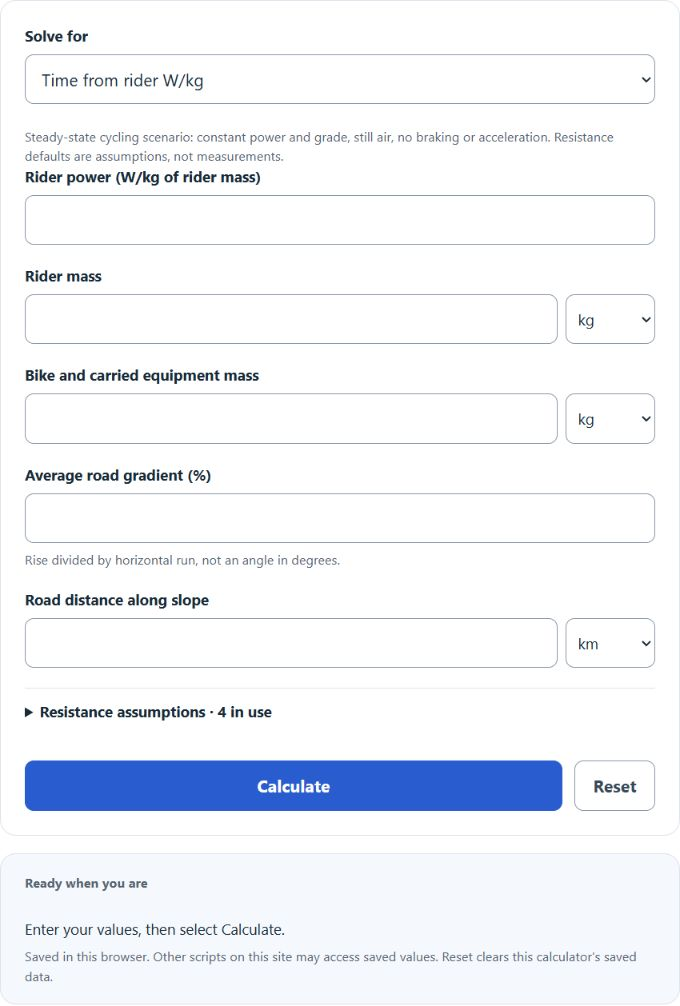
Estimate climb time from rider W/kg, average gradient and road distance using a transparent steady-state cycling power model.
How the Climb Time Calculator Works
Climbing speed comes from a balance between rider power at the wheel and the power needed to overcome gravity, tire rolling resistance, and aerodynamic drag. This tool solves that balance rather than assuming speed scales with W/kg alone.
The calculator converts rider W/kg to absolute watts when needed, applies drivetrain efficiency, translates percent grade into slope geometry, and numerically finds the steady speed where resistance equals available wheel power.
Formula and Method
Formula: Pwheel = v[m g sin(theta) + m g Crr cos(theta) + 0.5 rho CdA v^2]
Percent grade is rise divided by horizontal run, so sin(theta) = grade / sqrt(1 + grade^2). Time equals road distance divided by the solved speed.
Choosing the Right Inputs
Rider W/kg uses rider mass only; gravitational and rolling forces use rider plus bicycle and carried equipment. CdA, Crr, air density, and drivetrain efficiency are advanced scenario assumptions.
| Input | Primary effect | Important note |
|---|---|---|
| Rider W/kg | Sets rider watts with rider mass | Not system-mass W/kg |
| Gradient | Raises gravity force | Enter average rise/run percent |
| System mass | Raises gravity and rolling force | Include bike and carried gear |
| CdA and air density | Set aerodynamic drag | Still-air model |
| Crr | Sets rolling power | Surface and tires matter |
Understanding Your Results
Estimated time leads, followed by speed, rider and wheel power, elevation gain, VAM, and the gravity, rolling, and aerodynamic power components.
On steep climbs gravity usually dominates, making rider W/kg highly informative. Absolute watts and aerodynamics become more important as gradient falls and speed rises.
Worked Example
For a 75 kg rider on an 8 kg bicycle at 4.0 W/kg, 8% average grade, and 10 km road distance, the default model produces about 40:54 at 14.67 km/h.
Common Mistakes
Do not use system mass to calculate the entered rider W/kg, enter gradient degrees as percent, confuse horizontal distance with road distance, or treat default CdA and Crr as measurements.
Assumptions and Limitations
The model assumes constant power, grade, coefficients, and still air. It excludes accelerations, corners, drafting, headwind, altitude changes within the climb, roughness losses beyond Crr, fatigue, power fade, and pacing strategy.
Sources
Martin, Milliken, Cobb, McFadden and Coggan. Validation of a Mathematical Model for Road Cycling Power. Journal of Applied Biomechanics, 1998, 14(3), 276–291. DOI: 10.1123/jab.14.3.276. This calculator implements a simplified steady-state, still-air balance; it does not reproduce every term in that study.