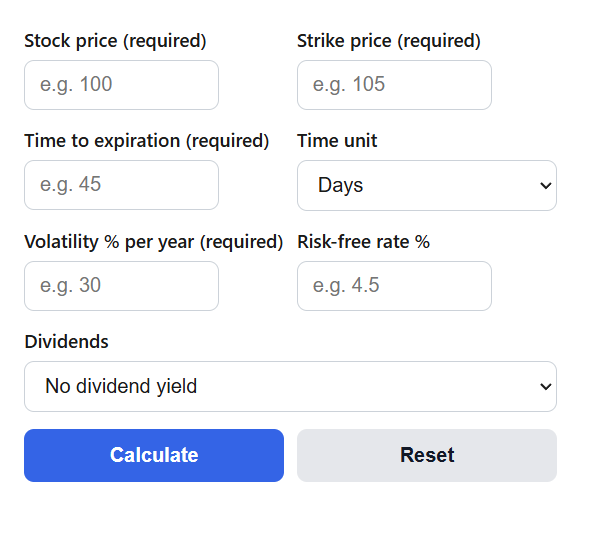
Black Scholes option price calculator. Enter stock price, strike, time, volatility, and rate to get call and put values, delta, d1, and d2 instantly.
Black-Scholes Formula
The Black-Scholes model prices a European call from five inputs (six with a dividend yield):
C = S*e^(-qT)*N(d1) - K*e^(-rT)*N(d2)
where d1 and d2 are:
d1 = [ln(S/K) + (r - q + sigma^2/2)*T] / (sigma*sqrt(T))
  d2 = d1 - sigma*sqrt(T)
Variables:
- C is the call value per share; the put value uses the mirrored formula P = K*e^(-rT)*N(-d2) – S*e^(-qT)*N(-d1)
- S is the current stock price and K the strike price ($)
- T is the time to expiration in years (days/365)
- sigma is the annualized volatility as a decimal
- r is the annual risk-free rate and q the dividend yield, as decimals
- N(x) is the standard normal cumulative distribution function
Enter the stock price, strike, time (days or years), volatility, and risk-free rate, and optionally a dividend yield under the dividends toggle. The calculator returns both the call and put values per share and per 100-share contract, each option’s delta, and the d1 and d2 terms so you can follow the math or feed other Greeks.
Option Value Sensitivity
Call and put values for S = $100, r = 4.5%, T = 45 days, no dividend, across strikes and volatilities.
| Strike | Call @ 20% vol | Call @ 40% vol | Put @ 20% vol | Put @ 40% vol |
|---|---|---|---|---|
| $90 | $10.66 | $12.12 | $0.16 | $1.62 |
| $100 | $3.08 | $5.86 | $2.53 | $5.31 |
| $110 | $0.35 | $2.32 | $9.74 | $11.71 |
Volatility is the price of uncertainty: doubling it roughly doubles the at-the-money value and multiplies far out-of-the-money values several times over, which is why implied volatility is the number options traders actually argue about.
Example Problems
Example 1: At-the-money call.
S = $100, K = $105, T = 45 days (0.1233 years), sigma = 30%, r = 4.5%, no dividend.
sigma*sqrt(T) = 0.30 * 0.3511 = 0.1053. d1 = [ln(100/105) + (0.045 + 0.045) * 0.1233] / 0.1053 = (-0.0488 + 0.0111) / 0.1053 = -0.358. d2 = -0.463. C = 100*N(-0.358) – 105*e^(-0.00555)*N(-0.463) = 100*0.3602 – 104.42*0.3216 = $2.44 per share, or $244 per contract.
Example 2: The matching put.
Using put-call parity, P = C – S + K*e^(-rT) = 2.44 – 100 + 104.42 = $6.86 per share – which is what the put formula returns directly.
Frequently Asked Questions
Which volatility should I enter?
Use the option’s implied volatility if you want to match market prices, or your own forecast (such as historical volatility) if you want to test whether the market’s price looks rich or cheap. The model’s output is only as good as this input.
Does Black-Scholes work for American options?
It prices European exercise – no early exercise. For American calls on non-dividend stocks the difference is essentially zero; for American puts and calls near ex-dividend dates the model understates value slightly, and binomial models are used for precision.
What does delta tell me?
Delta approximates how much the option price moves per $1 move in the stock – a 0.40-delta call gains about $0.40. It also doubles as a rough market estimate of the probability the option expires in the money, which is why traders quote strikes by delta.