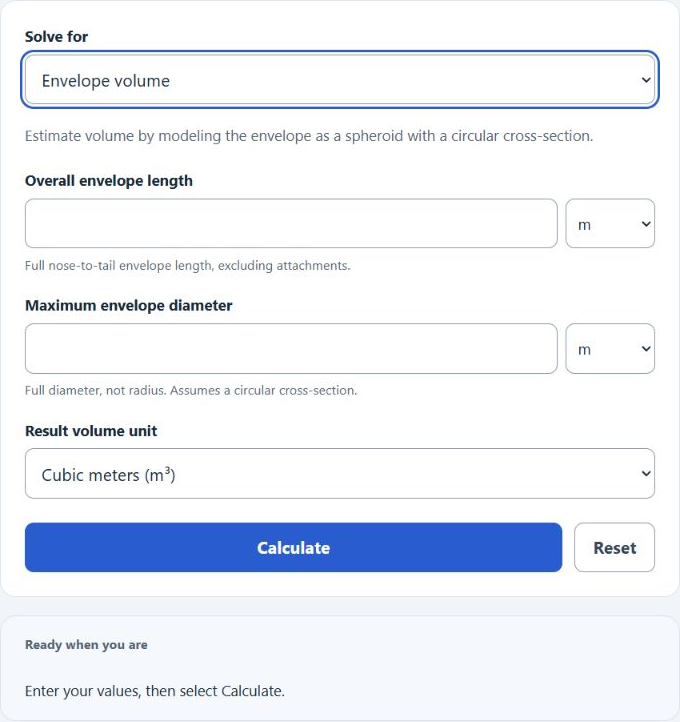
Select envelope volume, length or diameter, enter the two displayed measurements, and choose a result unit. The spheroid estimate supports metric lengths, feet, inches, liters, cubic feet and US liquid gallons.
Related Calculators
- End Cap Volume Calculator
- Circle Volume Calculator
- Cylinder Capacity Calculator
- Vessel Volume Calculator
- Area of an Oval Calculator
- All Math and Numbers Calculators
Blimp Volume Formula
The calculator models the envelope as a spheroid. It is prolate when length exceeds diameter, spherical when equal, and oblate when length is shorter. Select the value to solve for and enter the two displayed measurements.
- V = blimp volume
- L = blimp length
- D = maximum blimp diameter
- pi = 3.14159...
To calculate the missing value, the same formula is rearranged:
- Volume calculation: uses length and diameter to estimate spheroid envelope volume.
- Length calculation: uses volume and diameter to find the required blimp length.
- Diameter calculation: uses volume and length to find the required maximum diameter.
Common Blimp Volume Unit Conversions
Use these rounded conversions to check results. The calculator uses exact length definitions and identifies gallons as US liquid gallons.
| Unit | Equivalent |
|---|---|
| 1 cubic meter, m³ | 35.3147 cubic feet |
| 1 cubic foot, ft³ | 0.0283168 cubic meters |
| 1 cubic meter, m³ | 1,000 liters |
| 1 U.S. gallon | 0.00378541 cubic meters |
Illustrative Length-to-Diameter Ratios
The formula works for any positive length and diameter, but real blimp shapes are usually longer than they are wide.
| Length ÷ Diameter | Shape Description |
|---|---|
| 2:1 | Short, rounded envelope |
| 3:1 | Moderately elongated blimp shape |
| 4:1 | Long, slender envelope |
| 5:1 or higher | Very slender airship-style shape |
Example Calculations
Example 1: Calculate blimp volume
Suppose a blimp has a length of 40 m and a maximum diameter of 10 m.
The estimated blimp volume is 2,094.3951 m³.
Example 2: Calculate blimp diameter
Suppose a blimp volume is 1,500 m³ and its length is 30 m.
The required maximum diameter is 9.7721 m.
FAQ
What shape does this blimp volume calculator assume?
It uses a spheroid with a circular cross-section. Length greater than diameter gives a prolate spheroid. Real nose shape, tail taper and internal structures can change actual or usable volume; the size of that difference is not estimated here.
Why do I only enter length and diameter?
The formula assumes the blimp is symmetric around its long axis, so one maximum diameter represents both cross-section dimensions. If the envelope is not circular in cross-section, this simplified formula will be less accurate.
Can this volume be used to estimate lifting capacity?
Yes, but only as a starting point. Lift depends on the gas used, outside air density, temperature, pressure, envelope weight, payload, and other equipment. The calculator gives a geometric envelope estimate, not usable gas volume or final lift.