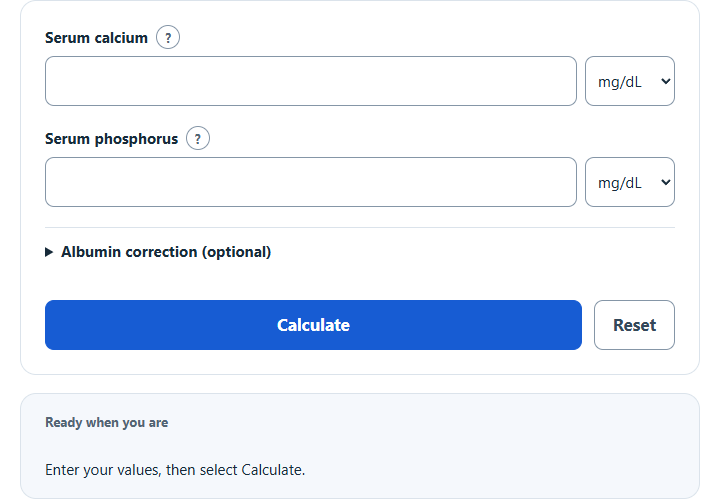
Calculate the calcium phosphorus product (Ca x P) from serum calcium and phosphorus in mg/dL or mmol/L, with an optional albumin correction for calcium.
- All Health Calculators
- Calcium/Phosphorus Ratio Calculator
- Corrected Calcium Calculator
- Adjusted Calcium Calculator
- Corrected Sodium Calculator
Calculator Functions
The calculator multiplies serum calcium by serum phosphorus to give the calcium phosphorus product (Ca × P) in mg²/dL² and in mmol²/L², and compares it with the 55 mg²/dL² level used in kidney care.
| Function | Use it when | You enter |
|---|---|---|
| Calcium phosphorus product | You have blood test results for calcium and phosphorus (phosphate) and want their product | Serum calcium and serum phosphorus, each in mg/dL or mmol/L |
An optional field takes serum albumin in g/dL or g/L. When it is filled in, calcium is corrected for albumin before it is multiplied. For the albumin correction by itself, use the Corrected Calcium Calculator. For calcium and phosphorus in food or feed, use the Calcium/Phosphorus Ratio Calculator.
Calcium Phosphorus Product Formula
| CPP | Calcium phosphorus product (mg²/dL²) |
| Ca | Serum total calcium, corrected for albumin when albumin is entered (mg/dL) |
| P | Serum phosphorus (mg/dL) |
A calcium of 9.4 mg/dL and a phosphorus of 4.1 mg/dL give 9.4 × 4.1 = 38.5 mg²/dL².
Results in mmol/L
P = 3.097 × PSI
CPPSI = CPP ÷ 12.41
CaSI and PSI are the lab values in mmol/L, and Ca and P are the same values in mg/dL. The factors come from the atomic masses of calcium (40.08) and phosphorus (30.97). They match the paired values in the kidney guideline, where 9.5 mg/dL of calcium is 2.37 mmol/L and 3.5 mg/dL of phosphorus is 1.13 mmol/L [1]. Dividing the product by 4.008 × 3.097 = 12.41 gives it in mmol²/L², so 55 mg²/dL² is about 4.4 mmol²/L².
Albumin-corrected calcium
A is serum albumin in g/dL. Much of the calcium in blood is bound to protein, so a low albumin makes total calcium read low. The guideline that set the 55 level bases it on corrected total calcium [1]. A calcium of 8.2 mg/dL with an albumin of 2.8 g/dL corrects to 8.2 + 0.8 × 1.2 = 9.16 mg/dL.
What the 55 mg²/dL² level means
The 2003 KDOQI guideline for chronic kidney disease advised keeping the product below 55 mg²/dL², mainly by controlling phosphorus, because higher products were linked with calcium deposits in blood vessels and soft tissue and with a higher risk of death in dialysis patients [1]. The later KDIGO guideline suggests using the calcium and phosphate values themselves, looked at together, rather than the product [2]. A product can look acceptable while one of the two values is out of range, so each should also be checked against the lab’s reference range.
Limits of This Estimate
- The 55 mg²/dL² level comes from studies of people with chronic kidney disease, mostly on dialysis [1]. It is not a general screening cutoff for people with healthy kidneys.
- The albumin correction is a simple approximation, and correction formulas have known limits in kidney disease [1]. Ionized calcium is a different test and should not be entered here.
- The calculator does not apply to calcium and phosphate mixed in IV nutrition solutions, where the risk of the two forming a solid depends on the product and concentrations of the solution.
- This is not medical advice or a diagnosis. Decisions about diet, phosphate binders or other treatment belong with your care team.
Sources
- National Kidney Foundation, KDOQI Clinical Practice Guidelines for Bone Metabolism and Disease in Chronic Kidney Disease, Guideline 6: the product target below 55 mg²/dL², the evidence behind it, the albumin correction and the paired mg/dL and mmol/L values
- KDIGO, CKD-MBD Quick Reference Guide, recommendation 3.1.5: using calcium and phosphate values together rather than the product