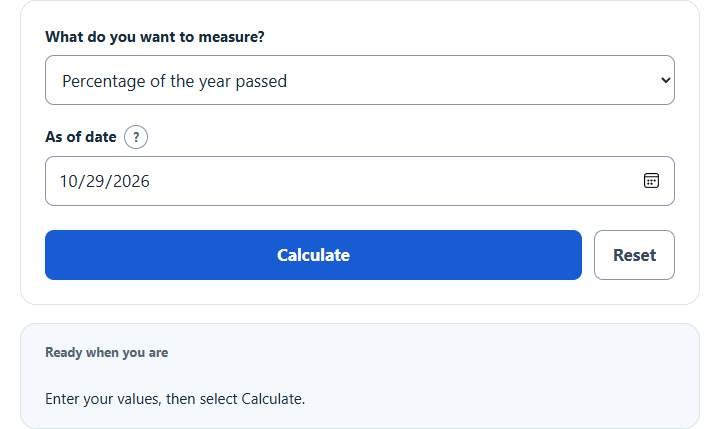
Find what percentage of the year, quarter or month has passed as of today or any date, or the percent complete for a date range or days out of a total.
Related Calculators
- Daily Increment Calculator
- Percentage Distance Calculator
- Rate Per 100 Calculator
- Average of Percentages Calculator (Weighted & Simple Mean)
- All Math and Numbers Calculators
Calculator Functions
| Function | What it does | What it requires |
|---|---|---|
| Percentage of the year passed | Finds how far through the calendar year a date falls | Requires an as-of date, which starts as today |
| Percentage of the quarter passed | Finds how far through its calendar quarter a date falls | Requires an as-of date, which starts as today |
| Percentage of the month passed | Finds how far through its month a date falls | Requires an as-of date, which starts as today |
| Percentage of a date range | Finds how far a date falls between any start date and end date | Requires a start date, an end date and an as-of date |
| Days completed out of a total | Converts a count of days completed to a percentage of a total number of days | Requires the days completed and the total days |
The four date functions count the whole days before the as-of date as passed. The as-of date itself is not counted, and a second figure shows the percentage with that day included. Every result also gives the percentage remaining, the days passed, the days remaining and the total days. Percentage of a date range has one optional setting for a date outside the range: keep the result between 0% and 100%, or show values below 0% or above 100%.
Calendar Percentage Formulas
| P | Percentage of the period that has passed (%) |
| Dc | Days completed, counted from the first day of the period up to the day before the as-of date |
| Dt | Total days in the period |
Each function sets the first day and the length of the period, then applies this one formula. The percentage remaining is 100 − P.
Percentage of the year passed
The period runs from January 1 to December 31, so Dt is 365, or 366 in a leap year. On July 2, 2026, 182 days have passed and the year is 182 ÷ 365 × 100 = 49.86% over. On July 2, 2028, a leap year, 183 of 366 days have passed, exactly 50%. One month is 8.49% of a 365 day year if it has 31 days, 8.22% if it has 30, and 7.67% for a 28 day February.
Percentage of the quarter passed
Quarters are the calendar quarters starting January 1, April 1, July 1 and October 1. They have 90 or 91 days in the first quarter and 91, 92 and 92 days in the others. On September 14, 2026, 75 of the 92 days in the third quarter have passed, which is 81.52%.
Percentage of the month passed
The period is the month the as-of date falls in, with 28, 29, 30 or 31 days. On September 15, 2026, 14 of 30 days have passed, so the month is 46.67% over. Counting the 15th as well gives 15 ÷ 30 = 50%, which is the second figure in the result.
Percentage of a date range
Dt is the number of days from the start date to the end date, and Dc is the number of days from the start date to the as-of date. The range ends at the start of the end date, so the end date itself is not counted. From September 15 to December 3, 2026 is 79 days. On October 20, 35 of them have passed: 35 ÷ 79 × 100 = 44.30%, with 44 days remaining. The end date must be after the start date.
Days completed out of a total
This function takes the two day counts directly, with no dates. Nine days out of 30 is 9 ÷ 30 × 100 = 30%, 24 days out of 30 is 80%, and 115 days out of 365 is 31.51%. Days completed can exceed the total, which gives a result above 100%.
| Days completed | Of 30 days | Of 31 days |
|---|---|---|
| 1 | 3.33% | 3.23% |
| 5 | 16.67% | 16.13% |
| 7 | 23.33% | 22.58% |
| 9 | 30% | 29.03% |
| 10 | 33.33% | 32.26% |
| 15 | 50% | 48.39% |
| 20 | 66.67% | 64.52% |
| 24 | 80% | 77.42% |
| 25 | 83.33% | 80.65% |
| 30 | 100% | 96.77% |
How to Calculate the Percentage of Days
Divide the days completed by the total days in the period and multiply by 100. For a span between two dates, count the days from the start date to today for the top number and the days from the start date to the end date for the bottom number. A task that started on August 24 and ends on December 11 covers 109 days. On October 5, 42 of them have passed, so it is 42 ÷ 109 × 100 = 38.53% of the way through.
Limits of This Estimate
- All days count equally. Weekends and holidays are not removed, so the result is a share of calendar days, not of working days.
- The date functions work in whole days. The time of day is ignored, so the figure does not change between midnight and midnight.
- Quarters are calendar quarters. A fiscal year or fiscal quarter that starts on another date goes in as a date range.