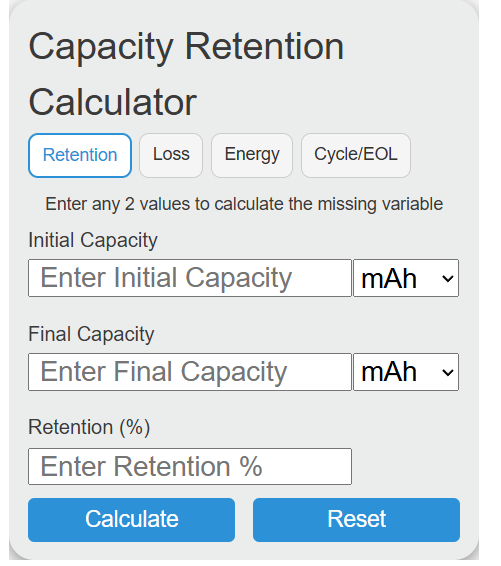
Calculate battery capacity retention, loss, energy retention, and estimated cycles to EOL from initial and final capacity, voltage, and cycles.
Related Calculators
- Battery Capacity Calculator (Amp Hours)
- Battery Health Percentage Calculator
- Battery Run Time Calculator
- Battery Efficiency Calculator
- Battery Energy Calculator
- All Chemistry Calculators
Capacity Retention Formula
The following formula is used to calculate the capacity retention for a given initial and final capacity.
Variables:
- R is the retention percentage
- Ci is the initial capacity in milliampere-hours (mAh)
- Cf is the final capacity in milliampere-hours (mAh)
To calculate the capacity retention, divide the final capacity by the initial capacity and multiply the result by 100 to get the percentage.
What is Capacity Retention?
Capacity retention refers to the ability of a battery to retain its charge capacity over time. It is a measure of how well a battery can maintain its initial charge capacity after multiple charge and discharge cycles. High capacity retention indicates that the battery can hold a charge close to its original capacity, while low capacity retention means the battery’s ability to hold a charge has significantly diminished. This metric is crucial for evaluating the longevity and performance of batteries in various applications, including consumer electronics, electric vehicles, and renewable energy storage systems.
How to Calculate Capacity Retention?
The following steps outline how to calculate the Capacity Retention.
- First, determine the initial capacity of the battery (Ci).
- Next, determine the final capacity of the battery after a certain number of cycles (Cf).
- Next, calculate the retention percentage using the formula R = (Cf / Ci) * 100.
- Finally, calculate the Capacity Retention.
- After inserting the values and calculating the result, check your answer with the calculator above.
Example Problem :
Use the following variables as an example problem to test your knowledge.
Initial Capacity (Ci) = 2000 mAh
Final Capacity (Cf) = 1800 mAh