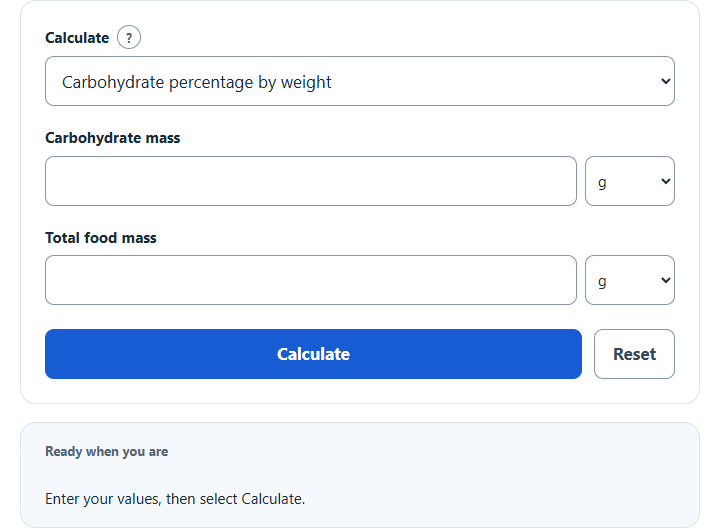
Calculate carbohydrate percentage by weight from carb grams and total food weight, or find carb grams or food weight from a known carb percentage.
Related Calculators
- Grams To Calories Calculator
- Percentage Of Calories Calculator
- %DV Calculator (Percent Daily Value)
- Cost Per 100 Calories Calculator
- All Food and Cooking Calculators
Calculator Functions
| Function | What it does | What it requires |
|---|---|---|
| Carbohydrate percentage by weight | Finds the share of a food’s weight that is carbohydrate | Requires the carbohydrate mass and the total food mass for the same portion |
| Carbohydrate mass from percentage | Finds the carbohydrate in a portion from its percentage by weight | Requires the total food mass and the carbohydrate percentage |
| Food mass from percentage | Finds the portion size that supplies a set amount of carbohydrate | Requires the carbohydrate mass and the carbohydrate percentage |
| Estimated net carbohydrates | Subtracts fiber and a chosen share of sugar alcohol from total carbohydrate | Requires total carbohydrate, fiber, sugar alcohol and the fraction of sugar alcohol to subtract |
| Glycemic load | Finds the glycemic load of a serving | Requires the available carbohydrate per serving in grams and the glycemic index |
| Glycemic index from load | Rearranges the glycemic load formula for glycemic index | Requires the available carbohydrate per serving and the glycemic load |
| Available carbohydrate from load | Rearranges the glycemic load formula for carbohydrate | Requires the glycemic index and the glycemic load |
Masses are accepted in grams, kilograms or ounces, and mass results can be shown in any of the three. The percentage functions also list carbohydrate per 100 g of food and the energy from that carbohydrate at 4 kcal per gram.
Carbohydrate Percentage Formulas
| P | Carbohydrate percentage by weight (%) |
| C | Carbohydrate mass (g) |
| T | Total food mass (g) |
This is a share of weight, not a share of calories. A food can be 25% carbohydrate by weight and get far more or far less than 25% of its calories from carbohydrate, depending on its fat, protein and water. The share of calories is worked out with the Percentage Of Calories Calculator. The energy line uses the general factor of 4 kcal (17 kJ) per gram of carbohydrate [1].
Carbohydrate percentage by weight
A 200 g portion with 50 g of carbohydrate is 50 ÷ 200 × 100 = 25% carbohydrate by weight. That is 25 g per 100 g of food and about 200 kcal from carbohydrate.
Carbohydrate mass from percentage
A 200 g portion of a food that is 25% carbohydrate holds 200 × 25 ÷ 100 = 50 g of carbohydrate.
Food mass from percentage
Getting 50 g of carbohydrate from a food that is 25% carbohydrate takes 50 ÷ 0.25 = 200 g of it. A 0% food cannot supply any carbohydrate, so that entry is rejected.
Estimated net carbohydrates
(sugar alcohol × fraction)
The fraction of sugar alcohol to subtract is a choice: 100%, 75%, 50% or none. With 30 g total carbohydrate, 8 g fiber, 6 g sugar alcohol and a 50% deduction, the estimate is 30 − 8 − 3 = 19 g. “Net carbs” has no legal definition and is not used by the U.S. Food and Drug Administration, and some fiber and sugar alcohols are partly digested, so the American Diabetes Association recommends counting total carbohydrate [2].
Glycemic load
carbohydrate ÷ 100 [3]
Carbohydrate here is the available carbohydrate in the serving, in grams, which leaves out fiber, and GI is on the scale where pure glucose is 100 [3]. A serving of watermelon with a GI of 76 and 11 g of available carbohydrate has a GL of 76 × 11 ÷ 100 = 8.36, which is why a high-GI food can still have a small effect per serving [3].
Glycemic index from load
carbohydrate × 100
A GL of 8.36 from 11 g of available carbohydrate works back to a GI of 76. This only reverses the arithmetic. A food’s real GI is measured by testing blood glucose in volunteers, and the calculator accepts values from 0 to 150.
Available carbohydrate from load
GL ÷ GI × 100
A GL of 8.36 at a GI of 76 corresponds to 8.36 ÷ 76 × 100 = 11 g of available carbohydrate.
Limits of This Estimate
- Educational use only, not medical advice. The results should not be used to dose insulin or change diabetes medication. Anyone with diabetes, kidney disease, an eating disorder or another medical condition, or who is pregnant, should follow their clinician’s guidance.
- The net carbohydrate figure depends on the deduction chosen. No deduction is standardized, and the effect of fiber and sugar alcohols varies by type and by person [2].
- Nutrition label values are rounded, and GI values vary with the food variety, ripeness and preparation, so glycemic load is approximate.
- The 4 kcal per gram energy figure is a general average for carbohydrate, not a value for a specific food.
Sources
- Food and Agriculture Organization of the United Nations, Food energy: methods of analysis and conversion factors, Chapter 3: the general energy factor for carbohydrate
- American Diabetes Association, Get to Know Carbs: the status of “net carbs” and the advice to count total carbohydrate, as of November 2026
- Linus Pauling Institute, Oregon State University, Glycemic Index and Glycemic Load: the glycemic load formula, available carbohydrate, the glucose scale and the watermelon example