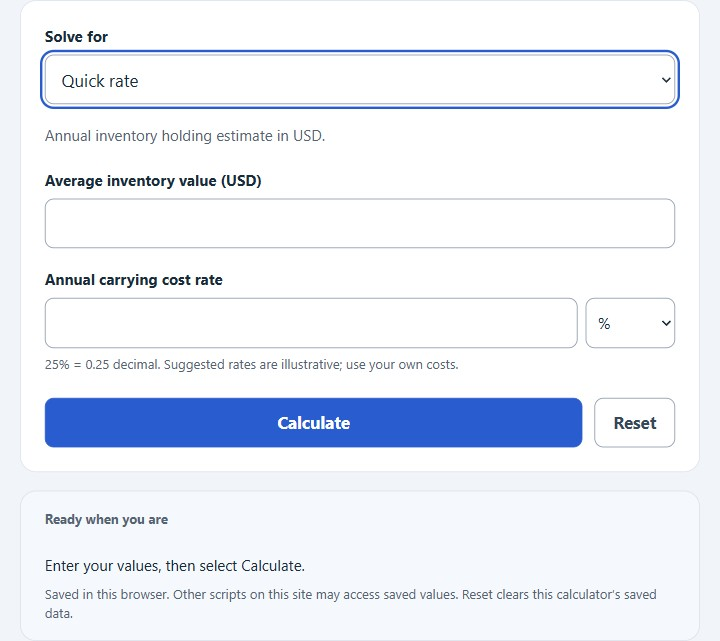
Calculate annual carrying cost from inventory value and carrying rate, or break it down by capital, storage, service, and risk costs.
- All Business Calculators
- Inventory Cost Calculator
- EOQ Calculator
- Reorder Point Calculator
- Safety Stock Calculator
- Average Inventory Calculator
- Days of Supply Calculator
Carrying Cost Formula
The carrying cost calculator estimates the annual cost of holding inventory. It has two modes: a quick rate-based calculation and a detailed component-based calculation.
Quick carrying cost formula
- Annual Carrying Cost is the estimated yearly cost to hold inventory.
- Average Inventory Value is the average dollar value of inventory held during the period.
- Carrying Cost Rate is the annual holding cost as a decimal or percentage.
Detailed carrying cost formula
- Capital Cost Rate is the cost of money tied up in inventory.
- Storage Cost Rate covers warehouse space, utilities, equipment, and related storage expenses.
- Service Cost Rate includes insurance, taxes, handling, and inventory administration costs.
- Risk Cost Rate accounts for shrinkage, damage, spoilage, theft, and obsolescence.
- Total Carrying Cost Rate is the sum of the component rates.
In quick mode, you enter one combined carrying cost rate. If you select percent, 25 means 25%. If you select decimal, 0.25 means 25%.
In detailed mode, you enter the component percentages separately. Blank component fields are treated as zero, then the calculator adds the percentages and applies the total rate to the average inventory value.
Illustrative Inventory Carrying Cost Rates
The rates below are examples, not current industry quotes or recommended defaults. Use your own annual cost data.
| Inventory situation | Illustrative annual carrying cost rate | Notes |
|---|---|---|
| Low overhead inventory | About 20% | Lower storage, lower risk, or faster-moving stock. |
| Retail or wholesale example | About 25% | Illustrative assumption; replace with a rate based on actual costs. |
| Manufacturing inventory | About 30% | May include raw materials, work in process, and finished goods. |
| Perishable or high-risk inventory | About 35% or more | Higher risk of spoilage, markdowns, damage, or obsolescence. |
Common Carrying Cost Components
| Component | What it includes | Example input |
|---|---|---|
| Capital cost | Interest, required return, or opportunity cost of cash tied up in inventory. | 10% |
| Storage cost | Warehouse rent, utilities, racking, equipment, and facility costs. | 8% |
| Service cost | Insurance, property taxes, handling, and inventory support costs. | 3% |
| Risk cost | Shrinkage, theft, damage, spoilage, markdowns, and obsolescence. | 4% |
Carrying Cost Examples
Example 1: Quick carrying cost calculation
You have an average inventory value of $250,000 and use a carrying cost rate of 25%.
The annual carrying cost is $62,500. That equals about $5,208.33 per month.
Example 2: Detailed carrying cost calculation
You have an average inventory value of $250,000 with these component rates: 10% capital, 8% storage, 3% service, and 4% risk.
The annual carrying cost is $62,500.
FAQ
What is a good carrying cost percentage?
There is no universal target. The example rates on this page illustrate the calculation; estimate capital, storage, service, and risk costs for your inventory and annual period instead of assuming a benchmark applies.
Should carrying cost be based on ending inventory or average inventory?
Use average inventory value when possible. Ending inventory only shows one point in time and can be misleading if inventory levels change during the year. A simple average can be calculated as beginning inventory plus ending inventory, divided by 2.
What does carrying cost not include?
Carrying cost usually focuses on the cost of holding inventory after it has been purchased or produced. It does not usually include the purchase cost of the goods themselves, direct production cost, ordering cost, or lost sales from stockouts unless you intentionally include those in your internal analysis.