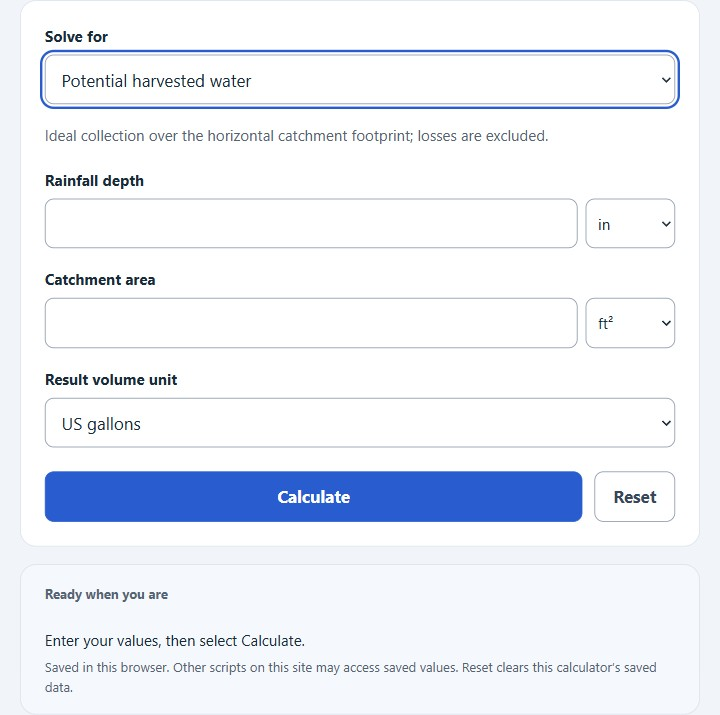
Select potential harvested water, catchment area, or rainfall depth and enter the two known values. This geometric model uses the horizontal catchment footprint and assumes 100% collection; actual stored water is lower after losses. Gallons mean US liquid gallons.
Related Calculators
- Time of Concentration Calculator
- Hazen Williams Equation Calculator
- Plumbing Slope Calculator
- Gravity Fed Water Pressure Calculator
- All Construction Calculators
Catchment Area Formula
Variables:
- CA is the horizontal catchment footprint (ft²), not the sloped roof surface
- HW is the ideal water volume (US gal) before collection and storage losses
- RFD is the rainfall depth (in)
Divide the ideal water volume in US gallons by rainfall depth in inches, then by 0.6233766234. The familiar 0.623 factor is rounded. One inch over one square foot is 1/12 cubic foot, giving about 0.6234 US gallons. Use rainfall and water volume from the same time interval; measured collected water with unknown losses cannot identify the true catchment area.
How to Calculate Catchment Area?
The following steps outline how to calculate the Catchment Area.
- First, determine the ideal water volume (US gal) before losses.
- Next, determine the rainfall depth (in).
- Next, use CA = HW / (RFD × 0.6233766234), with US gallons, inches and square feet.
- Finally, calculate the horizontal catchment area; rainfall must be greater than zero for a unique inverse result.
- After inserting the variables and calculating the result, check your answer with the calculator above.
Example Problem :
Use the following variables as an example problem to test your knowledge.
harvested water (gal) = 45
rainfall depth (in) = 34. The ideal catchment area is 45 / (34 × 0.6233766234) ≈ 2.1232 ft².
FAQs
What is Rainwater Harvesting?
Rainwater harvesting is the process of collecting, storing, and using rainwater from surfaces like roofs for various water needs, including irrigation, flushing toilets, and laundry, reducing the demand on traditional water supplies.
Why is the Catchment Area important in Rainwater Harvesting?
The catchment area is crucial because it determines the potential volume of rainwater that can be collected. A larger horizontal catchment area receives more rainwater for the same rainfall depth. Collection efficiency, first-flush losses and storage capacity determine how much is actually available for use.
How can I increase the efficiency of my Rainwater Harvesting system?
Efficiency can be increased by ensuring the catchment area is clean and unobstructed, using high-quality components for water collection and storage, and regularly maintaining the system to prevent leaks and contamination.
Are there any legal restrictions on Rainwater Harvesting?
In some areas, there may be legal restrictions or guidelines on rainwater harvesting, including permits, usage, and treatment requirements. It’s essential to check local regulations before installing a rainwater harvesting system.