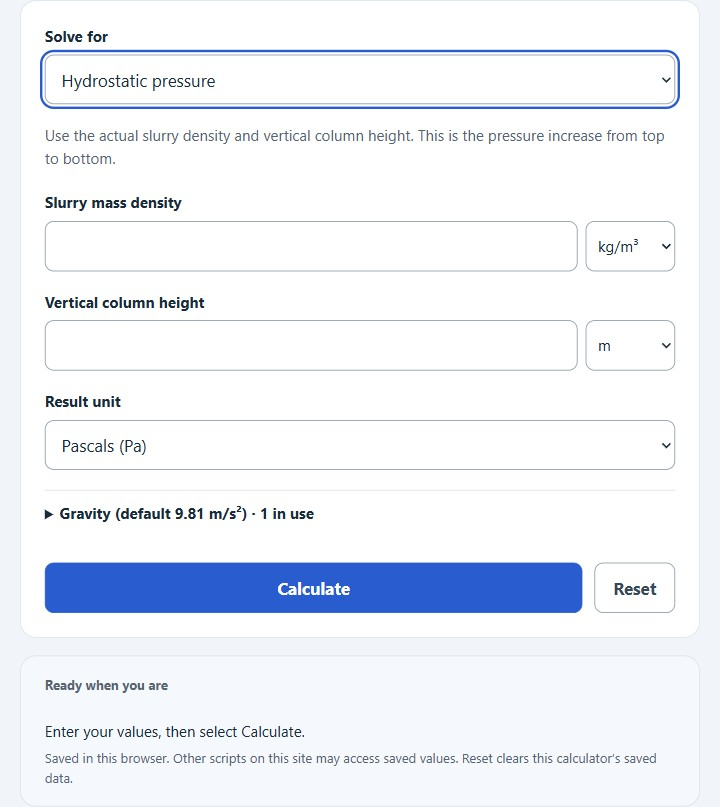
Select pressure, slurry density, vertical column height, or gravity to solve using the static P=ρgh model and unit conversion.
Related Calculators
- Earth Pressure Coefficient Calculator
- Surge Pressure Calculator
- CBR Ratio Calculator
- Swell Factor Calculator
- All Construction Calculators
Cement Lift Pressure Formula
The calculator uses the hydrostatic pressure relationship for a vertical cement slurry column. The main formula is:
- P = hydrostatic pressure increase from the top to the bottom of the slurry column
- ρ = density of the cement slurry
- g = gravitational acceleration
- h = height of the cement column
If pressure is the missing value, the calculator multiplies slurry density, gravity, and column height:
If density is the missing value, the formula is rearranged as:
If height is the missing value, the formula is rearranged as:
If gravitational acceleration is the missing value, the formula is rearranged as:
The calculator converts all entered values to SI base units before calculating: pascals for pressure, kilograms per cubic meter for density, meters for height, and meters per second squared for gravity. It then converts the answer back to the unit you selected.
Illustrative Density Ranges
These illustrative ranges show density conversions, not recommended mix densities. Use the measured or certified density of your actual slurry.
| Material or slurry type | Approximate density | Approximate density |
|---|---|---|
| Water | 1,000 kg/m³ | 62.4 lb/ft³ |
| Illustrative lower-density range | 1,400 to 1,700 kg/m³ | 87 to 106 lb/ft³ |
| Illustrative middle-density range | 1,800 to 2,000 kg/m³ | 112 to 125 lb/ft³ |
| Illustrative higher-density range | 2,100 to 2,400 kg/m³ | 131 to 150 lb/ft³ |
Unit Conversion Reference
| Quantity | Conversion used |
|---|---|
| Pressure | 1 psi ≈ 6,894.757293 Pa |
| Density | 1 lb/ft³ ≈ 16.018463374 kg/m³ |
| Height | 1 ft = 0.3048 m |
| Height | 1 in = 0.0254 m |
| Gravity | 1 ft/s² = 0.3048 m/s² |
Example Calculations
Example 1: Calculate cement lift pressure
Suppose the cement slurry density is 1,900 kg/m³, the cement column height is 30 m, and gravitational acceleration is 9.81 m/s².
The cement lift pressure is 559,170 Pa, or about 81.10 psi.
Example 2: Calculate cement column height
Suppose the pressure is 500,000 Pa, the slurry density is 1,850 kg/m³, and gravitational acceleration is 9.81 m/s².
The cement column height is 27.55 m.
FAQs
What does cement lift pressure mean?
Cement lift pressure is the pressure created by the weight of a vertical column of cement slurry. It depends on the slurry density, the height of the cement column, and gravity. A taller or denser slurry column produces more pressure at the bottom.
Why does the calculator use 9.81 m/s² for gravity?
9.81 m/s² approximates gravitational acceleration near the surface of Earth; standard gravity is defined as 9.80665 m/s². For most cement pressure calculations, this value is suitable. If you need to use field-specific or non-Earth gravity conditions, you can replace it with your own value.
How do I choose the value to solve?
Select the value to solve and enter the other three quantities. Gravity defaults to 9.81 m/s² unless you solve for it. Zero denominators can leave an inverse solution undetermined or impossible. This static uniform-density model excludes surface pressure, pumping friction, rheology and setting effects; it is not a safe pumping-pressure or formwork-design limit.