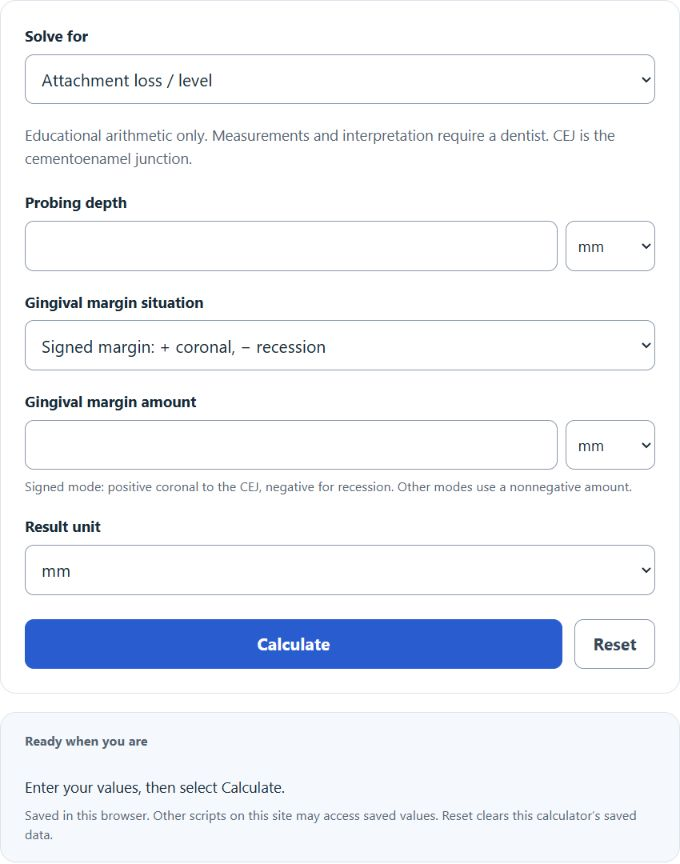
Calculate attachment loss or signed attachment level from probing depth and gingival margin, solve the inverse measurements, or check all three. The limited stage and indirect-grade reference is educational and requires clinician-confirmed periodontitis and a full dental evaluation.
Dental disclaimer: Educational use only. This tool does not diagnose periodontal disease and cannot replace an exam by a licensed dentist/periodontist. Periodontitis staging requires a full clinical evaluation (often including radiographs, tooth loss history, probing depths, and other complexity factors). If you have bleeding gums, pain, swelling, or loose teeth, seek dental care.
- All Health and Medical Calculators
- CDAI Clinical Disease Activity Index Calculator
- Apnea Hypopnea Index Calculator
- International Normalized Ratio Calculator
- BUN Creatinine Ratio Calculator
- Cardiac Index Calculator
Clinical Attachment Loss Formula
The following example problem outlines the steps and information needed to calculate the Clinical Attachment Loss.
References:
Standardizing clinical evaluations of periodontal condition to guide assessments and diagnoses using the Periodontal Assessment Protocol (GF-PAPro) (2025)
AAP/EFP staging and grading chart (2018). CAL bands are 1–2, 3–4 and ≥5 mm; this calculator leaves fractional gaps unclassified. CAL takes precedence over optional bone-loss percentage. Other complexity findings, disease extent, direct progression, smoking and diabetes can change clinical staging or grading. ADA attachment-loss documentation explains adding recession or subtracting a coronal margin.
Variables:
- CAL is the clinical attachment loss / level (mm), measured from the CEJ to the base of the sulcus/pocket
- PD is the probing depth (mm), measured from the gingival margin to the base of the sulcus/pocket
- GM is the gingival margin level (mm) relative to the CEJ: GM is positive when the gingival margin is coronal to the CEJ (enlargement), GM is negative when the margin is apical to the CEJ (recession), and 0 when at the CEJ
To calculate the signed attachment level, subtract GM from PD. Because recession is entered as a negative GM value, recession increases the level (for example, PD − (−3) = PD + 3). The calculator reports zero arithmetic loss when the raw signed level is coronal to the CEJ. That reported zero does not determine a unique signed level for inverse calculations. The selected 3 mm coronal margin is an example assumption, not a universal normal value.
How to Calculate Clinical Attachment Loss?
The following steps outline how to calculate the Clinical Attachment Loss.
- First, determine the probing depth (PD).
- Next, determine the gingival margin level (GM) relative to the CEJ (use a negative value for recession and a positive value if the margin is coronal to the CEJ).
- Next, gather the formula from above = CAL = PD - GM.
- Finally, calculate the Clinical Attachment Loss.
- After inserting the variables and calculating the result, check your answer with the calculator above.
Example Problem :
Use the following variables as an example problem to test your knowledge.
probing depth (mm) = 9
gingival margin level (mm) = -3 (meaning 3 mm of recession; the margin is 3 mm apical to the CEJ)
CAL = PD - GM = 9 - (-3) = 12 mm