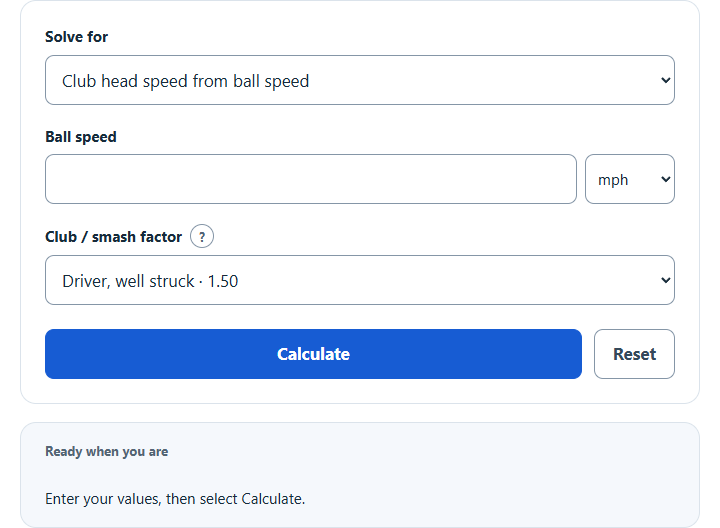
Convert ball speed to swing speed (club head speed) using a typical smash factor for your club, or estimate ball speed from club head speed.
Calculator Functions
| Function | What it does | What it requires |
|---|---|---|
| Club head speed from ball speed | Converts a measured ball speed into swing speed at the club head | Requires ball speed and a club or smash factor |
| Ball speed from club head speed | Finds the ball speed a swing speed produces | Requires club head speed and a club or smash factor |
| Club head speed from carry distance | Estimates swing speed from how far the ball carries | Requires carry distance and a carry factor in yards per mph |
Speeds can be entered in mph, km/h or m/s and carry in yards, meters or feet. Answers are given in mph with km/h alongside. The club list sets the smash factor: driver 1.50, 3-wood 1.48, hybrid 1.46, 5-iron 1.41, 7-iron 1.33, 9-iron 1.28 and pitching wedge 1.23, or a custom value up to 2. The two speed functions also print a short conversion table at the chosen smash factor.
Club Head Speed Formulas
| CHS | Club head speed, also called swing speed |
| BS | Ball speed just after impact, in the same unit as CHS |
| SF | Smash factor, the ratio of ball speed to club speed [1] |
Smash factor measures how much of the club’s speed reaches the ball. A well-struck driver is near 1.50, and the figure falls as loft increases, to about 1.25 for a pitching wedge [1]. The values in the club list follow that pattern and are typical figures for solid contact, so an off-center strike has a lower smash factor than the list assumes.
Club head speed from ball speed
The main formula applies directly. A 150 mph ball speed with a driver at 1.50 is 150 ÷ 1.50 = 100 mph of club head speed. A 120 mph ball speed with a 7-iron at 1.33 is 120 ÷ 1.33 = 90.2 mph.
| Ball speed (mph) | Driver, 1.50 | 5-iron, 1.41 | 7-iron, 1.33 |
|---|---|---|---|
| 90 | 60.0 | 63.8 | 67.7 |
| 100 | 66.7 | 70.9 | 75.2 |
| 110 | 73.3 | 78.0 | 82.7 |
| 120 | 80.0 | 85.1 | 90.2 |
| 130 | 86.7 | 92.2 | 97.7 |
| 140 | 93.3 | 99.3 | 105.3 |
| 150 | 100.0 | 106.4 | 112.8 |
| 160 | 106.7 | 113.5 | 120.3 |
| 170 | 113.3 | 120.6 | 127.8 |
| 180 | 120.0 | 127.7 | 135.3 |
The table gives club head speed in mph for each ball speed. The same ball speed means a faster swing with an iron than with a driver, because less of the club’s speed reaches the ball.
Ball speed from club head speed
A 100 mph driver swing at 1.50 produces a 150 mph ball speed, and the same swing at 1.40 produces 140 mph. That 10 mph gap is worth roughly 20 yards [1]. An 88 mph 7-iron swing at 1.33 gives 117 mph.
Club head speed from carry distance
carry factor
The carry factor is yards of carry per mph of club head speed. The starting value of 2.3 is a rule of thumb for a driver, so a 230-yard carry suggests about 100 mph. A measured carry divided by a measured club speed gives a personal factor that makes this function far more accurate. Carry is the distance through the air, not the total with roll.
Limits of This Estimate
- A launch monitor measures club head speed directly. A speed worked back from ball speed is only as good as the smash factor, and a 0.05 change in smash factor moves a 150 mph result by about 3 mph.
- The club list values and the 2.3 carry factor are typical figures, not measurements of a particular swing. These estimates are based on the best available data and estimations.
- Carry depends on launch angle, spin, strike, ball, wind and elevation, so the carry function is the roughest of the three and gives no ball speed.
Sources
- TrackMan, What is Smash Factor?: smash factor as ball speed divided by club speed, 1.50 for a driver, about 1.25 for a pitching wedge, and the 20-yard example