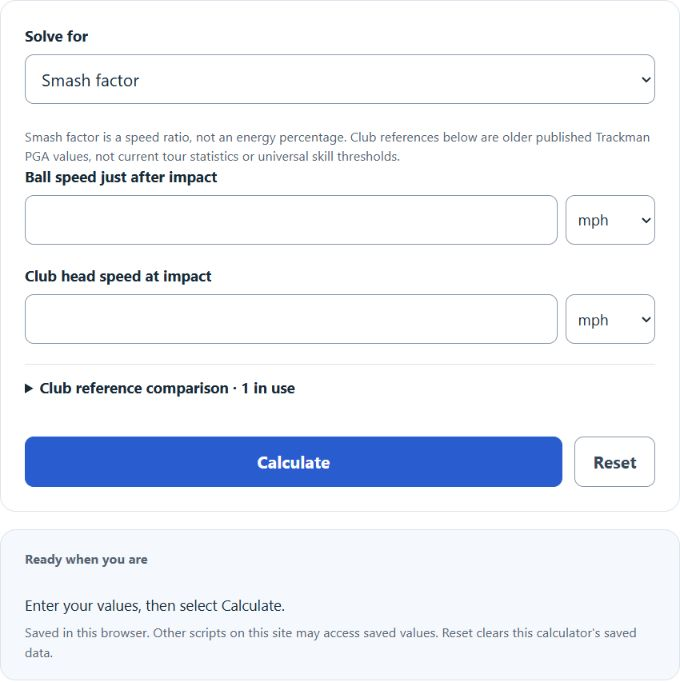
Calculate your golf smash factor from ball speed and club head speed, or solve for the ball or club speed behind any target, with older published club reference values.
Golf Smash Factor Formula
Smash factor is the ratio of ball speed to club head speed at impact:
SF = BS / CS
The same relationship can be rearranged to solve for either speed:
BS = SF * CS
 CS = BS / SF
Variables:
- SF is smash factor, the unitless ball-speed to club-speed ratio; it is not an energy percentage
- BS is the ball speed measured just after impact (mph, km/h, or m/s)
- CS is club head speed at impact. Convert speeds to a common unit before dividing; selected units are converted by the calculator.
The calculator supports all three formulas. Default mode compares measured speeds and shows the ball speed the same club speed would produce at the selected reference factor. The other modes solve the inverse relationships. Speed units convert physically; club selection changes only the reference comparison, not the formula. These comparisons do not rate skill or establish equipment conformity.
Smash Factor Reference Values by Club
Loft affects smash factor, so compare similar clubs and monitor conventions. These older Trackman PGA values, reproduced in The R&A’s Clubhead Speed report, provide reference context. They are not current tour statistics or validated amateur thresholds.
| Club | Older PGA reference | Interpretation |
|---|---|---|
| Driver | 1.48 | Reference only |
| 3-wood | 1.48 | Reference only |
| 5-wood | 1.47 | Reference only |
| Hybrid | 1.46 | Reference only |
| 3-iron | 1.45 | Reference only |
| 4-iron | 1.43 | Reference only |
| 5-iron | 1.41 | Reference only |
| 6-iron | 1.38 | Reference only |
| 7-iron | 1.33 | Reference only |
| 8-iron | 1.32 | Reference only |
| 9-iron | 1.28 | Reference only |
| Pitching wedge | 1.23 | Reference only |
Illustrative Driver Distance Comparison
Each row holds driver club speed constant and compares ball speed at three factors. The distance column assumes 2 yards per extra mph of ball speed, based on Trackman’s illustrative 100-mph driver comparison. Extending this fixed scale to other speeds is an illustration, not a carry prediction; launch, spin, ball and conditions matter.
| Club head speed | Ball speed at 1.40 | Ball speed at 1.45 | Ball speed at 1.50 | Illustrative distance gap (1.40 vs 1.50) |
|---|---|---|---|---|
| 80 mph | 112 mph | 116 mph | 120 mph | about 16 yards |
| 90 mph | 126 mph | 130.5 mph | 135 mph | about 18 yards |
| 100 mph | 140 mph | 145 mph | 150 mph | about 20 yards |
| 110 mph | 154 mph | 159.5 mph | 165 mph | about 22 yards |
| 120 mph | 168 mph | 174 mph | 180 mph | about 24 yards |
Under this illustration’s fixed scale, a 0.10 factor change adds 8 mph of ball speed at 80 mph club speed or 12 mph at 120 mph, corresponding to 16 or 24 illustrative yards. Actual distance change cannot be determined from smash factor alone.
Golf Smash Factor Example Problems
Example 1: A launch monitor shows a ball speed of 150 mph and a club head speed of 102 mph with a driver. Dividing 150 by 102 gives a smash factor of 1.47. The older driver reference used here is 1.48, so the rounded ratio is 0.01 below that reference. At 1.48, the same 102 mph swing would produce about 151 mph of ball speed.
Example 2: You swing your driver at 95 mph and want to know what ball speed clean contact would produce. Multiplying 95 by a target smash factor of 1.48 gives a ball speed of 140.6 mph. A lower reading warrants checking delivery, ball, equipment and monitor conventions; it does not isolate one cause.
Frequently Asked Questions
Can smash factor be higher than 1.50?
A monitor can report ratios above 1.50. Check units, monitor conventions, impact conditions and repeatability. Smash factor alone cannot establish equipment conformity; it is not an equipment-rule test.
What is a good smash factor for a 7-iron?
The older published reference table lists 1.33 for a 7-iron. This is context, not a universal target. Loft, delivery and measurement conventions affect the ratio; a higher iron ratio is not automatically better.
Why is my smash factor low even when contact feels solid?
Impact location, spin loft, delivery, ball characteristics and monitor conventions can all affect the ratio. Compare repeatable measurements with the same ball and equipment rather than applying a fixed range-ball correction. See Trackman’s explanation and The R&A’s older reference table, Figure 1.