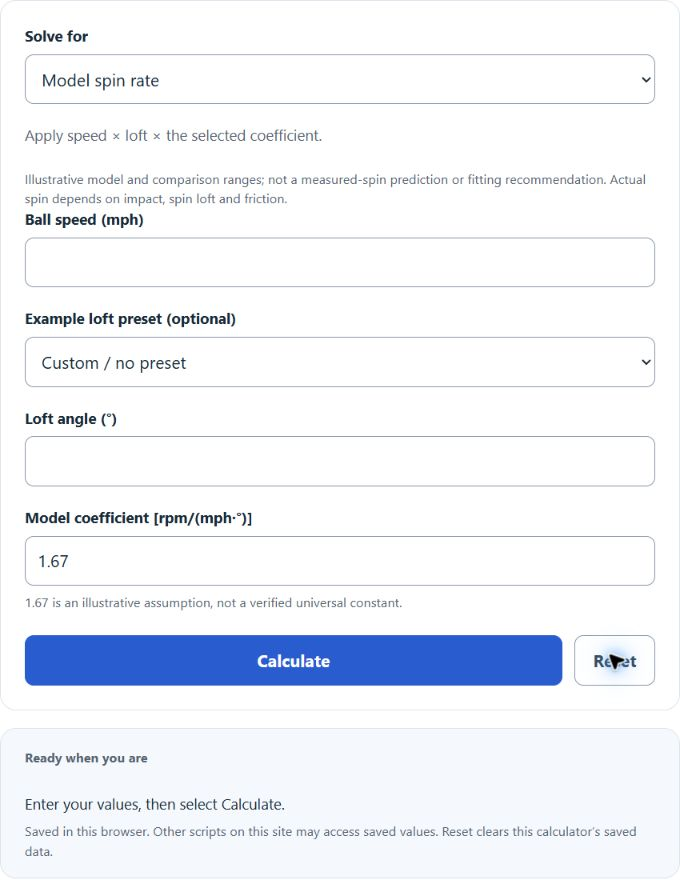
Calculate an illustrative spin model, its inverse speed or loft, or compare measured spin with editable example ranges. This tool does not predict measured spin or establish personal fitting targets.
Golf Ball Spin Formula
The following illustrative equation preserves this page’s original arithmetic. Its coefficient of 1.67 is not a verified universal physical constant. Actual spin depends on club delivery, spin loft, impact and friction; static loft and ball speed alone are insufficient. The coefficient can be edited in the calculator.
- Where SR is the spin rate (rpm)
- BS is the ball speed (mph)
- LA is the loft angle (°)
- c is the selected model coefficient in rpm/(mph·°), with illustrative default 1.67
To calculate the model spin, multiply ball speed in mph by loft in degrees and the selected coefficient. Select the missing quantity rather than leaving a field blank. Measured-spin comparison uses inclusive, editable reference bounds; club ranges and loft presets are examples, not fitting recommendations. Cover and optional ball speed are context only, with no fixed rpm correction.
What is Golf Ball Spin?
Definition:
Golf ball spin refers to the rate at which the ball rotates during flight, affecting its trajectory, distance, and control. Proper spin can enhance performance by influencing shot accuracy and stopping power.
How to Calculate Golf Ball Spin?
Example Problem:
The following example demonstrates the illustrative equation with c = 1.67; it is not a prediction of actual measured spin.
First, determine the ball speed. In this example, the ball speed is 150 mph.
Next, determine the loft angle. In this example, the loft angle is 10°.
Finally, calculate the illustrative model value using c = 1.67:
SR = BS * LA * c
SR = 150 * 10 * 1.67
SR = 2505 rpm
FAQ
What factors can affect the spin rate of a golf ball?
Spin immediately after impact depends on club delivery, spin loft, strike location, friction and ball design. Static loft is not the same as dynamic loft or spin loft.
How can I optimize my golf ball spin for better performance?
Use measured launch data and individual fitting to assess the balance of launch angle, ball speed and spin. This illustrative model and its example comparison ranges cannot identify your optimal spin.
Is a higher spin rate always beneficial in golf?
Not necessarily; while a higher spin rate can improve control around the greens, excessive spin may reduce overall distance. It is important to achieve a balance that fits your game.