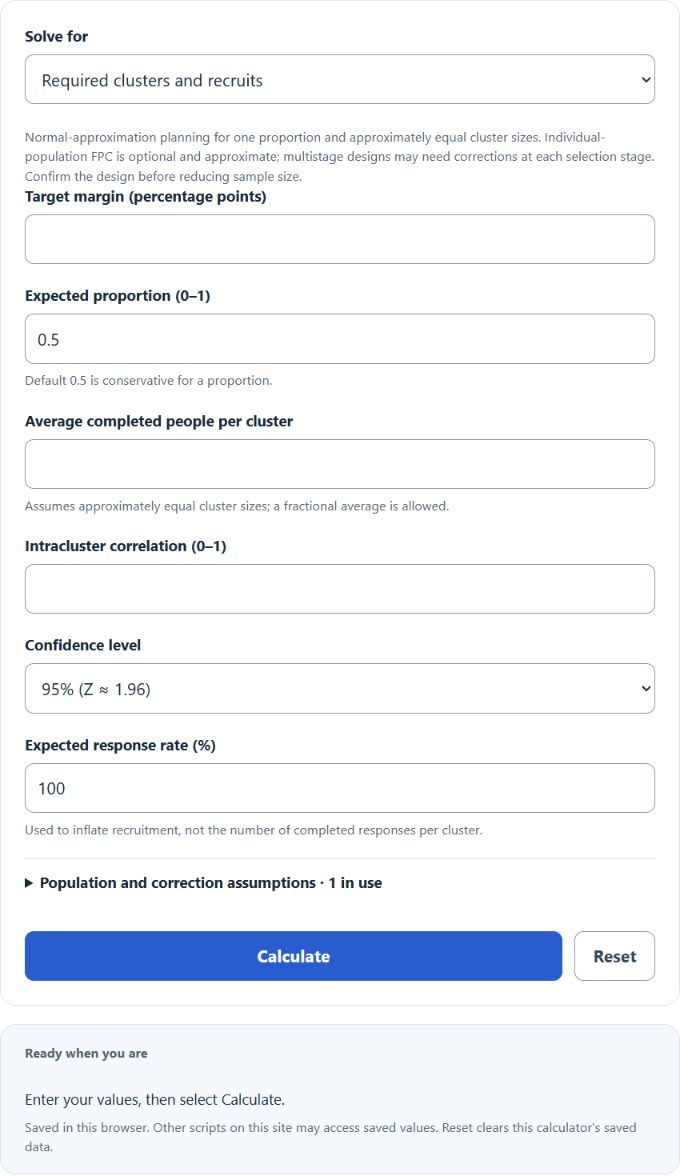
Plan required clusters, expected completed sample and recruitment from confidence, margin, ICC and response—or estimate precision under a specified cluster-size model. Optional population input checks feasibility; a separately selected individual-level finite-population correction is an approximation.
Related Calculators
- Cochran's Sample Size Calculator
- Crossover Sample Size Calculator
- Regression Sample Size Calculator
- Cohort Study Sample Size Calculator
- Slovin's Formula Calculator
- T-Statistic Calculator
- All Statistics Calculators
Cluster Sample Size Formula
The unadjusted (simple random sampling) sample size for estimating a single population proportion uses the standard proportion formula. For cluster sampling, you typically inflate that unadjusted sample size by a design effect and then convert the total sample size to a number of clusters.
For one proportion, n₀ = Z²p(1 − p)/E². For approximately equal cluster sizes, DEFF = 1 + (m − 1)ICC and n* = n₀ × DEFF. Whole clusters = ceiling(required completes / m). Keep intermediate values unrounded. The normal-approximation margin is Z × √[p(1 − p)DEFF/n], with n the expected completed sample.
Variables:
- n0 is the unadjusted sample size (simple random sample) for estimating a proportion
- n is the adjusted total sample size after accounting for clustering
- Z is the z-score for the chosen confidence level
- p is the expected population proportion (0 to 1); if unknown, p = 0.5 is a common conservative choice
- E is the desired margin of error (half-width) in proportion units (e.g., 0.05)
- m is the average cluster size (average number of subjects per cluster)
- ICC is the intra-cluster correlation coefficient (typically between 0 and 1)
- DEFF is the design effect (the inflation factor due to clustering)
- Clusters is the number of clusters required (rounded up to a whole cluster)
Calculate the unrounded simple-random-sample requirement, multiply by the design effect, then round up only at the whole-cluster step. Recruitment = ceiling(expected completed sample / response fraction). The default uses no finite-population correction. If explicitly selected, the individual-FPC planning approximation uses nFPC = n* / [1 + (n* − 1)/N] after cluster inflation; its reported margin includes √[(N − n)/(N − 1)]. This individual-population model is not a general correction for multistage cluster sampling, which may require sampling fractions at each stage. A supplied population also checks that expected completions and recruitment are feasible.
What is a Cluster Sample Size?
A cluster sample size is the total number of individual observations needed when sampling units in groups (clusters), such as schools, households, clinics, or villages. Because observations within the same cluster are often correlated, cluster sampling generally requires a larger total sample size than simple random sampling to achieve the same margin of error. A common way to account for this is to inflate an unadjusted (simple random sample) size by a design effect based on the average cluster size and the intra-cluster correlation coefficient (ICC).
How to Calculate Cluster Sample Size?
The following steps outline how to calculate the Cluster Sample Size.
- Determine the z-score (Z) based on the desired confidence level.
- Choose the expected population proportion (p). If you do not have a prior estimate, p = 0.5 is commonly used as a conservative assumption.
- Choose the desired margin of error (E) in proportion units (e.g., 0.05 for ±5 percentage points).
- Calculate n0 = (Z2 · p · (1 − p)) / E2 and keep the unrounded result.
- If using cluster sampling, select an average cluster size (m) and an ICC, then compute the design effect: DEFF = 1 + (m − 1) · ICC.
- Compute required completes = n0 × DEFF, apply the separately selected FPC approximation if appropriate, then compute whole clusters = ceiling(required completes / m).
- After inserting the values and calculating the result, check your answer with the calculator above.
Example Problem :
Use the following variables as an example problem to test your knowledge.
Z-Score (Z) = 1.96 (95% confidence)
Population Proportion (p) = 0.5
Margin of Error (E) = 0.05
Unadjusted sample size: n0 = (1.962 · 0.5 · (1 − 0.5)) / 0.052 = 384.16. Keep this unrounded until the cluster ceiling.
For average completed cluster size m = 10 and ICC = 0.02, DEFF = 1.18. With no FPC, required completes = 384.16 × 1.18 = 453.3088, so ceiling(453.3088 / 10) = 46 clusters and 460 expected completions. At 100% response, recruit 460 people. This is approximate single-proportion planning, not trial power or a guaranteed achieved precision; unequal sizes, weighting, rare proportions and few clusters need design-specific analysis.