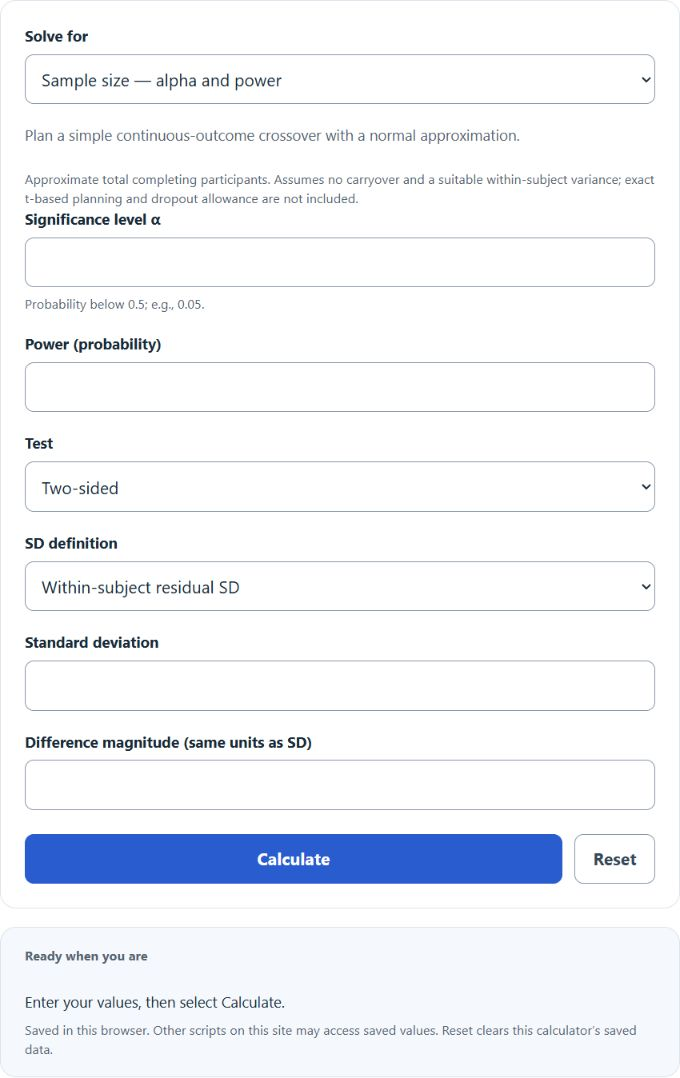
Calculate crossover study sample size or detectable difference from alpha, power, standard deviation, and difference in means for one- or two-sided tests.
- All Statistics Calculators
- Cochran’s Sample Size Calculator
- Cohort Study Sample Size Calculator
- Cluster Sample Size Calculator
- Regression Sample Size Calculator
- Slovin’s Formula Calculator
- T-Statistic Calculator
Crossover Sample Size Formula
The following normal approximation estimates the total completing participants for a simple continuous-outcome crossover superiority comparison. It assumes an appropriate within-subject residual standard deviation and negligible carryover. Select alpha/power or Z-input solve modes above.
Variables:
- n is the total completing participants; round up to an even total for equal allocation to two sequences
- Z_{alpha/2} = Φ⁻¹(1 − α/2) for a two-sided test; use Φ⁻¹(1 − α) for a one-sided test
- Z_{beta} = Φ⁻¹(power)
- sigma is the within-subject residual standard deviation; if the SD of treatment differences is supplied, replace factor 2 by 1
- Delta is the difference in means
To calculate the sample size, sum the critical values for the desired confidence level and power, square the result, multiply by 2 and the square of the standard deviation, and divide by the square of the difference in means.
What is a Crossover Study?
A crossover study is a type of clinical trial in which participants receive a sequence of different treatments. Each participant acts as their own control, receiving both the experimental treatment and the control or placebo treatment at different times. This design allows for more efficient use of participants and can provide more reliable comparisons between treatments. Crossover studies are commonly used in medical research to evaluate the efficacy of new treatments or interventions.
How to Calculate Sample Size for a Crossover Study?
The following steps outline how to calculate the sample size for a crossover study.
- First, determine the critical value for the desired confidence level (Z_{alpha/2}).
- Next, determine the critical value for the desired power (Z_{beta}).
- Next, determine the standard deviation (sigma).
- Next, determine the difference in means (Delta).
- Finally, calculate the sample size using the formula n = frac{(Z_{alpha/2} + Z_{beta})^2 cdot 2 cdot sigma^2}{Delta^2}.
- The normal estimate excludes exact small-sample t corrections and dropout allowance. For the example below, n = 62.72, rounded up to 64 participants (32 per sequence). Review period, carryover and variance assumptions before protocol use.
Example Problem :
Use the following variables as an example problem to test your knowledge.
Critical value for the desired confidence level (Z_{alpha/2}) = 1.96
Critical value for the desired power (Z_{beta}) = 0.84
Standard deviation (sigma) = 10
Difference in means (Delta) = 5