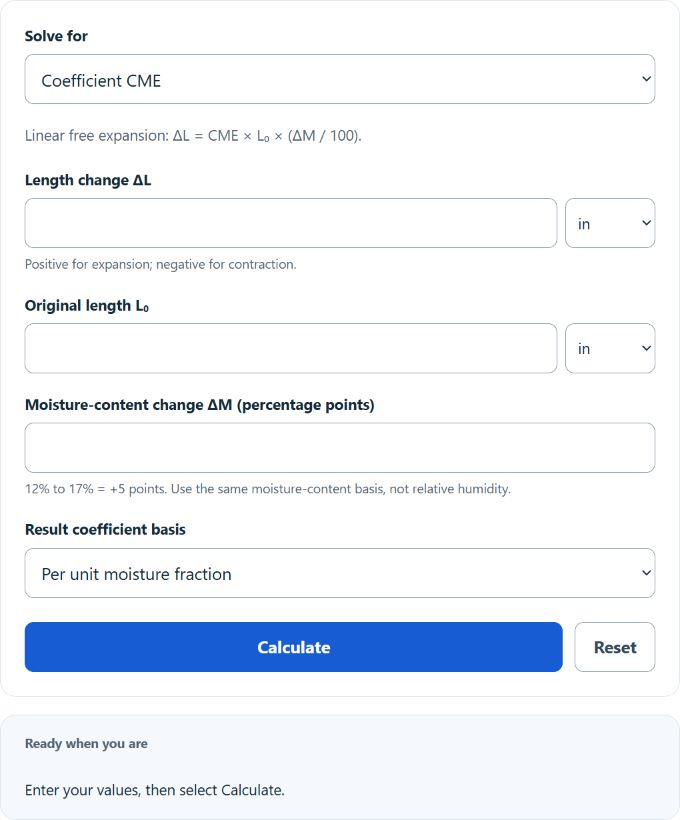
Choose coefficient of moisture expansion, signed length change, positive original length, or moisture-content change, then enter the other three values using the stated moisture basis.
Related Calculators
- Drying Rate Calculator
- Water to Cement Ratio Calculator
- Cladding Area Calculator
- Deck Strength Calculator
- All Construction Calculators
Coefficient Of Moisture Expansion Formula
The linear free-strain model relates signed length change to positive original length and moisture-content change on a consistent basis. A measured coefficient applies to a particular material, direction and range; the model does not include constraints, temperature, diffusion or strength effects. With CME expressed per unit moisture fraction:
Rearranged formulas used to solve for the missing value:
- CME = strain per unit moisture-content fraction; a per-percentage-point coefficient is 1/100 of this value
- ΔL = signed length change, positive for expansion and negative for contraction
- L0 = original length
- ΔM = change in moisture content as a decimal
Enter moisture-content change in percentage points: 12% to 17% is +5 points, which becomes +0.05 in the formula. This is not a 5% relative increase or a change in ambient relative humidity. Use a consistent moisture-content definition, such as water mass divided by dry material mass.
Length inputs use exact meter conversion factors, and the calculated length uses the selected result unit. The coefficient input and output menus distinguish strain per unit moisture fraction from strain per percentage point.
Select the desired result explicitly. Zero factors are valid for forward length change, while zero inverse denominators may be nonunique or incompatible. Original and implied final lengths must be positive.
Length Unit Conversions Used
These exact relationships are used for compatible length quantities; calculations use meters internally.
| Unit | Conversion to inches |
|---|---|
| in | 1 in = 1 in |
| ft | 1 ft = 12 in |
| cm | 1 cm = 1/2.54 in (exact) |
| m | 1 m = 100/2.54 in (exact) |
Moisture Change Percent to Decimal
Percentage-point changes are divided by 100 for the fractional moisture change used in the formula.
| Moisture change entered | Decimal used in formula |
|---|---|
| 1 percentage point | 0.01 |
| 5 percentage points | 0.05 |
| 10 percentage points | 0.10 |
| 15 percentage points | 0.15 |
Example Problems
Example 1: Calculate coefficient of moisture expansion
Suppose a material has an original length of 40 in, a change in length of 0.08 in, and a moisture-content increase of 5 percentage points.
The coefficient is 0.04 per unit moisture fraction, equivalent to 0.0004 strain per percentage point.
Example 2: Calculate change in length
Suppose CME is 0.03 per unit moisture fraction, the original length is 2 ft, and moisture content increases by 8 percentage points.
First convert 2 ft to inches:
Then calculate the change in length:
The change in length is 0.0576 in.
FAQ
What does the coefficient of moisture expansion mean?
The coefficient of moisture expansion describes how much a material expands or contracts for a given change in moisture content. A larger value means the material changes length more for the same moisture change.
Why does the calculator convert moisture percent to a decimal?
The formula above uses fractional moisture change and a coefficient per fraction. An increase of 5 percentage points is 0.05 in that convention. Using 5 without converting the coefficient basis creates a factor-of-100 error.
Do the length units have to match?
Length quantities must be compatible, but their input units can differ. The calculator uses exact conversions internally and an explicit result-unit selector. Moisture and coefficient bases must also agree.