Calculate the water to cement ratio from water and cement weight, or solve for the water or cement needed at a target w/c, plus a 28-day strength estimate.
- Mass to Volume Calculator
- Concrete Density Calculator
- Concrete Yield Calculator
- Weight to Volume Calculator
- Grout Volume Calculator
- All Construction Calculators
Water to Cement Ratio Formula
The water-to-cement ratio compares the weight of water in a concrete mix to the weight of cement. It is one of the most important mix variables because it affects workability, strength potential, permeability, shrinkage, and durability. A lower ratio generally produces a denser, stronger concrete when placement and curing are done correctly, while a higher ratio usually improves flow and finishing but can reduce long-term performance.
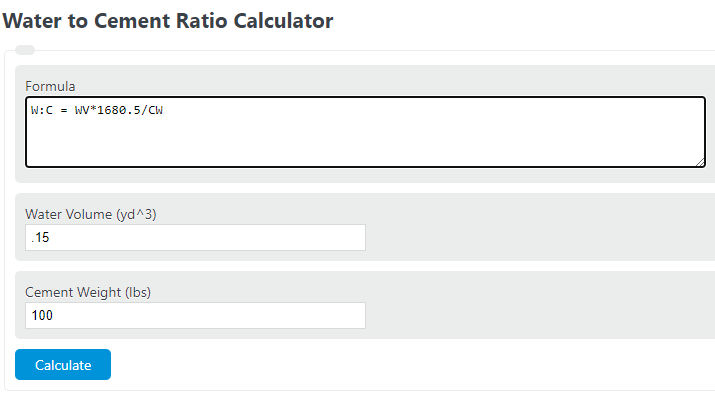
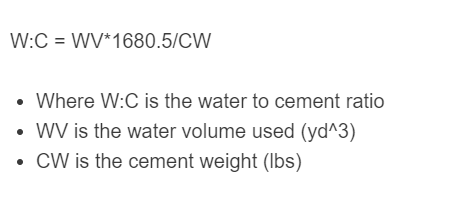
In this calculator, when water is entered as volume in cubic yards, that volume is converted to water weight before the ratio is calculated.
- w/c = water-to-cement ratio
- W = weight of water
- C = weight of cement
- WV = water volume in yd³
- CW = cement weight in lb
How to interpret the ratio
The ratio is dimensionless, which means it has no unit once water and cement are both expressed by weight. The practical meaning is simple: it tells you how much water is being used relative to the cement content. That single relationship has a major influence on how the concrete behaves both fresh and hardened.
| Ratio Range | General Effect on the Mix |
|---|---|
| Below 0.40 | Often lower permeability and higher strength potential, but reduced workability unless admixtures are used. |
| 0.40 to 0.50 | Common target range for many durable structural mixes when proper consolidation and curing are provided. |
| 0.50 to 0.60 | Easier placement and finishing, but typically more porous and weaker than lower-ratio mixes. |
| Above 0.60 | Frequently too wet for many structural applications unless the mix is intentionally designed for a special purpose. |
How to use the calculator
- Enter the amount of water used in the batch.
- Enter the cement weight used in the same batch.
- Select the correct unit for each value.
- Calculate the ratio to see how much water is being used relative to cement.
If the water input is a volume, the calculator converts that water to an equivalent weight first. This matters because the water-to-cement ratio is defined by weight, not by raw volume.
Example
Assume a batch uses 0.10 cubic yards of water and 350 lb of cement.
The water-to-cement ratio is approximately 0.48. In general terms, that is a moderate ratio that can balance workability and performance when the rest of the mix design is appropriate.
Why the water-to-cement ratio matters in concrete
Changing the amount of water in a mix does much more than change slump. Extra water can make concrete easier to place, pump, and finish, but it also tends to leave behind more pore space as the concrete hardens. That can reduce compressive strength, increase moisture movement, and make the concrete more vulnerable to freeze-thaw damage, abrasion, and chemical attack. On the other hand, using too little water can make the mix difficult to consolidate, which may trap air and create honeycombing. The target ratio should therefore be low enough for performance but workable enough for proper placement.
Practical tips
- Do not judge the mix by appearance alone. Even a small amount of added water can noticeably change the ratio.
- Account for aggregate moisture. Wet sand and stone contribute water to the batch and can increase the effective ratio.
- Use admixtures when needed. Water reducers and plasticizers can improve flow without requiring as much added water.
- Remember curing still matters. A good ratio does not guarantee good concrete if curing is poor.
- Check project specifications. Many structural and durability requirements set a maximum allowable ratio.
Water-to-Cement Ratio vs. Water-to-Cementitious Ratio
Some mix designs use cement alone in the denominator, while others use total cementitious material, which may include fly ash, slag, silica fume, or similar supplementary materials.
If your specification refers to water-to-cementitious ratio instead of water-to-cement ratio, the denominator includes all cementitious binders rather than only portland cement. That distinction is important when comparing mix submittals, jobsite adjustments, or test requirements.
FAQ
What is a good water-to-cement ratio?
For many general concrete applications, ratios around 0.40 to 0.60 are common. The right value depends on the required strength, exposure conditions, placement method, aggregate properties, and any admixtures used.
Why is the ratio based on weight instead of volume?
Weight gives a more accurate and consistent measure of the actual amount of water and cement in a batch. Volume alone can be misleading because the ratio is intended to compare mass to mass.
Does adding more water always make concrete better?
No. More water usually increases workability, but it often reduces strength and durability if everything else stays the same.
Can a low ratio still produce poor concrete?
Yes. If the mix is not consolidated, finished, or cured properly, concrete can still crack, scale, or lose strength even with a relatively low water-to-cement ratio.