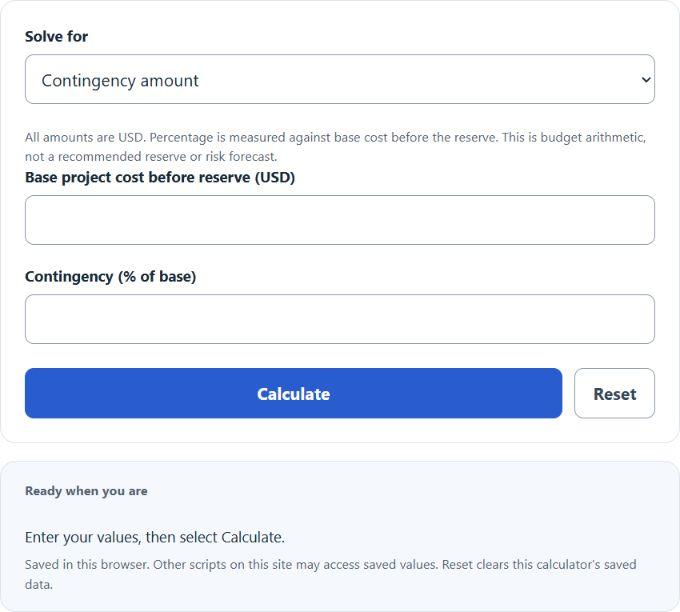
Calculate contingency amount, contingency percentage, or base project cost with total budget, reserve share, USD amounts, and illustrative sensitivity scenarios.
Related Calculators
- Total Cost Calculator
- Cost Ratio Calculator
- Suggested Retail Price (SRP) Calculator
- Reverse Fee Calculator
- All Business Calculators
Contingency Percentage Formula
The following formula is used to calculate the contingency percentage for a given project cost and contingency amount.
CP = (CA ÷ TPC) × 100, where TPC excludes the reserve.
Variables:
- CA is the contingency amount
- TPC is the base project cost before contingency
- CP is the contingency percentage
To calculate the contingency percentage, divide the contingency amount by the base project cost before contingency and multiply the result by 100 to get the percentage.
What is a Contingency Percentage?
A contingency percentage is a financial buffer added to a project's budget to cover unexpected costs or risks that may arise during the project's execution. This percentage is calculated based on the base project cost before contingency and may help cover unforeseen expenses. A reserve does not guarantee project completion. The contingency percentage is an essential part of project management and budgeting, helping plan for financial risks without guaranteeing project success.
How to Calculate Contingency Percentage?
The following steps outline how to calculate the Contingency Percentage.
- First, determine the contingency amount (CA).
- Next, determine the base project cost before contingency (TPC).
- Finally, calculate the contingency percentage using the formula C% = (CA / TPC) * 100.
- After inserting the values and calculating the result, check your answer with the calculator above.
Example Problem :
Use the following variables as an example problem to test your knowledge.
Contingency Amount (CA) = $10,000
Base Project Cost Before Contingency (TPC) = $200,000