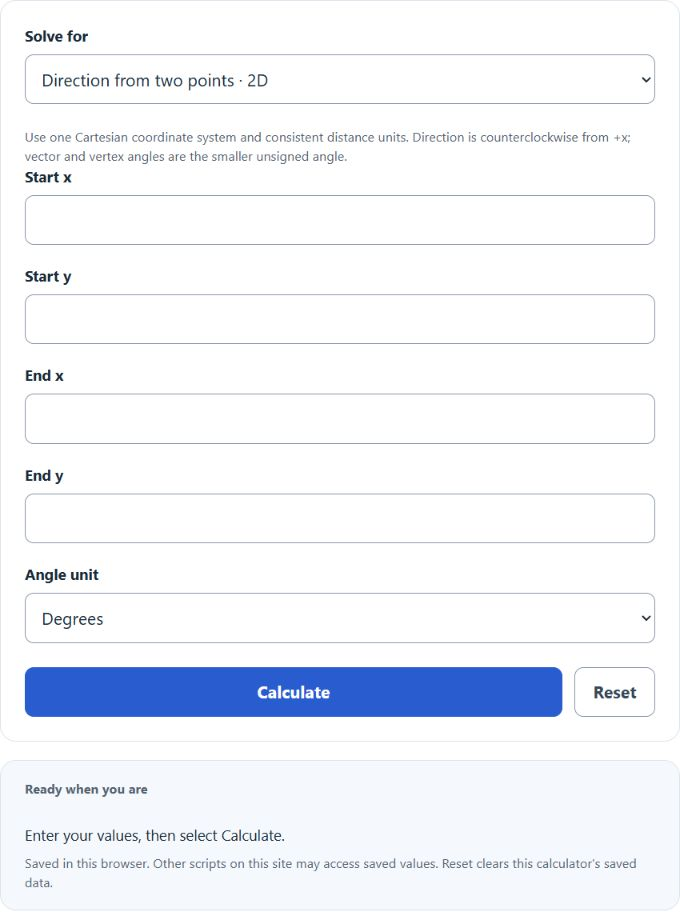
Calculate direction angles from two coordinates or find angles between 2D and 3D vectors and three points, with results in degrees or radians.
Related Calculators
- Rotation Calculator (new coordinates by rotation)
- Reflection Rule Calculator
- Euclidean Distance Calculator
- Inverse Cosine Calculator
- All Math and Numbers Calculators
Coordinate Angle Formulas
There are two primary methods for computing the angle between vectors in a coordinate system: the dot product method and the cross product method. Each has distinct advantages depending on the application.
Dot Product Method (Primary)
The dot product formula returns the angle between 0 and 180 degrees. For 2D vectors with components (x1, y1) and (x2, y2), the dot product equals x1*x2 + y1*y2. For 3D vectors, it extends to x1*x2 + y1*y2 + z1*z2. This method works in any number of dimensions and is numerically stable for angles near 90 degrees. It is the standard approach used in linear algebra, physics simulations, and most engineering software.
Cross Product Method
The cross product magnitude determines sin(theta), but arcsin alone returns only 0°–90° and cannot distinguish theta from 180°−theta. For the full 0°–180° angle, use atan2(|v1 × v2|, v1 · v2). In 2D, the cross product magnitude is |x1*y2 − y1*x2|; in 3D it is the magnitude of the cross product vector.
The atan2 Function for Directed Angles
The calculator’s Direction from two points mode uses atan2(Δy, Δx) and normalizes the result to 0°–360°. Standard arctan(Δy/Δx) cannot distinguish opposite quadrants and fails for a vertical direction.
What is a Coordinate Angle?
A coordinate angle is the angular separation between two directed line segments (vectors) measured within a coordinate system. Unlike a simple geometric angle drawn between two lines, a coordinate angle is defined algebraically through the components of each vector, making it computable from raw numerical data without any visual diagram.
Coordinate angles are foundational to how modern technology represents spatial relationships. Every GPS route calculation, every lighting effect in a video game, every joint movement in a robotic arm, and every orbital trajectory computed by a spacecraft relies on coordinate angle computations. The concept bridges pure geometry and applied computation because it translates spatial relationships into numbers that processors can evaluate in microseconds.
Direction Angles and Direction Cosines
A direction angle is the angle that a single vector makes with one of the coordinate axes. In 3D space, a vector has three direction angles: alpha (the angle with the positive x-axis), beta (the angle with the positive y-axis), and gamma (the angle with the positive z-axis). The cosines of these three angles are called direction cosines, and they satisfy a fundamental identity: cos2(alpha) + cos2(beta) + cos2(gamma) = 1. This identity holds for every nonzero vector in three-dimensional space.
Direction cosines serve as the normalized components of a unit vector. If a vector has components (a, b, c) and magnitude m, then cos(alpha) = a/m, cos(beta) = b/m, and cos(gamma) = c/m. Engineers use direction cosines to define the orientation of structural members in finite element analysis, the pointing direction of antennas in satellite communication, and the alignment of crystal lattice planes in materials science. A direction cosine matrix (DCM), built from these values, is one of the standard methods for representing 3D rotations in aerospace navigation systems alongside quaternions and Euler angles.
Special Angle Relationships Between Vectors
Certain coordinate angles carry specific geometric and physical meaning. Recognizing these relationships is critical in fields ranging from signal processing to structural engineering.
When the angle between two vectors equals 0 degrees, the vectors are parallel and point in the same direction. Their dot product equals the product of their magnitudes, and the cross product is zero. Parallel vectors arise in uniform flow fields, collinear force systems, and when checking if two line segments share the same direction.
At 90 degrees, vectors are orthogonal (perpendicular) and their dot product is zero. Orthogonality supports coordinate construction and signal decomposition. For centered data vectors it can indicate zero sample correlation, but it does not generally establish statistical independence.
At 180 degrees, vectors are antiparallel and their dot product equals the negative product of their magnitudes. This describes opposing directions. Equal and opposite momenta are one possible example; electric and magnetic fields of a plane electromagnetic wave are perpendicular, not antiparallel.
Angles between 0 and 90 degrees indicate an acute relationship where the vectors share a general directional tendency. Their dot product is positive. Angles between 90 and 180 degrees indicate an obtuse relationship where the vectors generally oppose each other, producing a negative dot product. In data science, this sign distinction is the foundation of cosine similarity, where a positive dot product between document vectors suggests topical similarity and a negative value suggests dissimilarity.
Common Vector Angle Reference Values
The following reference pairs demonstrate coordinate angles at key values. These are useful for verifying calculator results and building intuition about how vector components relate to the angle between them.
| Vector 1 (x, y) | Vector 2 (x, y) | Dot Product | Angle (degrees) | Relationship |
|---|---|---|---|---|
| (1, 0) | (1, 0) | 1 | 0 | Identical direction |
| (1, 0) | (1, 1) | 1 | 45 | Acute |
| (1, 0) | (0, 1) | 0 | 90 | Orthogonal |
| (1, 0) | (-1, 1) | -1 | 135 | Obtuse |
| (1, 0) | (-1, 0) | -1 | 180 | Antiparallel |
| (3, 4) | (4, 3) | 24 | 16.26 | Nearly aligned |
| (1, 1) | (-1, 1) | 0 | 90 | Orthogonal |
| (2, 5) | (-5, 2) | 0 | 90 | Orthogonal (rotated 90 degrees) |
| (1, 0, 0) | (0, 1, 0) | 0 | 90 | Orthogonal (3D axes) |
| (1, 1, 1) | (1, 1, 1) | 3 | 0 | Identical direction (3D) |
| (1, 1, 1) | (-1, -1, -1) | -3 | 180 | Antiparallel (3D) |
| (1, 0, 0) | (1, 1, 0) | 1 | 45 | Acute (3D) |
A useful pattern visible in this table: swapping the components of a 2D vector and negating one of them (for example, rotating (a, b) to (-b, a)) always produces a vector at exactly 90 degrees to the original. This property is the basis of the perpendicular vector operation used extensively in computational geometry.
Numerical Precision Considerations
Floating-point arithmetic introduces rounding errors that matter when computing coordinate angles. The arccos function amplifies small errors near 0 and 180 degrees because its derivative approaches infinity at those endpoints. A dot product that should equal exactly 1.0 might compute as 1.0000000000000002 due to rounding, and arccos of any value outside [-1, 1] returns NaN (not a number), crashing the calculation entirely.
The calculator above scales and normalizes vectors, then uses atan2 of the cross product magnitude and dot product. The normalized dot product is bounded to the floating-point range [−1, 1].
Applications Across Fields
Computer Graphics and Game Engines
Rendering engines compute coordinate angles millions of times per frame. The angle between a surface normal vector and the light direction vector determines diffuse lighting intensity through Lambert's cosine law: intensity equals the cosine of that angle, so a surface facing the light directly (0 degrees) receives full illumination while a surface at 90 degrees receives none. Specular highlights depend on the angle between the reflection vector and the camera view vector. Backface culling, which skips rendering triangles facing away from the camera, checks whether the angle between the surface normal and the view direction exceeds 90 degrees. Modern GPUs execute these dot product operations in dedicated hardware because they occur in every single pixel shader invocation.
Robotics and Kinematics
Robot arm positioning (inverse kinematics) requires computing the angles between successive link vectors to determine joint configurations. A six-axis industrial robot computes coordinate angles across each joint to reach a target position and orientation. Collision avoidance systems calculate the angle between a robot's current velocity vector and the direction to nearby obstacles, triggering deceleration when this angle falls below a safety threshold. In drone navigation, the angle between the forward-facing vector and the wind velocity vector determines the crab angle correction needed to maintain a straight flight path.
Navigation and Geodesy
GPS receivers compute the angle between satellite position vectors and the receiver's position vector to determine which satellites have the best geometric configuration for accurate positioning. Satellite geometry, including angular separation, influences geometric dilution of precision (GDOP); GDOP is not itself an angle. In maritime and aviation navigation, the bearing angle between a vessel's heading vector and the vector to a waypoint determines the course correction required. Great-circle navigation on the Earth's surface uses the spherical law of cosines, which is the spherical analogue of the coordinate angle formula, to compute the shortest path between two points on a globe.
Physics and Engineering
The work done by a force equals the dot product of the force vector and the displacement vector, which is the product of their magnitudes times the cosine of the angle between them. At 0 degrees, all force contributes to displacement. At 90 degrees, zero work is done (a centripetal force holding an object in circular motion does no work). Torque computation requires the cross product, which depends on the sine of the angle between the force and the lever arm. Electromagnetic field analysis uses coordinate angles to resolve electric and magnetic field components along different axes, which is essential for antenna gain pattern calculations and waveguide mode analysis.
Data Science and Machine Learning
Cosine similarity, which is the cosine of the coordinate angle between two high-dimensional vectors, is one of the most widely used similarity metrics in information retrieval and natural language processing. Search engines represent documents as term-frequency vectors and rank results by the cosine of the angle between the query vector and each document vector. Word embedding models like Word2Vec encode semantic meaning into vector components such that the angle between word vectors reflects semantic similarity. Recommendation systems use the same principle: a small coordinate angle between a user preference vector and an item feature vector suggests a strong match.
Coordinate Angles in Higher Dimensions
The dot product formula generalizes directly to any number of dimensions. Minkowski spacetime uses an indefinite metric and different definitions of angle or rapidity; the ordinary Euclidean angle here does not apply. In the high-dimensional spaces common in machine learning (where word embeddings might have 300 dimensions and neural network layers can have thousands), the coordinate angle between vectors retains its geometric interpretation even though the space cannot be visualized. A surprising property of high-dimensional geometry is that random vectors in spaces with hundreds of dimensions are almost always nearly orthogonal to each other, with the angle clustering tightly around 90 degrees. This phenomenon, sometimes called the curse of dimensionality, affects clustering algorithms and nearest-neighbor searches because it reduces the contrast between near and far in terms of angular separation.