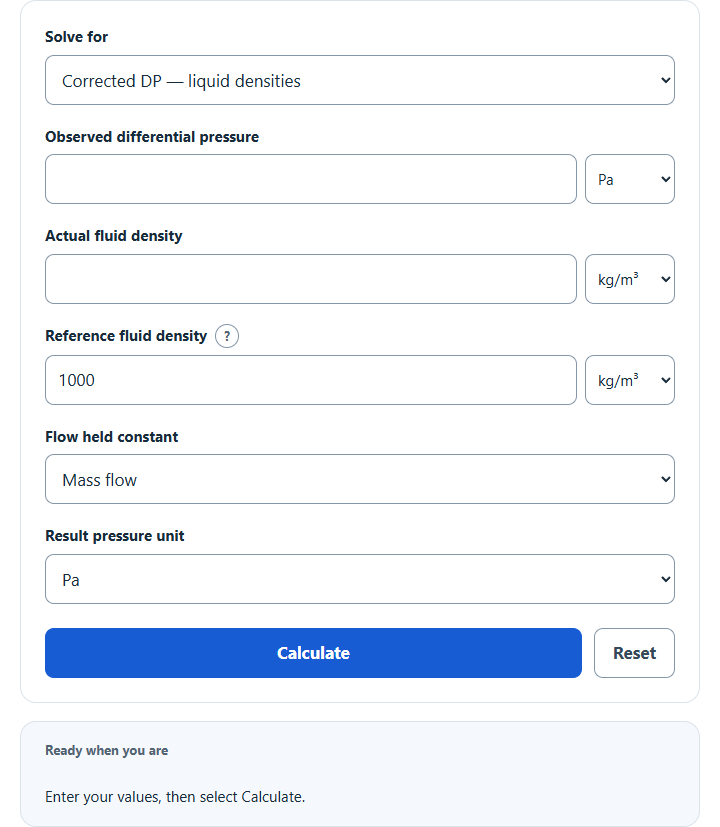
Calculate corrected differential pressure (DP) at reference conditions from observed DP and fluid densities, or from gas pressure and temperature.
Related Calculators
- Flow Rate Pressure Calculator
- Compressor Discharge Pressure Calculator
- Adiabatic Compression Temperature Calculator
- Joule–Thomson Coefficient Calculator
- All Physics Calculators
Corrected Differential Pressure Formula
The displayed gas formula maps observed DP at flowing conditions to reference-condition DP at the same actual volumetric flow, assuming the same ideal gas, fixed geometry and unchanged coefficients. It is the default gas convention; a constant-mass-flow comparison uses the reciprocal multiplier.
Variables:
- DPc is the corrected differential pressure
- DPo is the observed differential pressure
- Tf is the flowing absolute temperature in kelvin
- Tb is the reference absolute temperature in kelvin
- Pb is the reference absolute pressure
- Pf is the flowing absolute pressure
Use absolute pressures and temperatures in kelvin in this equation. For the density method at constant mass flow, ΔPreference = ΔPobserved × ρactual/ρreference. At constant actual volumetric flow, the density multiplier is ρreference/ρactual. The density mode defaults to constant mass flow to retain its original convention. Inverse modes divide by the selected multiplier.
What is Corrected Differential Pressure?
Here, corrected DP means a modelled equivalent pressure difference at specified reference conditions, not a universal accuracy correction. For a fixed flow element, ΔP is proportional to density times actual volumetric flow squared, or to mass flow squared divided by density. The ratio therefore depends on what flow is held constant and which state is the source. Ideal-gas inputs assume constant composition and compressibility factor Z = 1. Real instruments may also require expansion factors, discharge coefficients, Reynolds-number effects and manufacturer calibration; this tool does not calculate a certified flow rate.
How to Calculate Corrected Differential Pressure?
The following steps outline how to calculate the Corrected Differential Pressure.
- First, determine the observed differential pressure (DPo).
- Next, determine the flowing temperature (Tf).
- Next, determine the base temperature (Tb).
- Next, determine the reference absolute pressure (Pb).
- Next, determine the flowing absolute pressure (Pf).
- Finally, calculate the Corrected Differential Pressure using the formula DPc = DPo * (Tf / Tb) * (Pb / Pf).
- After inserting the values and calculating the result, check your answer with the calculator above.
Example Problem :
Use the following variables as an example problem to test your knowledge.
Observed Differential Pressure (DPo) = 50 Pa
Flowing Temperature (Tf) = 300 K
Base Temperature (Tb) = 273 K
Base Pressure (Pb) = 101325 Pa
Flowing absolute pressure (Pf) = 100000 Pa. For the default constant-actual-volumetric-flow gas comparison: DPc = 50 × (300/273) × (101325/100000) ≈ 55.6731 Pa. A constant-mass-flow comparison uses the reciprocal multiplier and gives approximately 44.9050 Pa.