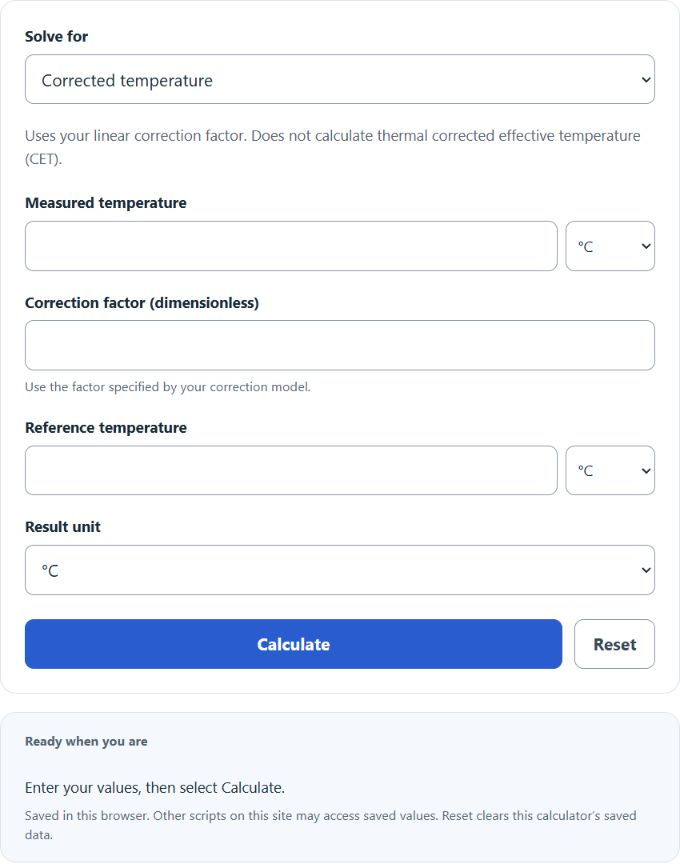
This page retains its user-supplied linear correction model in °C, °F, or K. It does not calculate thermal corrected effective temperature (CET), which requires globe/wet-bulb temperature and air-velocity inputs.
Related Calculators
- Annual Temperature Range Calculator
- Parcel Temperature Calculator
- Temperature Difference Calculator
- Equilibrium Temperature Calculator
- Final Temperature Calculator
- All Everyday Life and Education Calculators
Corrected Temperature (Linear Correction) Formula
The calculator uses a linear temperature correction model. Internally, all temperature inputs are converted to Celsius before the formula is applied, then the result is converted back to the unit you selected.
- Tc = corrected temperature
- Tm = measured temperature
- Cf = correction factor, dimensionless
- Tr = reference temperature
If you choose Corrected temperature, the calculator uses the main formula above.
If you choose Measured temperature, the calculator rearranges the formula to solve for the measured temperature. This requires 1 + Cf to not equal zero.
If you choose Correction factor, the calculator solves for the dimensionless correction factor. This requires the measured temperature and reference temperature to be different.
If you choose Reference temperature, the calculator solves for the reference temperature. This requires the correction factor to not equal zero.
Temperature unit conversions used by the calculator are:
Temperature Units and Correction Factor Behavior
Use these tables to check units and understand how the correction factor changes the measured temperature.
| Unit | Symbol | Conversion to Celsius |
|---|---|---|
| Celsius | °C | No conversion needed |
| Fahrenheit | °F | (°F - 32) × 5/9 |
| Kelvin | K | K - 273.15 |
| Correction Factor | Effect in the Formula | Meaning |
|---|---|---|
| 0 | Tc = Tm | No correction is applied. |
| Positive | Adds a correction based on Tm - Tr | For distinct measured and reference temperatures, the corrected temperature moves farther from the reference. |
| Negative | Subtracts part of Tm - Tr | Distance from the reference is multiplied by |1 + Cf|. It decreases for −2 < Cf < 0, is unchanged at −2, and increases below −2. Factors below −1 cross the reference. |
Example Calculations
Example 1: Calculate corrected temperature
Suppose the measured temperature is 80 °C, the reference temperature is 20 °C, and the correction factor is 0.05.
The corrected temperature is 83 °C.
Example 2: Calculate correction factor
Suppose the corrected temperature is 55 °C, the measured temperature is 50 °C, and the reference temperature is 25 °C.
The correction factor is 0.2.
FAQ
What does a linear temperature correction mean?
A linear temperature correction means the adjustment is proportional to the difference between the measured temperature and the reference temperature. If that difference doubles, the correction amount also doubles, assuming the correction factor stays the same.
Why does the calculator convert temperatures to Celsius first?
The linear correction must be applied on a consistent temperature scale. The calculator converts Celsius, Fahrenheit, and Kelvin inputs to Celsius, performs the calculation, then converts the result back to the unit selected for the missing value.
Can the correction factor be negative?
Yes. A negative correction factor is valid if it matches the correction model you are using. It reverses the correction term; the final temperature may cross the reference, and a factor below −2 increases its distance from the reference. Temperatures and calculated temperature results must not fall below absolute zero.