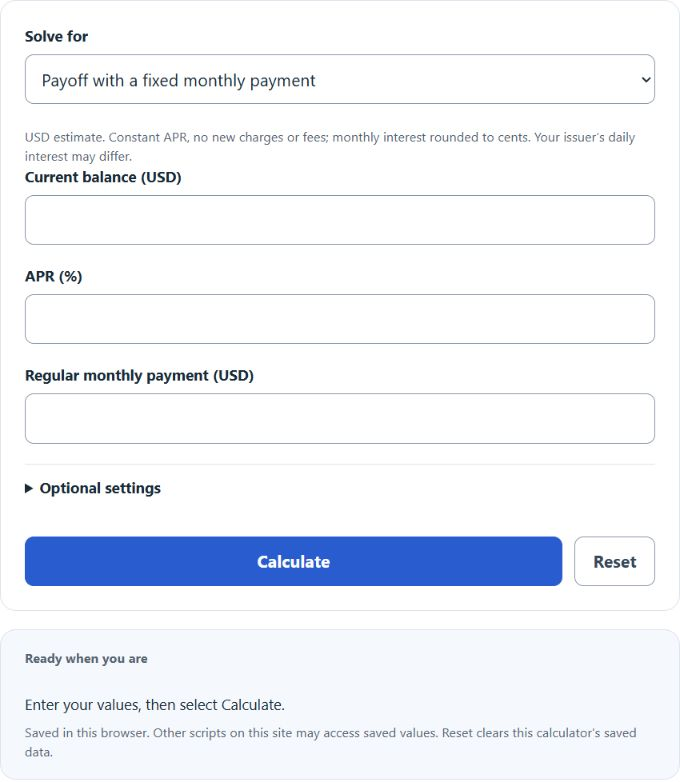
Use this Credit Card Payoff Time Calculator to estimate months to payoff, the payoff date, total interest, and savings from monthly or one-time extra payments.
Credit Card Payoff Time Formula
A fixed-payment payoff is calculated by adding one month’s interest to the balance, subtracting the scheduled payment, and repeating until the balance reaches zero.
I_m = round_cents(B_m * APR / 1200)
 B_(m+1) = max(0, B_m + I_m - P - E - L_m)
Variables:
- Im is interest charged in month m
- Bm is the balance at the start of month m
- APR is the annual percentage rate entered as a percentage, such as 24 for 24%
- P is the regular fixed monthly payment
- E is the recurring extra monthly payment
- Lm is a one-time extra payment applied in the selected month
When there is no one-time payment and the rate and payment remain fixed, payoff months can also be estimated with the amortization relationship below. It assumes unrounded interest and requires a positive monthly rate with payment larger than the first month’s interest. At zero APR, the unrounded number of payments is balance divided by payment.
n = -ln(1 - r * B / P) / ln(1 + r)
Here r is the monthly rate, B is the starting balance, P is the monthly payment, and n is the number of payments. The calculator uses month-by-month simulation instead of relying only on the closed form because simulation can include recurring and one-time extra payments and can cap the final payment at the remaining balance.
Fixed Payment Payoff Reference
These estimates use a $5,000 balance at 24% APR, no new charges, and one payment per month.
| Monthly payment | Estimated payoff time | Estimated total interest |
|---|---|---|
| $150 | 56 months | $3,322.17 |
| $200 | 36 months | $2,000.57 |
| $250 | 26 months | $1,449.37 |
| $300 | 21 months | $1,143.33 |
Example Problems
Example 1: Find payoff time from a fixed payment.
You owe $5,000 at 24% APR and pay $250 each month. The first month’s interest is 5000 * 0.24 / 12 = $100, so $150 of the first payment reduces principal. Repeating the calculation pays the balance off in about 26 months with roughly $1,449 in total interest.
Example 2: Compare an extra-payment plan.
Using the same $5,000 balance, increasing the payment from $200 to $250 reduces the estimate from 36 months to 26 months. The higher payment saves about 10 months and roughly $551 in interest.
Frequently Asked Questions
What if my payment is less than the monthly interest?
Without a later extra payment, a payment that does not reduce principal cannot pay off a positive balance. A later one-time payment may rescue a plan that initially grows; the calculator simulates up to 1,200 months and reports savings only when the regular comparison plan also pays off.
Does the payoff date exactly match my issuer’s date?
It is an estimate. When a start date is supplied, the first payment is one month later; payment dates keep its day of month, clamped to the last day of a shorter month. A blank start date omits the date estimate. Interest is rounded half up to cents each month. Daily interest, statement dates, payment posting, variable APRs, fees, and new transactions can move the actual date. Use the card’s payoff quote for a final payment.
Should I use the statement minimum or a fixed payment?
A fixed payment is usually easier to plan and does not automatically shrink as the balance falls. Paying at least the current fixed amount—and more when possible—generally pays the balance faster than following a declining minimum.