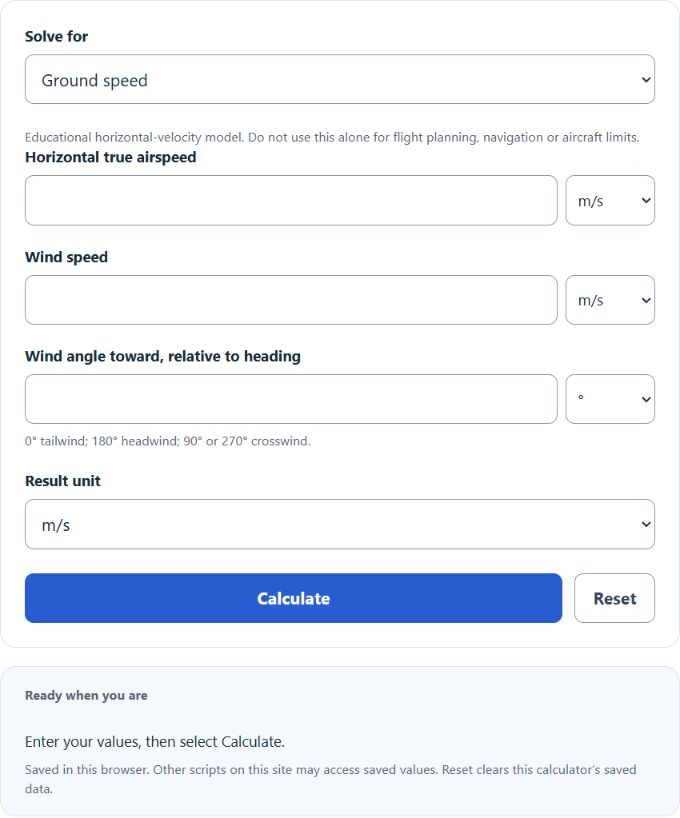
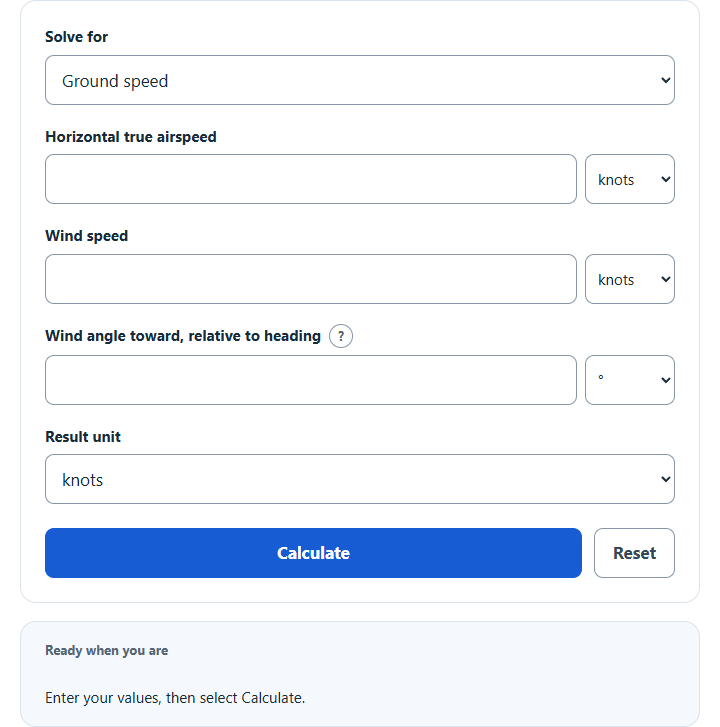
Calculate ground speed from true airspeed, wind speed and wind angle in knots, mph or km/h, or solve for airspeed, wind, travel time or crosswind.
Calculator Functions
| Function | What it does | What it requires |
|---|---|---|
| Ground speed | Finds speed over the ground from airspeed and wind | Requires the horizontal true airspeed, the wind speed and the wind angle |
| True airspeed | Finds the airspeed that gives a known ground speed in a known wind | Requires the ground speed, the wind speed and the wind angle |
| Wind speed | Finds the wind speed that explains the gap between airspeed and ground speed | Requires the ground speed, the true airspeed and the wind angle |
| Wind angle | Finds the angle between the heading and the wind | Requires the ground speed, the true airspeed and the wind speed |
| Travel time | Finds how long a leg takes at a ground speed | Requires the travel distance and the ground speed |
| Travel distance | Finds how far the aircraft travels in a given time | Requires the ground speed and the travel time |
| Speed from distance & time | Finds the average ground speed over a leg already flown | Requires the travel distance and the travel time |
| Headwind & crosswind | Splits a wind into its headwind or tailwind part and its crosswind part | Requires the wind speed, the direction the wind comes from and the runway or aircraft heading |
Speeds can be entered and shown in knots, mph, km/h, m/s, ft/s or ft/min, distances in nautical miles, miles, km, m or ft, and times in hours, minutes or seconds. The wind angle is the direction the wind blows toward, measured from the heading: 0° is a tailwind, 180° a headwind and 90° or 270° a direct crosswind. The headwind and crosswind function uses the reported direction the wind comes from instead.
Ground Speed Formulas
2 × TAS × W × cos θ) [1]
| GS | Ground speed |
| TAS | Horizontal true airspeed |
| W | Wind speed |
| θ | Wind angle toward, relative to heading |
Ground speed is the length of the aircraft’s velocity through the air added to the wind’s velocity, which pilots draw as the wind triangle [1]. The formula is the law of cosines applied to that triangle. With no wind, ground speed equals true airspeed. A 120 knot airspeed with a 20 knot tailwind gives 140 knots over the ground, and the same wind on the nose gives 100 knots [1].
Ground speed
The main formula applies directly. At 100 knots true airspeed with a 20 knot wind at 45°, ground speed is √(10,000 + 400 + 2,828) = 115.0 knots. The result is the speed for the heading entered, with the aircraft drifting with the wind. It is not the speed along a course held by crabbing into the wind. The along-heading part of the velocity is listed with the result.
True airspeed
√(GS² − W² × sin² θ)
This is the main formula solved for airspeed. When both the plus and the minus sign give a speed of zero or more, both are shown, and the wind direction or other information is needed to pick one.
Wind speed
√(GS² − TAS² × sin² θ)
The same rearrangement with wind speed and airspeed swapped. If no real speed fits the three inputs, the calculator says so.
Wind angle
(2 × TAS × W)
The answer is the angle between 0° and 180°. Speeds alone cannot tell whether the wind is on the left or the right, so the mirrored angle on the other side is listed too. Three speeds that cannot form a triangle, such as a ground speed larger than airspeed plus wind, have no answer.
Travel time
210 nautical miles at a ground speed of 140 knots takes 1.5 hours, or 90 minutes.
Travel distance
1 hour 45 minutes at 120 knots covers 120 × 1.75 = 210 nautical miles.
Speed from distance & time
270 nautical miles flown in 3 hours is an average ground speed of 90 knots.
Headwind & crosswind
α is the direction the wind comes from minus the runway or aircraft heading, with both measured from the same north, true or magnetic. A 20 knot wind from 300° on runway heading 270° is 30° off the nose: 17.3 knots of headwind and 10 knots of crosswind from the right. A negative headwind is reported as a tailwind.
Limits of This Estimate
- The airspeed must be true airspeed in level flight, not indicated airspeed. In a steep climb or descent, use the horizontal part of the true airspeed.
- The wind is treated as steady. Gusts and winds that change along the route are not modeled.
- Time, distance and average speed assume one constant ground speed for the whole leg.
- The wind-triangle method and the time, speed and distance relations come from the FAA handbook; the trigonometric forms are the standard vector solution of that triangle. These estimates are based on the best available data and estimations.
Sources
- Federal Aviation Administration, Pilot’s Handbook of Aeronautical Knowledge (FAA-H-8083-25), Chapter 16, Navigation: effect of wind on ground speed, the wind triangle, and time, distance and ground speed