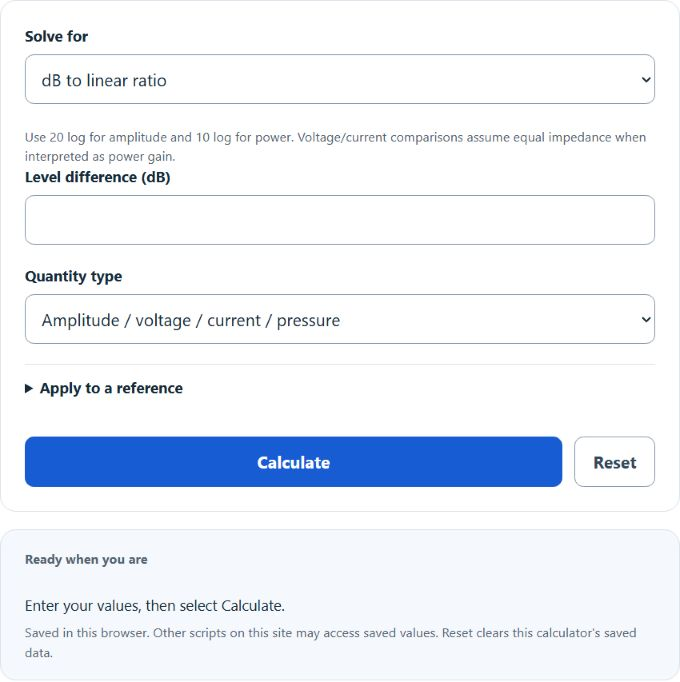
Convert dB to an amplitude, voltage, current, pressure, power, or intensity ratio, reverse the ratio to dB, and apply it to an optional reference value.
- dB ↔ Percentage Calculator
- Omega To Frequency Calculator
- Bits Per Second Calculator
- Bandwidth Per User Calculator
- All Unit Converters
dB to Amplitude Formula
The following formulas are used to convert a decibel value into a linear amplitude ratio.
Variables:
- dB is the level in decibels
- A is the resulting amplitude
- A0 is the reference amplitude
- A / A0 is the amplitude ratio
For amplitude ratio, select the amplitude quantity type, divide dB by 20 and raise 10 to that power. Power or intensity ratios use 10 instead of 20. Voltage/current ratios correspond to power gain only at equal impedance.
What is dB to Amplitude Conversion?
dB to amplitude conversion translates a logarithmic level difference into a linear ratio. For amplitude-based quantities such as voltage, current, sound pressure, and similar field quantities, decibels are defined using 20 times the base-10 logarithm of the amplitude ratio. Converting back to amplitude tells you exactly how many times larger or smaller one signal is compared to a reference.
This is useful because decibels compress very large ranges into manageable numbers. For example, a positive dB value indicates gain above the reference, while a negative dB value indicates attenuation below the reference.
How to Calculate Amplitude from dB?
The following steps outline how to convert decibels to an amplitude ratio.
- First, select dB to linear ratio and the amplitude quantity type, then enter the level difference in decibels (dB).
- Next, divide the decibel value by 20.
- Then, calculate 10 raised to the power of that result.
- The final value is the amplitude ratio A / A0.
- After inserting the values and calculating the result, check your answer with the calculator above.
Example Problem:
Use the following variables as an example problem to test your knowledge.
Level in dB = 6
Amplitude Ratio = 10(6 / 20) = 1.9953
dB to Amplitude Conversion Table
The table below lists several common decibel values and their corresponding amplitude ratios.
| Level (dB) | Amplitude Ratio (A / A0) |
|---|---|
| -20 dB | 0.10 |
| -10 dB | 0.3162 |
| -6 dB | 0.5012 |
| 0 dB | 1.00 |
| +6 dB | 1.9953 |
| +20 dB | 10.00 |
| +40 dB | 100.00 |
Common dB to Amplitude Examples
Some common reference points are worth remembering when working with amplitude ratios. A value of 0 dB means no change, so the amplitude ratio is exactly 1. A value of +6 dB corresponds to nearly doubling the amplitude, while +20 dB means the amplitude is multiplied by 10. Likewise, -6 dB is about half the amplitude of the reference.
- 0 dB → 1.00 times the reference amplitude
- +6 dB → about 2.00 times the reference amplitude
- +20 dB → 10.00 times the reference amplitude
- -6 dB → about 0.50 times the reference amplitude
Understanding this relationship makes it easier to interpret specifications in electronics, acoustics, audio engineering, and instrumentation where logarithmic units are commonly used.