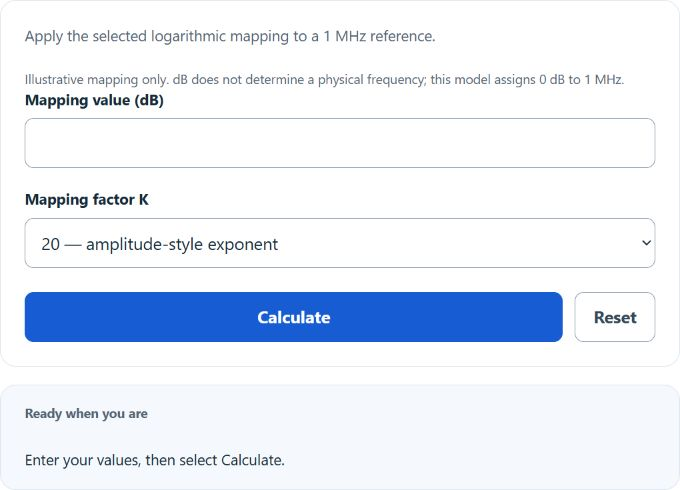
Apply an illustrative logarithmic mapping with a stipulated 1 MHz reference and a factor of 20 or 10. A dB level alone cannot determine a physical frequency.
Quick Overview: This converter uses a logarithmic mapping between decibels and frequency by stipulating that 0 dB maps to 1 MHz.
- The amplitude-style mapping uses: f = 10^(dB / 20)
- The power-style mapping uses: f = 10^(dB / 10)
- 10 dB amplitude corresponds to approximately 3.1623 MHz
- 10 dB power corresponds to 10.0000 MHz
Because dB are logarithmic ratios and MHz are linear frequency units, this is a mathematical reference conversion rather than a direct physical unit conversion.
- MHz to ppm Converter
- Events Per Second Calculator
- RMS To PMPO Calculator
- Inverter Voltage Calculator
- All Unit Converters
dB to MHz Formula
The following formulas are used to map a decibel value to a frequency in megahertz using a 1 MHz reference.
Variables:
- f is the frequency in MHz
- dB is the decibel value
- K is 20 for the stipulated amplitude-style mapping
- K is 10 for the stipulated power-style mapping
Divide the mapping value by the selected factor, raise 10 to that power, and multiply by the stipulated 1 MHz reference. These factors do not establish a physical relationship between amplitude or power and frequency.
What is dB to MHz?
dB to MHz is a reference-based logarithmic conversion that places a decibel value onto a frequency scale. Since decibels represent ratios and megahertz represent actual frequency, there is no strict physical unit conversion between them. This calculator assumes that 0 dB corresponds to 1 MHz and then uses the selected decibel relationship to determine the equivalent frequency.
How to Calculate dB to MHz?
The following steps outline how to calculate the frequency in MHz from a decibel value.
- First, determine the decibel value (dB).
- Next, select the illustrative mapping factor: 20 or 10.
- Use f = 10^(dB / 20) for amplitude values or f = 10^(dB / 10) for power values.
- After calculating the result, verify your answer with the converter above.
Example Problem:
Use the following variables as an example problem to test your knowledge.
Decibel Value (dB) = 10
Mapping Factor K = 20 (amplitude-style exponent)
Frequency (MHz) = 10^(10 / 20) = 3.1623 MHz
If the same 10 dB value is treated as a power quantity, then the result is 10^(10 / 10) = 10.0000 MHz.