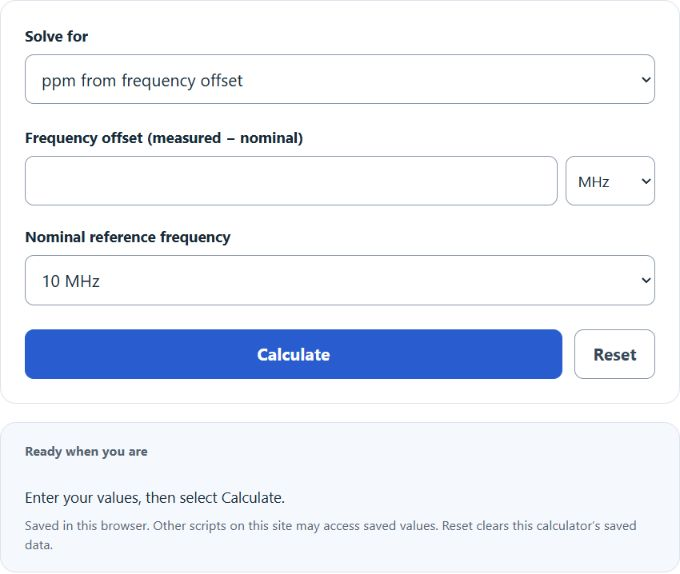
Convert a signed frequency offset to ppm error, or ppm to an offset, using a nominal reference frequency. Choose a preset from 1 to 100 MHz or enter a custom reference.
- ppb (Parts Per Billion) Calculator
- Samples To Seconds Calculator
- Symbol Rate Calculator
- Frames To ms Calculator
- All Unit Converters
MHz to PPM Formula
The following formula is used to convert a frequency offset in megahertz into an equivalent parts-per-million error.
To calculate the frequency offset from a ppm value, use the inverse form of the equation below.
Variables:
- ppm is the parts-per-million frequency error
- Δf is the frequency offset in megahertz
- fref is the reference or nominal frequency in megahertz
To calculate ppm, divide the frequency offset by the reference frequency and multiply the result by 1,000,000. Both values must be expressed in the same units, so using MHz for both keeps the ratio dimensionless.
What is MHz to PPM Conversion?
MHz to ppm conversion is used to describe how large a measured frequency deviation is relative to a nominal reference frequency. ppm stands for parts per million and is commonly used in oscillator, clock, RF, and test-equipment specifications. For a fixed offset, the ppm value becomes smaller as the reference frequency increases because the offset represents a smaller fraction of the nominal signal.
Common reference frequencies include 1 MHz and 10 MHz for lab standards and test equipment, 16 MHz, 20 MHz, and 25 MHz for microcontroller and crystal oscillator clocks, and 40 MHz and 100 MHz for higher-speed digital and RF systems.
How to Convert MHz to PPM?
The following steps outline how to convert a frequency offset in MHz into ppm.
- First, determine the frequency offset, Δf, in megahertz.
- Next, determine the nominal or reference frequency, fref, in megahertz.
- Then calculate the ppm error using the formula ppm = (Δf / fref) × 106.
- Finally, compare the absolute ppm error to the allowed tolerance. A positive offset means measured frequency is above nominal; a negative offset means it is below nominal.
Example Problem:
Use the following variables as an example problem to test your knowledge.
Frequency Offset (Δf) = 0.001 MHz
Reference Frequency (fref) = 10 MHz
ppm = (0.001 / 10) × 106 = 100 ppm
MHz to PPM Conversion Table
The table below lists the ppm error produced by a 0.001 MHz (1 kHz) offset for several standard reference frequencies.
| Reference Frequency | Offset Δf (MHz) | Error in ppm |
|---|---|---|
| 1 MHz | 0.001 | 1000 ppm |
| 10 MHz | 0.001 | 100 ppm |
| 16 MHz | 0.001 | 62.5 ppm |
| 20 MHz | 0.001 | 50 ppm |
| 25 MHz | 0.001 | 40 ppm |
| 40 MHz | 0.001 | 25 ppm |
| 100 MHz | 0.001 | 10 ppm |
In oscillator datasheets, tolerances are often quoted in ppm, while counters and analyzers may display the same deviation in hertz or megahertz. Converting between MHz and ppm makes it easier to verify whether a measured drift stays within an allowed stability budget.