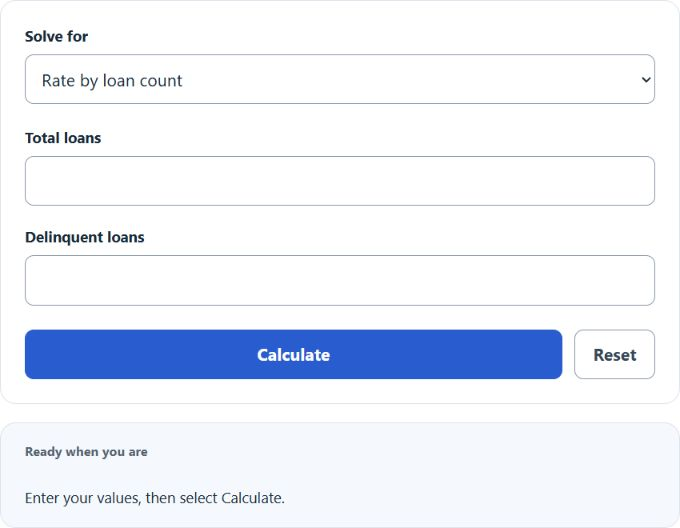
Calculate delinquency percentage, delinquent loan count, or delinquent balance using total loans, balances, rates, and days-past-due buckets.
Related Calculators
- Reserve Percentage Calculator
- Promissory Note Value Calculator
- Cash Coverage Ratio Calculator
- Bank Guarantee Cost Calculator
- All Business Calculators
Delinquency Rate Percentage Formula
Variables:
- DP is the Delinquency Rate Percentage (%)
- DL is the number of delinquent loans
- TL is the total number of loans
For a count-based rate, divide delinquent loans by total loans, then multiply by 100. For a balance-based rate, divide delinquent outstanding balance by total outstanding balance in the same currency and scale. Choose a consistent portfolio, reporting date and delinquency definition. Inverse loan counts are implied estimates and can be fractional when the entered rate is rounded.
How to Calculate Delinquency Rate Percentage?
The following steps outline how to calculate the Delinquency Rate Percentage.
- First, determine the number of delinquent loans.
- Next, determine the total number of loans.
- Next, gather the formula from above = DP = DL / TL * 100.
- Finally, calculate the Delinquency Rate Percentage.
- After inserting the variables and calculating the result, check your answer with the calculator above.
Example Problem :
Use the following variables as an example problem to test your knowledge.
number of delinquent loans = 1900
total number of loans = 250000. Delinquency rate = 1900 / 250000 × 100 = 0.76%.
Frequently Asked Questions (FAQ)
What is a delinquent loan?
A delinquent loan has an overdue payment. Statistical definitions vary: the Federal Reserve includes loans 30 or more days past due and still accruing, plus nonaccrual loans. This calculator offers count buckets at 30+, 60+ or 90+ days; nonaccrual status must be handled consistently in your inputs. Buckets must be disjoint and, when all four are supplied, must sum to the portfolio total.
Why is it important to calculate the Delinquency Rate Percentage?
Calculating the Delinquency Rate Percentage helps financial institutions and investors understand the risk level of a loan portfolio. A higher rate indicates more borrowers are failing to make timely payments, which can signal financial instability.
Can the Delinquency Rate Percentage affect a borrower’s credit score?
Yes, delinquent loans can significantly affect a borrower’s credit score. Late payments are reported to credit bureaus, and the longer a loan remains delinquent, the more it can harm a borrower’s credit rating.
How can borrowers avoid loan delinquency?
Borrowers can avoid loan delinquency by setting up automatic payments, keeping track of due dates, and contacting lenders for assistance or to negotiate payment plans if they anticipate difficulty in making timely payments.