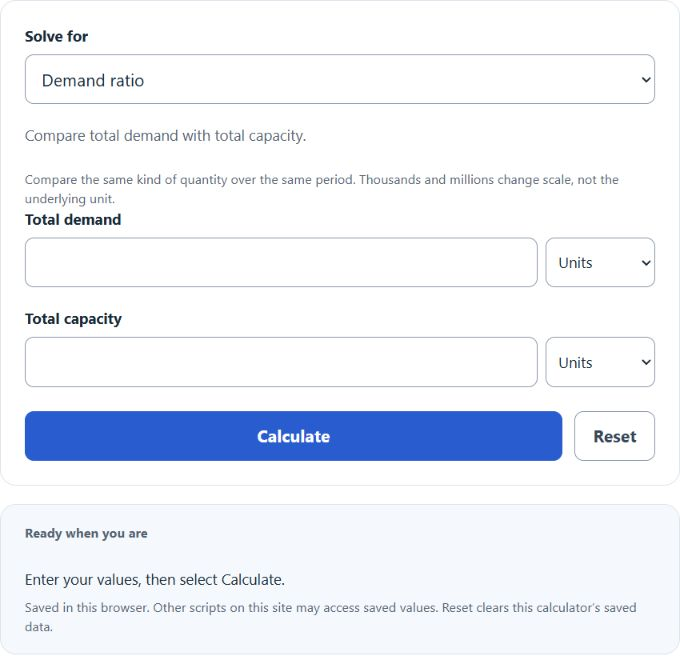
Choose demand ratio, total demand, or total capacity, then enter the two known values. Unit scales include units, thousands, and millions.
Related Calculators
- Click-Through Rate (CTR) Calculator
- Reverse Conversion Rate Calculator
- Retention Rate Calculator
- VTR (View-Through Rate) Calculator
- All Business Calculators
Demand Ratio Formula
The demand ratio compares total demand to positive total capacity. It is dimensionless: use the same underlying unit and time period, converting both values to a common scale before dividing.
- DR = demand ratio
- TD = total demand
- TC = total capacity
To solve for total demand:
To solve for total capacity:
If you enter demand or capacity in thousands or millions, the calculator first converts both values to base units before applying the formula:
- Units = multiply by 1
- Thousands = multiply by 1,000
- Millions = multiply by 1,000,000
The calculator has three functions. If you enter total demand and total capacity, it calculates the demand ratio. If you enter demand ratio and total capacity, it calculates total demand. If you enter demand ratio and total demand, it calculates the total capacity required.
Demand Ratio Interpretation and Unit Conversions
| Demand Ratio | Meaning | Basic Interpretation |
|---|---|---|
| Less than 1.00 | Demand is below capacity | There is unused capacity. |
| 1.00 | Demand equals capacity | Capacity is fully used. |
| Greater than 1.00 | Demand exceeds capacity | Additional capacity may be needed. |
| Selected Unit | Base Unit Conversion | Example |
|---|---|---|
| Units | Value × 1 | 500 units = 500 units |
| Thousands | Value × 1,000 | 500 thousands = 500,000 units |
| Millions | Value × 1,000,000 | 2 millions = 2,000,000 units |
Example Problems
Example 1: Calculate demand ratio
You have total demand of 75,000 units and total capacity of 100,000 units.
The demand ratio is 0.75. This means demand is 75% of capacity.
Example 2: Calculate required capacity
You have total demand of 250,000 units and a demand ratio of 0.80.
The required total capacity is 312,500 units.
FAQ
What does a demand ratio above 1 mean?
A demand ratio above 1 means total demand is greater than total capacity. For example, a demand ratio of 1.25 means demand is 125% of capacity, so demand exceeds capacity by 25%.
Can demand ratio be negative?
In normal use, demand ratio should not be negative because demand and capacity are usually nonnegative values. A negative result usually means one of the inputs was entered incorrectly or the situation being modeled does not fit this calculation.
Why do demand and capacity need the same unit scale?
The ratio is only meaningful when total demand and total capacity are measured on the same scale. For example, 500 thousand units divided by 1 million units should be treated as 500,000 divided by 1,000,000, which gives a demand ratio of 0.50.